The Seven Commandments
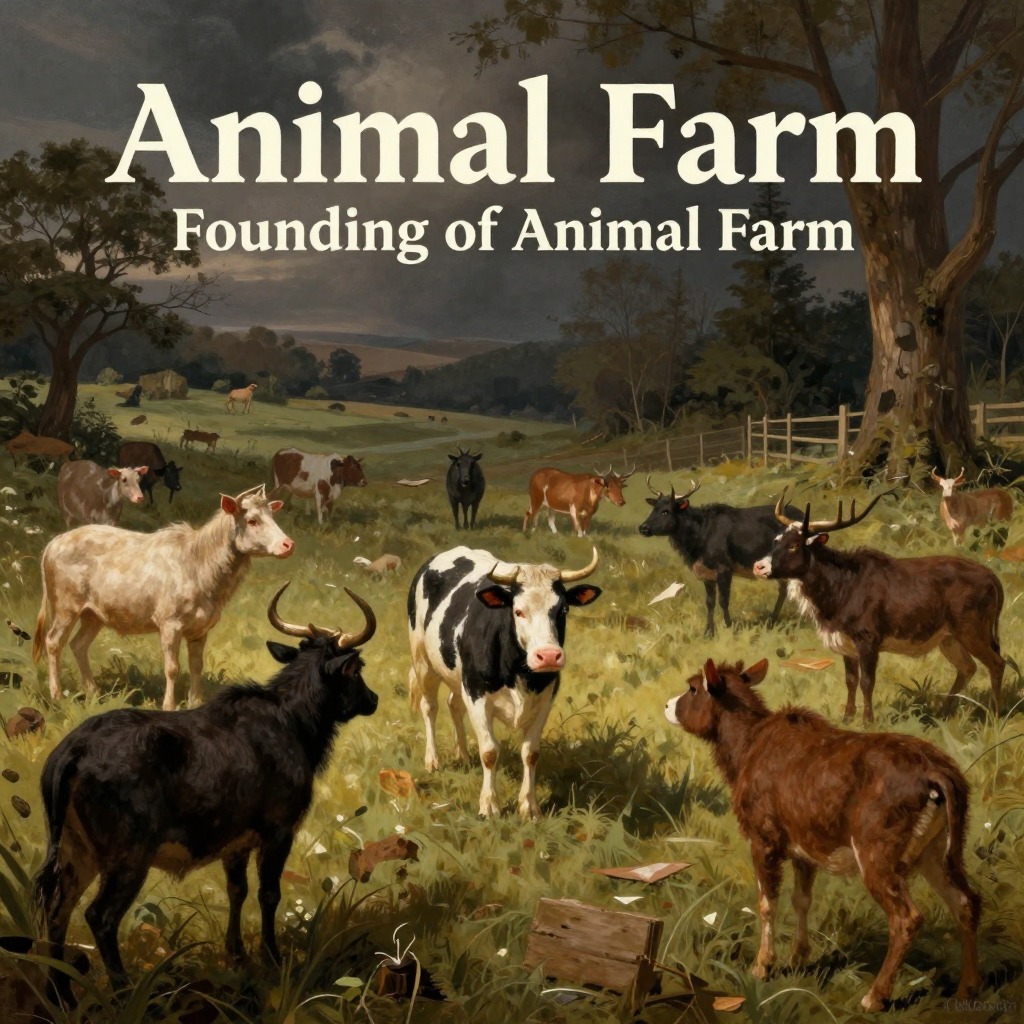
Animal FarmThe Seven Commandments are the foundational legal code of Animal Farm, originally inscribed by the pigs to codify the principles of Animalism and establish an unalterable law for all animals to live by. Over the course of the novel, the commandments are repeatedly and surreptitiously altered by the ruling pigs to justify their own privileges and tyranny, culminating in their reduction to a single, paradoxical maxim that encapsulates the complete betrayal of the revolution's ideals.
Origin and Inscription
After the expulsion of Mr. Jones, the pigs—who had taught themselves to read and write from an old spelling book—revealed that they had reduced the principles of Animalism to Seven Commandments. These were to form an unalterable law by which all animals on Animal Farm must live forever after. Snowball, being the best writer, climbed a ladder set against the end wall of the big barn and, with Squealer holding the paint-pot a few rungs below, inscribed the commandments on the tarred wall in great white letters that could be read thirty yards away. The original seven commandments were: 1. Whatever goes upon two legs is an enemy. 2. Whatever goes upon four legs, or has wings, is a friend. 3. No animal shall wear clothes. 4. No animal shall sleep in a bed. 5. No animal shall drink alcohol. 6. No animal shall kill any other animal. 7. All animals are equal. The writing was very neat, though "friend" was misspelled as "freind" and one of the "S's" was the wrong way round. Snowball read the commandments aloud for the benefit of the others, and all the animals nodded in complete agreement, with the cleverer ones at once beginning to learn them by heart.
The First Alterations: Privilege and Ideological Revision
The first erosion of the commandments occurred not through a change in the written text but through the pigs' actions and Squealer's reinterpretations. When the pigs began sleeping in the farmhouse beds, Clover, who thought she remembered a definite ruling against beds, fetched Muriel to read the Fourth Commandment. Muriel spelled it out: "No animal shall sleep in a bed with sheets." The addition of the words "with sheets" had not been part of the original commandment, but because it was now on the wall, it must have been. Squealer then explained that a bed merely meant a place to sleep in, and that the rule was against sheets, a human invention, which the pigs had removed. Similarly, after the executions of animals accused of collaborating with Snowball, some animals remembered that the Sixth Commandment decreed "No animal shall kill any other animal." Clover asked Benjamin to read it, but he refused; she then fetched Muriel, who read: "No animal shall kill any other animal WITHOUT CAUSE." The last two words had somehow slipped out of the animals' memory, but they now saw that the commandment had not been violated, as there was good reason for killing the traitors. Later, after the pigs were discovered drunk, Muriel noticed that the Fifth Commandment, which the animals had thought was "No animal shall drink alcohol," actually read: "No animal shall drink alcohol TO EXCESS." These incremental additions—"with sheets," "without cause," "to excess"—transformed absolute prohibitions into conditional allowances that served the pigs' interests.
The Final Transformation: The Single Commandment
The ultimate corruption of the Seven Commandments occurred in the final chapter of the novel. After the pigs had begun walking on their hind legs and carrying whips, Clover, her eyes dim with age, led Benjamin to the end of the big barn where the commandments were written. She asked him to read what was there, as she could no longer make it out. For once, Benjamin consented to break his rule of silence and read out what was written on the wall. There was nothing there now except a single commandment: "ALL ANIMALS ARE EQUAL BUT SOME ANIMALS ARE MORE EQUAL THAN OTHERS." This final, self-contradictory maxim replaced the entire original code, openly declaring the hierarchy that had long been practiced. The original seven commandments, which had promised equality and freedom, had been systematically dismantled until only this cynical justification of tyranny remained.
Narrative and Thematic Significance
The Seven Commandments function as the central ideological document of Animal Farm, a written constitution whose progressive corruption mirrors the degeneration of the revolution itself. The commandments are the fixed point against which all change is measured; their alteration is always presented as a correction of the animals' faulty memory, never as an act of rewriting. The pigs' ability to change the text—first by adding qualifying phrases, then by replacing the entire code—demonstrates how language and law can be manipulated by those in power to legitimize oppression. The final commandment, "All animals are equal but some animals are more equal than others," stands as the novel's most famous line, a perfect expression of the hypocrisy at the heart of the new order. The commandments, once a symbol of hope and unity, become a monument to betrayal, their final form revealing that the pigs have become indistinguishable from the human beings they overthrew.