Windmill
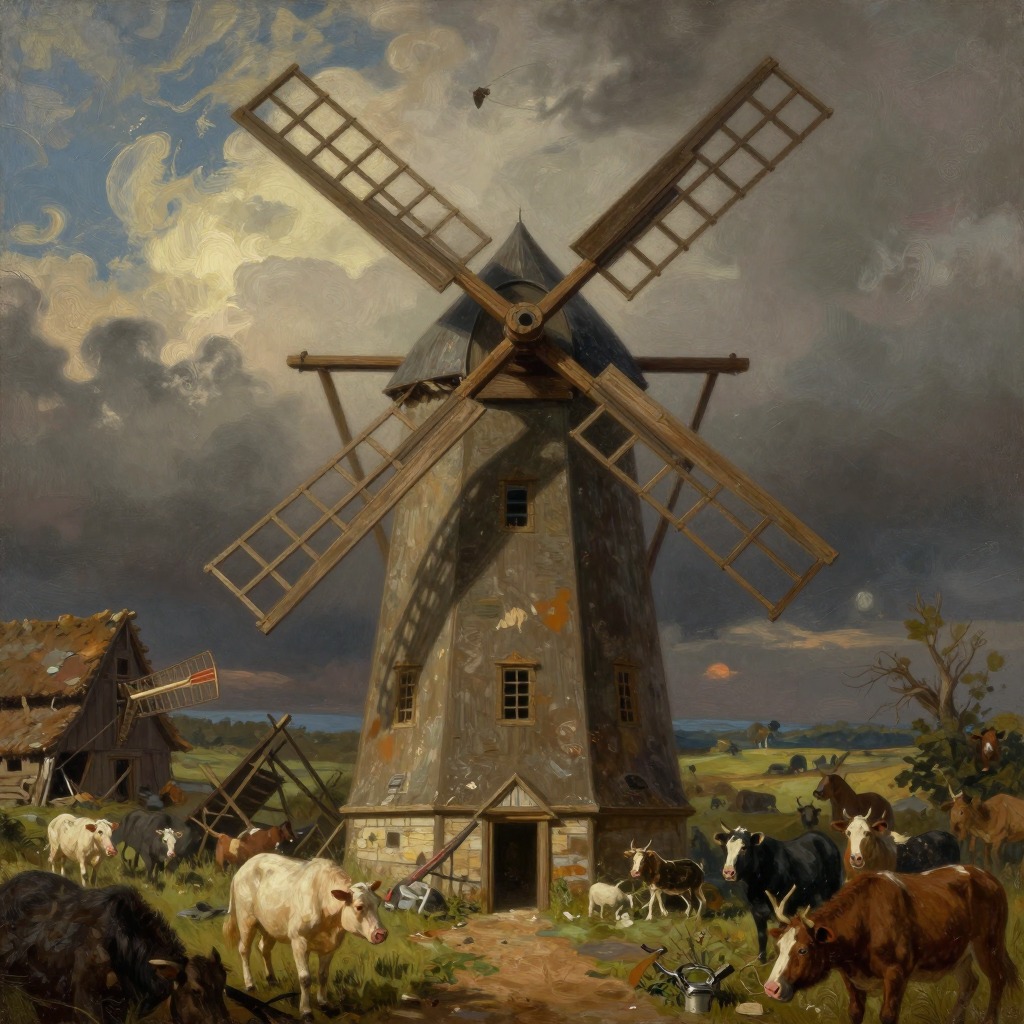
Animal FarmThe windmill is the most significant physical project and ideological symbol on Animal Farm, embodying the animals' collective hope for a future of leisure and prosperity through technology, yet it becomes a central object of political rivalry, a site of violent conflict, and ultimately a monument to the regime's complete betrayal of its founding principles.
Conception and Political Division
The idea for the windmill originates with Snowball, who, after surveying the farm, declares that a small knoll in the long pasture—the highest point on the farm—is the perfect location. He envisions a windmill that would operate a dynamo, supplying the farm with electrical power to light and warm the stalls, and run a circular saw, a chaff-cutter, a mangel-slicer, and an electric milking machine. The animals, accustomed only to primitive machinery, listen in astonishment as Snowball paints pictures of fantastic machines that would do their work while they grazed at ease or improved their minds. Snowball works out the mechanical details from three of Mr. Jones's old books—'One Thousand Useful Things to Do About the House', 'Every Man His Own Bricklayer', and 'Electricity for Beginners'—spending hours in the old incubator shed, drawing complex plans with chalk on the smooth wooden floor. The plans grow into a complicated mass of cranks and cog-wheels covering more than half the floor, which the other animals find unintelligible but impressive. Napoleon, however, holds aloof from the start, declaring himself against the windmill. One day he arrives unexpectedly, examines the plans, and then suddenly lifts his leg, urinates over them, and walks out without a word. The farm becomes deeply divided: Snowball argues the windmill can be built in a year and thereafter the animals would only need to work three days a week, while Napoleon argues the great need is to increase food production and that wasting time on the windmill would lead to starvation. The animals form two factions under the slogans "Vote for Snowball and the three-day week" and "Vote for Napoleon and the full manger." Only Benjamin refuses to side with either, saying that windmill or no windmill, life would go on as it had always gone on—badly.
Construction, Destruction, and Rebuilding
Despite Napoleon's initial opposition, after Snowball's expulsion he announces that the windmill is to be built after all, claiming the plans were actually his own and that his opposition was merely a tactical maneuver to get rid of Snowball. The building process is slow and laborious. The animals solve the problem of breaking up limestone by lashing ropes around huge boulders and dragging them up the slope of the quarry, then toppling them over the edge to shatter below. Transporting the broken stone is comparatively simple, with horses carrying cart-loads, sheep dragging single blocks, and even Muriel and Benjamin yoking themselves into an old governess-cart. Boxer's strength proves essential, often being the one to strain against the rope when a boulder begins to slip and drag the others down the hill. The animals work a sixty-hour week throughout spring and summer, and in August Napoleon announces voluntary Sunday work, with rations halved for those who absent themselves. By autumn the windmill is almost half built, but in November a violent gale destroys it, leveling it to its foundations. Napoleon immediately blames Snowball, pronouncing the death sentence upon him and offering rewards for his capture. The animals begin rebuilding with walls three feet thick instead of eighteen inches, requiring much larger quantities of stone. The work is cruel, especially during a bitter winter with food shortages, but the animals carry on, knowing the outside world is watching. The windmill is finally completed the following autumn, and Napoleon personally congratulates the animals and announces it will be named Napoleon Mill. However, two days later, Frederick's men attack, and using blasting powder, they blow up the windmill completely, destroying even the foundations and scattering the stones hundreds of yards away. The animals, enraged, drive the men off in the Battle of the Windmill, but the windmill is gone. They immediately begin rebuilding again from the foundations.
Final Form and Symbolic Meaning
Years pass, and the windmill is successfully completed at last. However, it is not used for generating electrical power as Snowball had dreamed. Instead, it is used for milling corn, bringing in a handsome money profit. The animals are hard at work building yet another windmill, with promises that dynamos will be installed when that one is finished, but the luxuries Snowball once taught them to dream of—stalls with electric light and hot and cold water, and the three-day week—are no longer talked about. Napoleon denounces such ideas as contrary to the spirit of Animalism, declaring that the truest happiness lies in working hard and living frugally. The farm grows richer, but the animals themselves do not, except for the pigs and dogs. The windmill, once a symbol of hope for liberation from labor, becomes a source of profit that enriches the ruling elite while the ordinary animals remain generally hungry, sleeping on straw, drinking from the pool, and laboring in the fields. The windmill's trajectory—from Snowball's visionary plans to Napoleon's co-opted project, from a ruin blamed on a scapegoat to a completed mill that enriches the pigs—mirrors the entire arc of the Revolution's corruption. It stands as the most concrete evidence that the animals' labor has been redirected from their own liberation to the enrichment of a new ruling class, and that the dream of a society where machines would free them from toil has been replaced by the reality of endless work for the benefit of others.