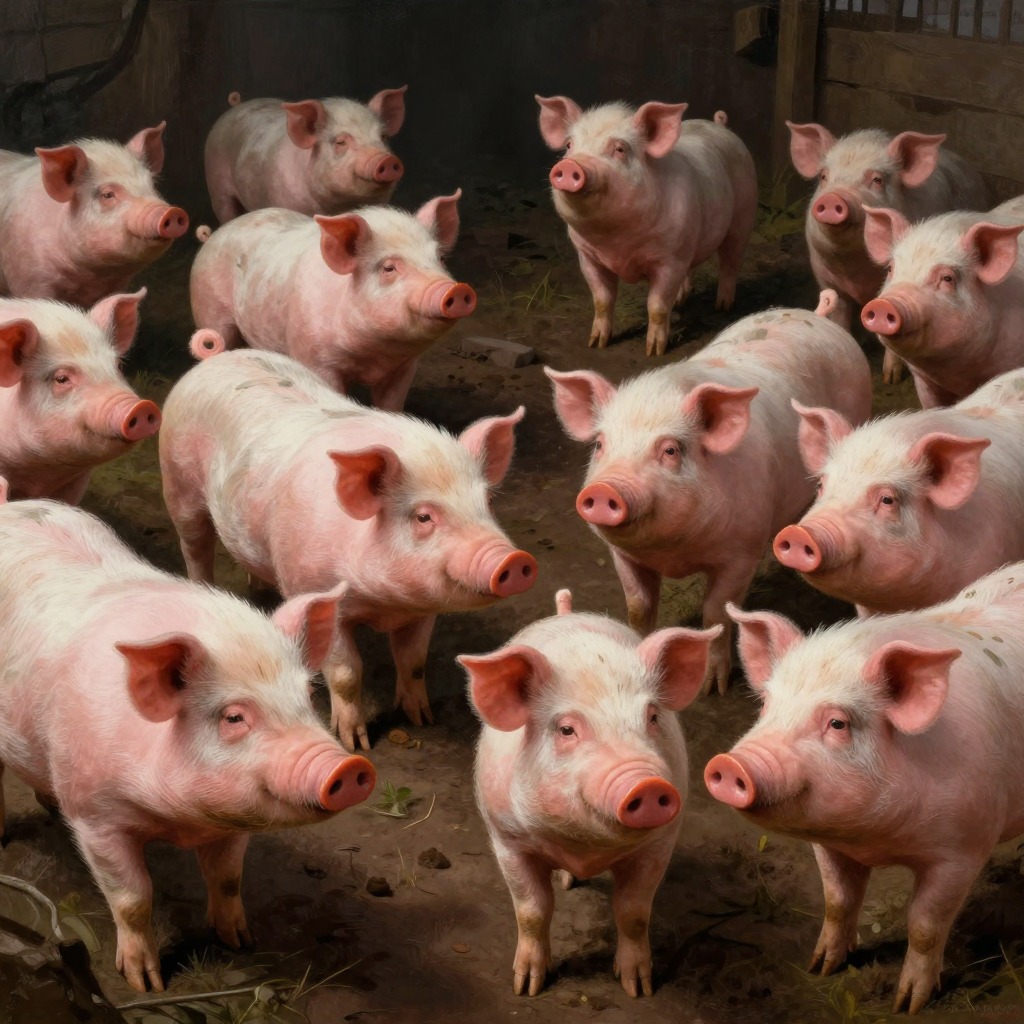
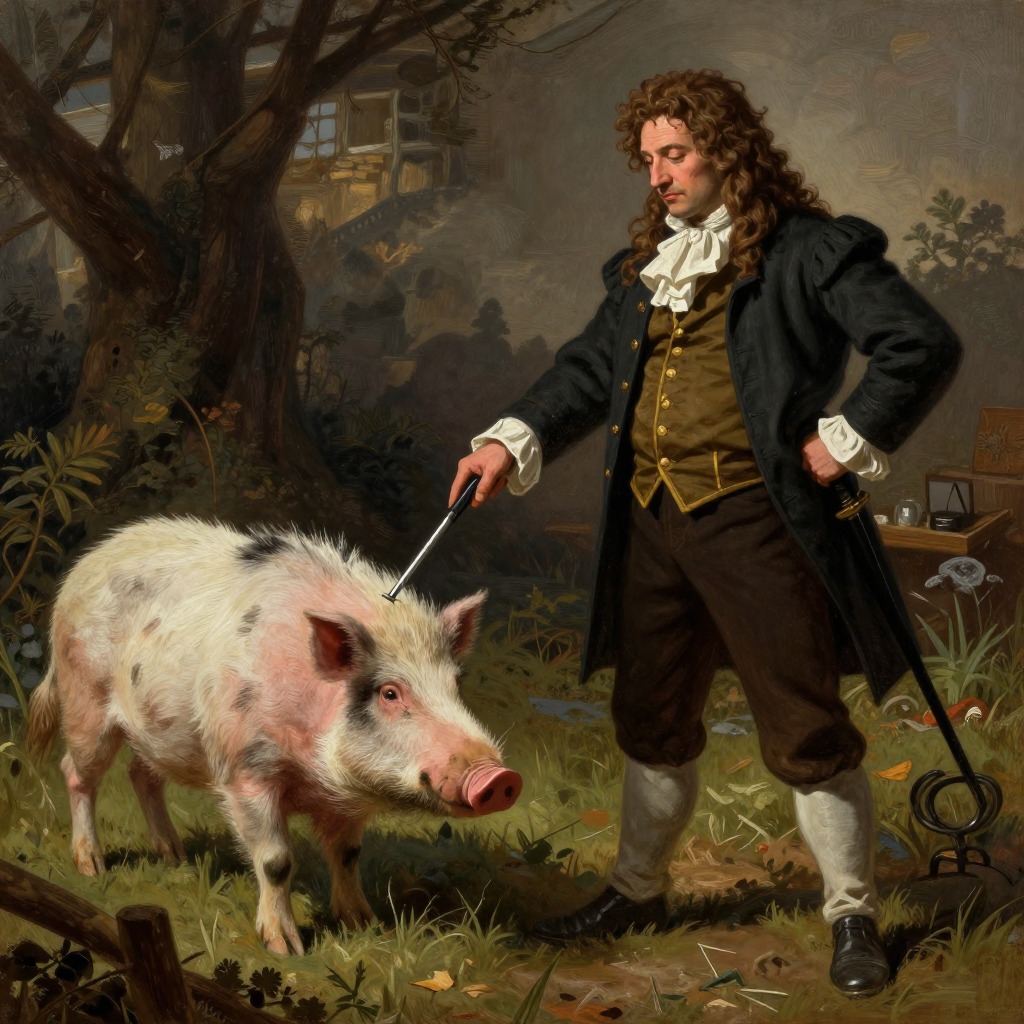
portrait of Napoleon
Animal FarmThe portrait of Napoleon is a painted image of the pig leader executed by Squealer in white paint on the wall of the Big Barn, serving as a central icon of the personality cult that develops around Napoleon as he consolidates absolute power on Animal Farm. It stands at the opposite end of the barn from the Seven Commandments, physically framing the ideological space of the farm: one wall bears the laws that are supposed to govern animal life, the other bears the face of the ruler who rewrites them. The portrait is surmounted by a poem, 'Comrade Napoleon,' composed by the pig poet Minimus, which Napoleon approved and caused to be inscribed on the wall. The poem addresses Napoleon as 'Friend of fatherless! / Fountain of happiness! / Lord of the swill-bucket!' and declares that even a sucking-pig, before it grows as big as a pint bottle, should learn to be 'Faithful and true to thee.' The portrait thus anchors a full apparatus of veneration: a visual image, a poetic text, and a set of ritualized titles—'our Leader, Comrade Napoleon,' 'Father of All Animals,' 'Terror of Mankind,' 'Protector of the Sheep-fold,' 'Ducklings' Friend'—that the pigs invent and Squealer deploys in speeches delivered with tears rolling down his cheeks.
Creation and Placement
The portrait was created after the executions that followed the purge of Snowball's alleged agents, at a time when Napoleon had withdrawn from public view and appeared only in ceremonial form with an escort of six dogs. Squealer, who had already demonstrated his skill at rewriting history—claiming that Snowball's windmill plans were actually Napoleon's, that the resolution against trade had never been passed, and that the Fourth Commandment had always mentioned sheets—now turned his talents to visual propaganda. He painted the portrait in white on the end wall of the Big Barn, opposite the wall where the Seven Commandments were inscribed. The portrait was placed above the poem 'Comrade Napoleon,' which Minimus had composed and which Napoleon had approved. The poem's lines—'Thou are the giver of / All that thy creatures love, / Full belly twice a day, clean straw to roll upon'—stood in direct contradiction to the actual conditions on the farm, where rations had been reduced, the hens had been forced to surrender their eggs, and the animals worked longer hours than they had in Jones's day.
Function in the Personality Cult
The portrait operated as the visual centerpiece of a systematic cult of personality. Squealer's speeches, delivered with tears rolling down his cheeks, dwelt on 'Napoleon's wisdom the goodness of his heart, and the deep love he bore to all animals everywhere.' The animals were taught to credit Napoleon for every successful achievement: hens would remark to one another, 'Under the guidance of our Leader, Comrade Napoleon, I have laid five eggs in six days,' and cows drinking at the pool would exclaim, 'Thanks to the leadership of Comrade Napoleon, how excellent this water tastes!' The portrait gave these verbal formulas a fixed visual reference point, making the absent leader perpetually present in the barn where the animals assembled every Sunday morning to receive their orders. Napoleon himself rarely appeared in public—often not even on Sundays—but the portrait ensured that his image dominated the space where the animals gathered.
Contrast with the Seven Commandments
The placement of the portrait at the opposite end of the barn from the Seven Commandments created a spatial tension that mirrored the ideological transformation of the farm. The Commandments, originally painted in great white letters that could be read thirty yards away, had been silently amended: 'No animal shall sleep in a bed' had acquired 'with sheets'; 'No animal shall kill any other animal' had gained 'without cause'; 'No animal shall drink alcohol' had been extended 'to excess.' The portrait, by contrast, was a single unchanging image—but the meaning of that image changed as Napoleon's power grew. By the time the pigs began walking on their hind legs and carrying whips, the portrait of the leader who had once stood for the Rebellion had become the icon of a regime that had abolished the name 'Animal Farm' and restored the name 'Manor Farm,' that had suppressed the song 'Beasts of England,' and that had replaced the green flag's hoof-and-horn emblem with a plain green banner.
The Portrait and the Final Transformation
In the final chapter, when the pigs emerge from the farmhouse walking on their hind legs and wearing Mr. Jones's clothes—Napoleon in a black coat, ratcatcher breeches, and leather leggings, his favorite sow in Mrs. Jones's watered silk dress—the portrait on the barn wall remains as it was, but the reality it represents has been completely inverted. The pigs now carry whips, have installed a wireless set and a telephone, and entertain human farmers at a card game where Napoleon and Mr. Pilkington toast 'the prosperity of The Manor Farm.' The portrait, which once signified the leader of a revolutionary animal society, now presides over a farm where the single remaining Commandment reads 'ALL ANIMALS ARE EQUAL / BUT SOME ANIMALS ARE MORE EQUAL THAN OTHERS'—a principle that the portrait itself, showing one animal elevated above all others, had always embodied.