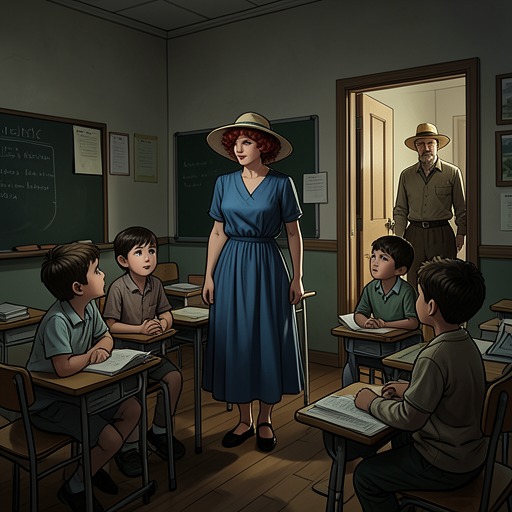
Avonlea school
Anne of AvonleaAvonlea school is the village classroom where Anne Shirley’s first experience as a teacher is tested against the practical demands of discipline, care, and responsibility. Its rows of desks and familiar pupils promise an orderly beginning, but the school also becomes the setting for an explosion, a mouse prank, and Anne’s painful breach of her own opposition to corporal punishment. Across these episodes, it is both a workplace and a small stage on which her ideals meet the unpredictable life of a rural community.
Setting and Daily Routine
When Anne first arrives to teach, the schoolroom is quiet and the pupils are already seated in prim rows. The preceding teacher has established this routine, giving Anne a composed classroom to enter even as she privately feels frightened and trembles. Her own carefully prepared opening address, written and memorized the night before, vanishes from her mind. She begins instead by asking the children to take out their Testaments, then uses their reading time to steady herself and take stock of the class.
The room gathers children Anne knows from her own school years alongside younger pupils and newcomers to Avonlea. Rather than treating the class as an undifferentiated group, she studies individual faces and imagines what the unfamiliar children might become. Her first day passes in a kind of blur: she hears lessons, sets sums and copywork, and conducts the ordinary work of school almost mechanically. The children behave well overall, and only two incidents require discipline. The routine is real, but so is the effort it takes Anne to sustain it.
Teaching, Discipline, and Attachment
The classroom quickly reveals a tension between orderly instruction and Anne’s wish to reach pupils as individuals. Anthony Pye sits apart at a corner desk, watching her with open hostility. Anne decides from the outset that she will win his affection, but her first attempt to address his conduct shows how little authority she has yet established with him. After he pours the remaining water from his slate bottle down Aurelia Clay’s neck, Anne keeps him in at recess and speaks to him about what she expects of boys: that they behave as gentlemen toward girls. Her appeal is kind, but Anthony remains unmoved and leaves with a scornful whistle.
Anne does not interpret his resistance simply as misbehavior. She worries that his contempt weakens her authority with the other pupils, yet believes that patience and kindness may eventually change the relationship. Later, she tells Gilbert Blythe that Anthony obeys with a show of toleration and holds her in contempt because he believes girl teachers are no good. Anne distinguishes this from mere disobedience: what troubles her is that she has not won his respect. She still sees a likable child beneath his sullenness and regards teaching as worthwhile partly because overcoming such difficulties interests her.
Paul Irving offers a contrasting beginning. On the first day, he and Anne exchange smiles before speaking and become fast friends. Anne’s sense that he is unusually thoughtful and imaginative helps make the classroom more than a site of discipline; it can also be where an immediate affinity is recognized. She later speaks of Paul with particular affection and confidence in his promise. The two relationships show the range of the school’s daily life: trust may begin in a silent exchange, while respect may demand sustained effort.
A Day of Mishaps and a Breach of Principle
A winter school day makes the fragility of classroom order especially visible. The night before, Anne has been kept awake by toothache, and she arrives with a swollen cheek to find a cold, smoky room because the fire will not burn. Her tone with the children is sharper than usual. A sequence of small disturbances intensifies the pressure: squeaky pencils distract her, and Barbara Shaw trips over the coal scuttle, scattering coal and breaking her slate. The resulting laughter in the room adds to Anne’s already difficult morning.
After dinner, while searching her desk drawer for chalk, Anne is startled by a mouse that springs out and runs across the desk. Anthony laughs aloud. In the moment, Anne responds with anger rather than the composure she might have managed in a calmer mood. She takes up the heavy hardwood pointer and calls Anthony forward. The punishment is not described as severe, but it makes him wince and brings tears to his eyes. Anne immediately stops, sends him back to his seat, and feels ashamed and remorseful. At home she weeps over what she has done, convinced that she has violated her own principles and destroyed her last chance of winning his affection. The episode makes the school a place where Anne’s ideal of patient teaching is not merely stated but put under strain.
The same day has already included a more spectacular disruption. Anne mistakes a parcel for Mrs. Hiram’s nut cakes and has Joe Sloane put it into the stove. It contains firecrackers and pinwheels intended for Warren Sloane’s birthday celebration. The sudden noise and spinning fireworks send the children into confusion; Prillie Rogerson faints, and Annetta Bell becomes hysterical. Once the fireworks stop, Anne opens the doors and windows and helps carry Prillie to the porch. Order takes an hour to return, and Anne, still upset, pushes the lessons through at a punishing pace. The accident turns a school day into a public embarrassment, but it also shows Anne taking practical steps to restore safety and resume the class.
Weather, Community, and Narrative Significance
Avonlea school is set within a larger landscape of roads, fields, and seasonal change. On a September excursion with Diana Barry, Anne delights in the hills, woods, and cricket-filled air of Prince Edward Island; this surrounding countryside is part of the imaginative and communal world from which the school draws its pupils. Yet rural beauty does not guarantee ease. During a prolonged dry spell, Anne worries about parched fields, suffering gardens, and the scorched pastures of James A. Harrison. Her concern connects the schoolteacher’s view of her pupils and village to the material conditions of local farming.
The school also stands at the threshold of a sudden natural disaster. On May 23, an unusually warm day leaves Anne and her pupils sweltering over fractions and syntax. When thunder sounds in the afternoon, she dismisses the children early so they can reach home before the storm. Hail then devastates Avonlea: crops and garden growth are cut down, apple-tree blossoms are stripped, and most of the trees planted by the Avonlea Village Improvement Society are broken or shredded. In the days that follow, roads become impassable for wheeled travel, and residents walk or ride to compare the damage. The school’s routine is thus nested in a community exposed to weather, agricultural hardship, and shared recovery.
As a location, Avonlea school brings together the book’s contrasting scales of attention. Inside the classroom, a misplaced parcel, a troublesome mouse, or one pupil’s contempt can alter the day; beyond its doors, the seasons and the livelihood of the village shape what the children and teacher return to. The school’s recurring importance lies in this combination: it is an everyday institution, but its routines expose Anne’s changing authority, her capacity for attachment, and the limits she must confront when pressure overtakes principle.