Echo Lodge
Anne of AvonleaEcho Lodge, the secluded stone home of Miss Lavendar Lewis, is both a distinctive place in the landscape and a shelter for lives shaped by imagination. Its garden and echoing river valley welcome Anne Shirley and Diana Barry into Miss Lavendar’s lonely world; later, the house becomes the setting for a long-delayed marriage. When its rooms are finally closed, the house is not abandoned: it waits for summer, carrying forward the story’s promise that dreams and laughter will return.
Setting and Architecture
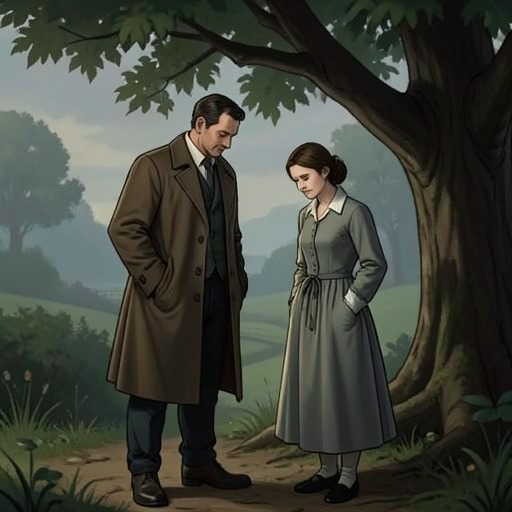
Anne and Diana come upon Echo Lodge while walking through a shaded lane beneath old firs. Their approach makes the house feel like a discovery beyond ordinary village life: where the familiar farmhouses seem much alike, this small stone dwelling appears startlingly individual. Diana recognizes it as the home of Miss Lavendar Lewis, a place she has heard about but never visited.
The low-eaved house is built from rough blocks of red Island sandstone. Two dormer windows, set beneath quaint wooden hoods, look out from its small peaked roof, while two large chimneys rise above it. Ivy takes hold across the uneven stonework; by autumn, frost turns its leaves bronze and wine-red. The house’s modest scale and distinctive materials make it seem less like a conventional farmhouse than a dwelling already half inside a story.
An oblong garden opens from the lane through a gate. The house bounds one side, while an old stone dyke, almost hidden beneath moss, grass, and ferns, encloses the other three. Tall spruces shade the garden, and beyond it a meadow slopes toward the blue loop of the Grafton River. The surrounding hills and young firs leave no other house or clearing in sight. This separation gives Echo Lodge its privacy, but also explains why visitors are scarce and its owner feels isolated.
A Home for Make-Believe and Company
The house first reveals its character through a prepared tea party. Anne and Diana find a table set for guests, but Miss Lavendar admits that nobody was expected: lonely because so few people come to the out-of-the-way house, she had pretended to be giving a party, cooked for it, decorated the table with her mother’s wedding china, and dressed for the occasion. Charlotta the Fourth, her devoted companion, shares in the household’s imaginative life. For Miss Lavendar, make-believe is not merely decoration; it is a means of enduring solitude and keeping pleasure alive.
Anne responds to this confession with recognition rather than embarrassment. Her eagerness to stay leads Miss Lavendar to welcome the visitors to the tea she had prepared. What begins as a chance encounter therefore turns the house from a private setting for imagined company into a place of actual companionship. Its rooms and garden remain secluded, but the visit brings the outside world directly to Miss Lavendar’s door.
Friendship and Recurring Visits
After that October meeting, Anne visits Echo Lodge often, sometimes with Diana by road or through the woods, and sometimes alone when Diana cannot come. The visits develop into a close, sustaining friendship between Miss Lavendar, who has preserved the freshness of youth, and Anne, whose imagination and intuition offer a kind of understanding beyond her years. Anne and Diana bring the energy of their lives in the wider community into the secluded house; Charlotta greets them with broad smiles, glad of their company and of their affection for her mistress.
The house’s quiet is not simply an absence of life. One afternoon, while Anne and Miss Lavendar talk in the garden, Paul Irving discovers the echoes. His calls from the dyke return across the river transformed into ringing sounds, making the surrounding landscape an active part of the visit. Echo Lodge thus gathers different kinds of response to the world: Miss Lavendar’s private make-believe, Anne’s imaginative companionship, and Paul’s delighted experiments with sound.
That closeness also makes separation painful. When Anne tells Miss Lavendar that she will leave in the fall, Miss Lavendar admits that she will miss her and fears that friendship only ends in a hurt worse than the emptiness that came before. Anne answers that she will not disappear from Miss Lavendar’s life: letters and vacations can preserve their connection. Her assurance matters especially because the house has long stood apart from the ordinary traffic of visitors; the friendship makes its distance less absolute.
The Garden Wedding and the House’s Future
Echo Lodge’s garden acquires a new significance when Miss Lavendar and Stephen Irving plan to marry there. The ceremony is to take place beneath the honeysuckle trellis, the very spot where Stephen proposed to her twenty-five years earlier. The garden therefore holds both the beginning and the fulfillment of their old romance. The announced gathering is small, with Mrs. Irving, Paul, Gilbert Blythe, Diana, Anne, and Miss Lavendar’s cousins expected to attend.
The couple plan to leave on a Pacific-coast trip and return in the fall. Paul and Charlotta the Fourth are then to go to Boston to live with them. Echo Lodge, however, will remain part of their lives: its hens and cow are to be sold, and its windows boarded, but they intend to come back and live there every summer. Anne is relieved that the house will not be stripped and left permanently empty, or occupied by strangers. Even in their absence, it will remain their home in waiting.
Closing the House, Keeping Its Promise
After the wedding, Anne and Charlotta return to put the house in order and lock it up. The garden is still bright with late sunshine, butterflies, and bees, yet the little house already seems desolate in the aftermath of celebration. Charlotta, who cried on the way back from the station, finds the quiet after a wedding almost as cheerless as the quiet after a funeral. The contrast makes the practical work of clearing the rooms feel like a second leave-taking.
Anne stays until the decorations are removed, the dishes washed, and the remaining delicacies packed for Charlotta’s brothers. She then walks through the still rooms, closes the blinds, and locks the door. Yet the ending refuses to make Echo Lodge a permanently deserted place. It broods among the garden shadows, lonely but not forsaken, with future summers still ahead. Its echoing valley, like the house itself, keeps time for another return.