Echoes as a motif
Anne of AvonleaEchoes are a recurring motif in Anne Shirley, joining a child’s wonder at sound with Lavendar Lewis’s grief for the life she has not lived and the novel’s final image of time continuing beyond a farewell. At Echo Lodge, noises return transformed across the river; for Lavendar, they also resemble the beautiful, mocking aftersounds of lost hopes and dreams. The motif’s meaning shifts with its setting: what first promises play becomes a language for loneliness, then answers a wedding bell as both greeting and leave-taking.
The pleasure and uncertainty of the literal echoes
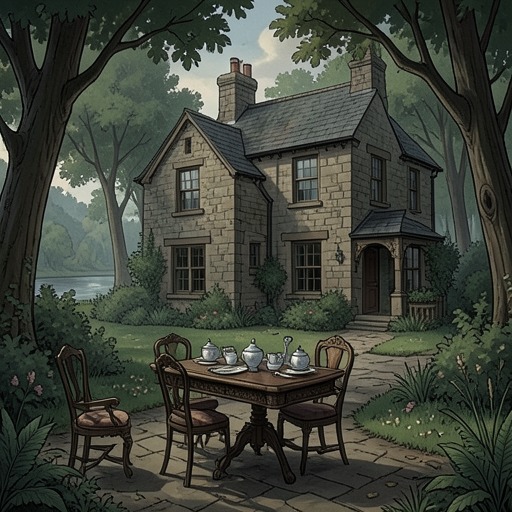
Paul Irving’s first visit to Echo Lodge had been disappointing because the weather was too windy for echoes. On a later visit, he anxiously asks Lavendar whether it is a good day for them. Her assurance that it is the best kind brings the motif back as a concrete, anticipated experience: the echoes depend on conditions, and Paul remembers the earlier visit precisely because the expected response did not come.
After lunch, Paul goes to the dyke and diligently makes noises. They are not all melodious at their source, but the returning sounds seem changed by their journey over the river, becoming, in the narrator’s image, gold and silver. The scene makes transformation central to the motif. An echo is recognizably connected to an original sound, yet its return is not merely a flat repetition: the playful noises acquire a beauty Paul could not produce alone. His delight gives the echoes an immediate, shared life, while Anne Shirley and Lavendar sit apart on the stone bench beneath the poplar and talk.
That contrast matters. For Paul, the echoes are a discovery and an amusement, secured by a day that is finally favorable. For Lavendar, the same surroundings can carry a much heavier meaning. The motif does not have one fixed emotional charge; the returning sound can be a child’s pleasure or a reminder of what has passed, depending on who listens and what the place recalls.
Lavendar’s echoes of lost hopes
As Anne is preparing to leave in the fall, Lavendar admits that she will miss her and fears the hurt that friendship brings when people leave one another’s lives. Anne answers that absence is not worse than emptiness and points to letters and vacations as ways their friendship can continue. Lavendar’s sadness then broadens beyond this immediate departure. She says she is tired even of the echoes, which have become echoes of lost hopes, dreams, and joys: beautiful, but also mocking.
The shift from sound to memory turns the motif into a description of Lavendar’s sense of her own life. An echo implies that something once sounded and is now heard again at a distance. Lavendar’s image gives that interval emotional weight: her past remains present enough to reverberate, but its return cannot restore what was lost. The beauty of the sound therefore does not cancel its pain. Her complaint is tied to the fear of growing old and becoming cranky, and she jokes that perhaps blue pills are all she needs. Charlotta the Fourth’s news of early strawberries interrupts this mood; Lavendar promptly welcomes the prospect of tea beneath the silver poplar and decides she needs no pills. The scene does not erase the loneliness she has voiced, but it shows how quickly present company and a small pleasure can draw her back into the day.
Wedding bells as greeting and farewell
At Lavendar’s wedding, the echoes return in a changed context. As she leaves her old home with Stephen Irving, those gathered at the door send her off with rice and an old shoe. Paul adds a huge brass dinner bell, ringing it furiously from the porch simply to make a joyful noise. When the clamor fades, the echoes answer from across the river like fairy wedding bells, growing fainter until they seem to offer Lavendar both greeting and farewell.
This response gathers the motif’s earlier meanings without reducing the wedding to a simple happy ending. The echoes are again beautiful and responsive to a sound made in the present, but they also belong to the place Lavendar is leaving and to the life of dreams and make-believe associated with it. The narrator describes her departure as a movement from that old life toward a fuller life of realities in the busy world beyond. The familiar echoes accompany the transition rather than preventing it: they make the old home audible at the very moment she goes.
A future beyond the last farewell
Later, when Anne and Charlotta the Fourth return to put the little stone house in order and lock it up, the garden is still sunlit, but the house already seems desolate after the celebration. Charlotta remarks that a wedding, once over, is scarcely more cheerful than a funeral. The echoes’ farewell thus belongs to a sequence of departures and aftermaths: the guests leave, the festivities end, and the house becomes quiet again.
Yet the novel refuses to make that quiet final. The little stone house is lonely but not forsaken; future summers will bring it more dreams, laughter, and joy, while the echoes across the river bide their time. This ending returns the motif to its literal landscape and makes recurrence a promise rather than a mere replay of loss. The sounds wait for another occasion and another listener. In the meantime, they preserve the connection between the place’s remembered past and the life still possible there. Echoes can carry grief because they attest to what is gone, but their continued presence also keeps the future open.