Green Gables
Anne of AvonleaGreen Gables is the home and farm around which the novel’s domestic life gathers. Its significance lies not in isolation from change but in its capacity to absorb it: a household shaped by Marilla Cuthbert’s practical duties and Anne Shirley’s active affection becomes a home for the orphaned Keith twins, and later makes room for Rachel Lynde so Anne can pursue further education. The farm’s fences, rooms, yard, and nearby paths give concrete form to the work of caring for others—and to the possibility of leaving without ceasing to belong.
Setting and Household
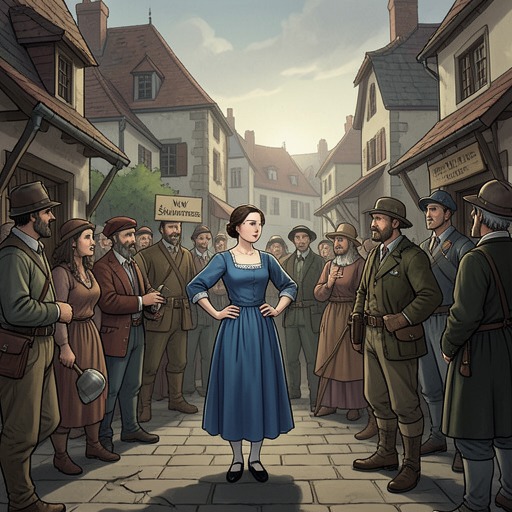
Green Gables is a working farm in Avonlea, with pasture, stock, and fences that require attention. Early in the story, Anne finds J. A. Harrison angry because a cow has entered his oatfield for the third time. She explains that the cow is hers, not Marilla’s, and that Matthew Cuthbert gave her the animal when it was a calf. Anne apologizes for the damage but also points out that the boundary fence separating the oatfield from the pasture is in poor repair. The incident makes the farm’s boundaries more than a matter of scenery: their condition affects neighbors, animals, and crops, while the management of livestock adds to the household’s responsibilities.
Those responsibilities weigh on Marilla as an auction of the stock approaches. The farm has too much stock for her to manage with only an unreliable hired worker, and she expects the property’s farming arrangements to change. The practical concerns of animal care and fencing sit alongside more intimate worries: Mary Keith is dying, and no secure future has yet been established for her children. Green Gables is thus introduced as a place where the demands of farm life and the obligations of family care continually meet.
The house’s interior matters especially when the household expands. Later, Marilla proposes that Rachel have the north gable for a bedroom and use the spare room as a kitchen, with her own stove and furniture. This plan gives Rachel a degree of independence while allowing the women to share the home without having to share a kitchen. The spare room, once available for guests, can therefore become part of a workable new household arrangement.
A Home for the Keith Twins
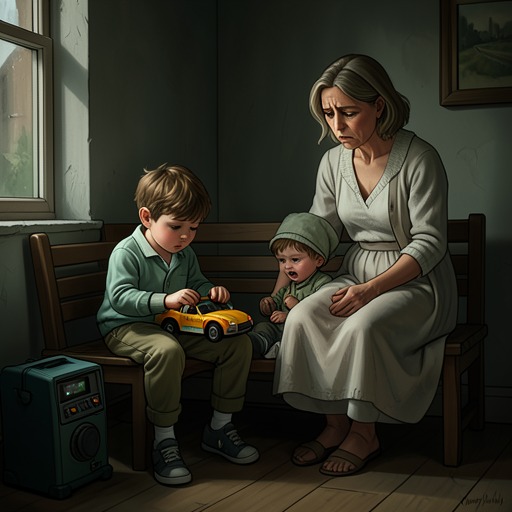
After Mary Keith’s funeral, Marilla returns to Green Gables with the twins. Anne is waiting at the gate to help them down from the buggy. Dora accepts Anne’s welcome calmly; Davy greets her with a hug and introduces himself with cheerful confidence. Their different temperaments are apparent at once, and the supper table quickly reveals that taking them in will mean adapting to their habits as well as providing shelter.
Marilla initially regards their care as a serious addition to her burdens. Her failing eyesight prevents her from sewing, so Anne agrees to make and mend the children’s clothes despite disliking the work. When a letter from their uncle says he cannot take the twins in the spring and asks whether they can stay until fall, the household faces the possibility that its care of them will continue. By then, Marilla recognizes that the children have become less troublesome—or that the family has grown used to them—and Anne observes that Davy’s manners have improved.
A later letter resolves the uncertainty. The twins’ uncle, Richard Keith, has died, and his will leaves two thousand dollars to Marilla in trust for David and Dora until they come of age or marry. The interest is to support their maintenance. The inheritance matters because Marilla wants to keep the children but has worried about the cost, particularly as they grow older; the rent from the farm is not enough to make that expense easy, and she does not want Anne’s money used for them. The provision makes a permanent home at Green Gables financially possible. In this way, the house’s role as the twins’ home depends not only on affection but also on a practical arrangement that makes continued care sustainable.
Work, Memory, and the Wider Community
Green Gables is also a base from which Anne moves through her responsibilities in Avonlea. When the school year ends, she walks down the hill with flowers in a basket for her weekly visit to Matthew’s grave. The pilgrimage links the home she shares with Marilla to the memory of the man who first gave her the love and sympathy she had needed. Though the visit takes her away from the house, its regularity shows how Green Gables belongs to a life shaped by enduring attachments as well as daily work.
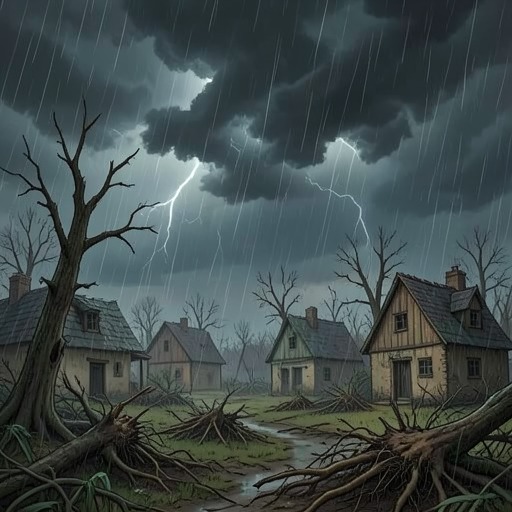
The surrounding landscape is not merely a peaceful backdrop to that life. During a prolonged dry spell, Anne worries about the parched fields and her garden, while J. A. Harrison’s pastures are so scorched that his cows struggle to find enough to eat. On May 23, unusual heat gives way to a hailstorm. Anne dismisses school early so the children can get home before it arrives; afterward, hailstones cover the ground and damage fields and gardens across the area. Apple-tree blossoms are stripped and branches broken, and most of the two hundred trees planted by the village improvers are snapped or torn. The next day, roads are difficult for wheeled travel, and news from elsewhere in the province reports deaths, injuries, damaged communications, and the loss of young livestock. Green Gables stands within this exposed farming community, where weather can overturn the promise of a season and make shared news, repair, and mutual concern newly important.
The farm’s own damage is visible when Gilbert Blythe arrives at Green Gables that evening and finds Marilla and Anne covering broken windows with strips of oilcloth. The moment places the home within the storm’s consequences rather than outside them. Its familiar rooms offer shelter, but the damaged windows show that even the household’s center must respond to forces beyond its control.
Change, Continuity, and a New Arrangement
The possibility of Anne leaving Green Gables for Redmond College first seems incompatible with Marilla’s needs and the twins’ care. Anne worries that she cannot leave Marilla alone with the children. Marilla’s solution is to invite Rachel to live at the farm: Rachel is facing the loss of her own home after her family’s financial difficulties, and leaving Avonlea would be painful for her. The offer answers two problems at once. Rachel will gain a home in the place where she wants to remain, while her presence will give Marilla company and help with the twins.
Their plan is made deliberately practical. Rachel will keep her own bedroom and kitchen, and the two women agree on their respective duties and boundaries. They expect others to doubt that they can live together, but those predictions do not disturb them; they have already reached a clear understanding of how the arrangement will work. Rachel is willing to help with the twins, though she does not undertake to answer Davy’s questions. Marilla, in turn, recognizes that Anne’s future should not be sacrificed to the demands of his curiosity. Anne resigns from teaching, and Rachel accepts the offer, though she remains in her own house for the summer while preparing to move in the fall.
By the end of August, the spare room is ready for Rachel, whose household belongings have been reduced through an auction. The coming changes gather around Green Gables: Rachel is to move in, while Anne and Gilbert are to leave for Redmond. The house is therefore neither a static refuge nor a place Anne must reject to grow. Its arrangements change so that care can be shared and the next stage of her life can begin. Even after the wedding at the stone house, Anne returns to her familiar task of putting rooms in order before sitting beneath the poplar to wait for Gilbert. Green Gables remains the home from which she can look outward, carry old attachments with her, and meet a changing future.