Hester Gray's garden
Anne of AvonleaHester Gray's garden is a secluded, overgrown plot in the back fields of Avonlea, where a springlike abundance of narcissi brings an almost-forgotten household back into view. Its surviving garden traces are evidence of Hester and Jordan Gray's life together, while the flowers and fruit trees extend that story beyond Hester's death. When Anne Shirley and Diana Barry find the garden, it becomes at once a physical discovery, a place of remembrance, and an unexpected birthday gift for Anne.
Setting and Appearance
The garden lies beyond the farms that extend toward the upper Carmody road. Beeches and firs hem in the small corner, which remains open to the south. A moss- and grass-covered stone dyke encloses it. Along the eastern side stands a row of garden cherry trees; traces of old paths remain, and a double line of rosebushes marks the middle. Most strikingly, narcissi have spread over the rest of the ground, flowering in yellow and white above the grass. The plot is no longer maintained as a working garden, but its former arrangement remains legible beneath the growth.
The discovery comes during a September outing through the island countryside. Anne and Diana travel along a winding red road through fields and woods, past spruces, young maples, ferns, and a brook. That open-air journey makes the secluded garden feel like a surprise within a landscape already presented as richly varied. The plot's enclosure and traces of human design distinguish it from the surrounding woods, while its flowers make neglect look less like erasure than a change in who tends the place.
Hester and Jordan's Garden
Diana Barry identifies the plot as Hester Gray's garden and tells Anne the history associated with it. The farm once belonged to David Gray, who gave it to his son, Jordan. Jordan had gone to Boston for work, where he met Hester Murray, a country-raised woman who disliked store work and longed to return to a quiet rural place. She agreed to marry him on the condition that he take her somewhere surrounded by fields and trees; Jordan brought her to Avonlea and built a small house on the farm.
Hester and Jordan lived there for four years. Hester rarely went out, and few people visited beyond Diana's mother and Rachel Lynde. Diana's account contrasts Hester's limited skill at keeping house with her particular gift for flowers: Jordan made the garden for her, and she spent much of her time there. The garden was therefore not simply a decorative setting. It answered Hester's desire for a quiet home and offered her a place in which she could be happy as her health declined.
According to Diana's account, Hester had been ill, apparently with consumption, before she came to Avonlea and grew steadily weaker. Jordan cared for her himself, carrying her outside wrapped in a shawl so that she could rest on a garden bench. Hester asked him to pray with her that, when her time came, she might die in the garden. Her wish was fulfilled: Jordan carried her out, gathered the roses that were in bloom, and laid them over her. She smiled up at him and died. The garden thus becomes the setting for the story's defining convergence of care, chosen place, and loss.
Discovery and Remembrance
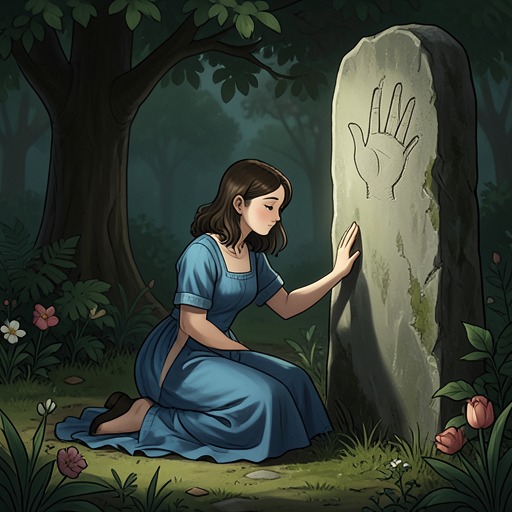
The garden's past reaches Anne and her companions not through a written account but through Diana's spoken recollection. The evidence that makes the story memorable is already present in the landscape: the old dyke and paths, the rows of planted flowers and trees, and the profusion that has outlasted the people who arranged it. Diana also points to Hester's grave in the Avonlea graveyard, where a small brown stone bears her name and age, twenty-two; Jordan is buried beside her, without a stone. The garden and the graveyard preserve different traces of the same history, one through cultivation and one through memorial inscription.
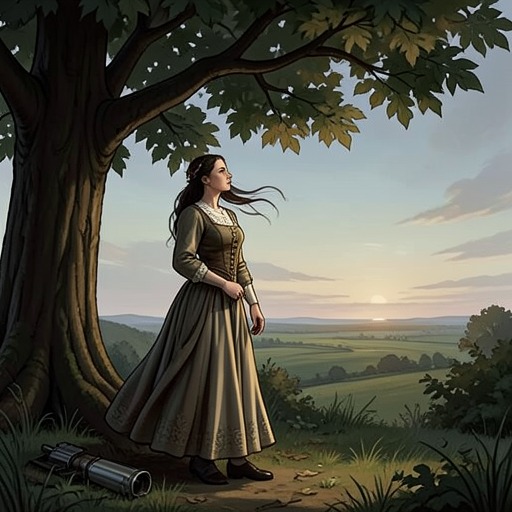
Anne responds by imagining Hester's appearance, since Diana knows only that she was pretty. She pictures a slight young woman with dark curls, brown eyes, and a wistful face, making clear that this portrait is Anne's imaginative construction rather than a fact passed down in the story. Anne also interprets Hester's life as a brief period of happiness in the quiet surroundings she had wanted, and sees beauty in the fact that she died among roses with Jordan beside her. The garden invites this imaginative response, but the distinction between remembered fact and Anne's conjecture remains visible.
Continuity and Significance
Hester had told Diana's mother that she would not live to eat the cherries from the trees she planted. She planted them because she wanted something of her making to continue living and helping to make the world beautiful after her death. The trees therefore give the garden a future-facing meaning: their value rests not on Hester enjoying their fruit, but on the life and beauty they may offer later. The narcissi, spreading beyond the original beds, provide a further image of persistence, although the story does not claim that Hester planted them.
For Anne, finding the garden is personally timed as well as emotionally significant. She calls it her adopted birthday and receives its story as a birthday gift, connecting the discovery to a day she already treats as special. The plot's importance lies in how it gathers private history into a landscape that remains open to discovery: Hester's longing for rural quiet, Jordan's devoted care, her death, and her wish to leave beauty behind are recalled through the garden's physical traces. Its present appearance does not restore the lost household; it allows the past to be encountered through what has endured.