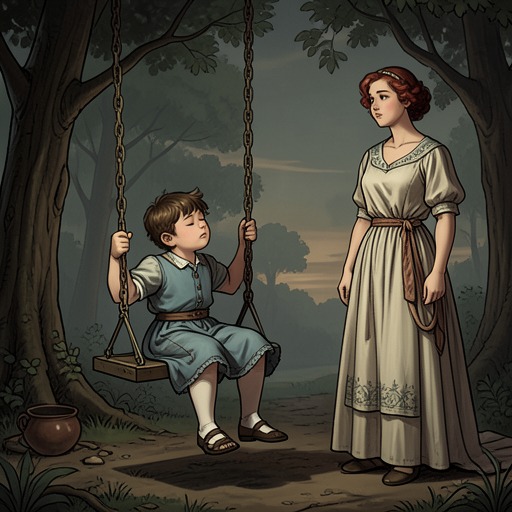
Imagination and fancy
Anne of AvonleaImagination and fancy are not an escape from life in Anne of Avonlea so much as a way of seeing it more fully. For Anne Shirley, a cloud, an abandoned house, a moonlit landscape, or a half-submerged log can open onto a story or disclose an inward meaning. Fancy gives shape to her ambitions and pleasures, but it also becomes a practice of attention: she imagines past lives, recognizes the emotional weight of places, and meets another person through the worlds that person has made.
The Uses of Fancy
Anne’s imagination can displace a task without making her indifferent to it. One August afternoon, she sits down to construe Virgil, but the harvest slopes, poppies, firs, and clouds draw her away from Latin. The clouds become the setting for an imagined future in which a celebrated former pupil credits his success to the teacher who once inspired him at Avonlea school. Anne’s vision is flattering, and even the future celebrity’s precise distinction is left conveniently vague; yet the fantasy expresses a serious ideal of teaching. She imagines influence not as mere instruction but as the capacity to kindle ambition and shape a life.
The same capacity makes Anne alert to the possibility of kinship. The narrative describes her as always watchful for kindred spirits, a readiness that belongs to the same imaginative disposition. Fancy lets her expect meaningful inward affinities even where practical evidence may be limited. It is an orientation toward people as well as scenery: Anne looks for a mind or heart that might answer her own.
Places Made into Stories
Anne’s fancy gives the past a presence in the landscape. Passing the deserted Boulter house, she imagines it remembering its former life: a large family, a lovely garden, roses, children, laughter, and songs. In her imagining, the empty house is not simply a ruin but a lonely witness to vanished happiness. She pictures the children and the old joys returning on moonlit nights, briefly allowing the place to dream itself young again. The scene reveals how readily Anne personifies what has been left behind, and how her stories are shaped by tenderness toward loss.
Diana Barry does not share this response. She recalls that imagining ghosts into the Haunted Wood frightened the girls, points out that the Boulter children are alive and grown, and rejects the idea that flowers or songs could have ghosts. Anne does not turn the disagreement into a quarrel; she sighs, recognizing that the route into fancy is one she sometimes has to take alone. The contrast makes imagination both a source of intimacy and a private territory: affection does not guarantee a shared way of seeing.
Nature offers Anne a more companionable setting for this private play. On a September drive through fields and woods, she takes the scent of dying fir as a kind of heavenly perfection, imagining that the aroma might be the fir trees’ souls and that heaven could preserve the scent without the death. Diana answers practically that trees have no souls, while conceding that the smell is lovely and proposing a cushion filled with fir needles. Anne, in turn, is content to be herself, an Avonlea schoolteacher on a friendly country road. Fancy does not require her to reject ordinary identity; it lets her move between it and a more enchanted possibility.
The Private Life of an Imaginative Mind
Anne’s days leave little time for imagining. She is occupied with teaching, studying, and helping Marilla Cuthbert with the twins, so the walks home from school and the half-hour before sleep become precious intervals. In the woods she may imagine herself as a dryad living in an old pine or a small wood-elf under a leaf; the white birch she kisses becomes, in fancy, her sister. At night she can choose a more triumphant role, becoming a queen, a prima donna, or a Red Cross nurse. The freedom to stop being a queen whenever she wishes is part of the pleasure: make-believe offers the exhilaration of a role without its real-life inconveniences.
This distinction between settings gives Anne’s fancy range rather than a single fixed form. Bedtime imaginings let her try out brilliance and triumph; the woods draw her toward kinship with trees and small creatures. Even her physical gesture of kissing the birch briefly makes visible the affection behind that second kind of imagining. Diana’s teasing that Anne is still a little girl does not erase the pressures of adult work. Instead, Anne’s response shows that growing up has not extinguished childhood habits, and that these short imaginative intervals continue to matter amid duty.
Imagination as Trust and Sympathy
Paul Irving’s letter to Anne reveals that fancy is not hers alone. He tells his teacher about the rock people he knows at the shore, explaining that he has shared them only with his grandmother and father, but wants Anne to know because she understands such things. His imagined company includes Nora, who lives in Andrews’ Cove and knows stories of mermaids and water kelpies, and the Twin Sailors, who travel everywhere and have seen more than the ordinary world contains. In one adventure, the younger sailor follows the track of the full moon across the water, reaches the moon, and sails through a little golden door into further adventures.
The letter gives imagination a relational consequence. Paul does not present these figures as a subject for general discussion; he entrusts them to someone whose understanding makes disclosure feel worthwhile. Anne’s receptiveness, already evident in her own elaborate fancies, allows the child’s private world to become a form of communication. The imagined people are stable companions who will still be there when winter keeps Paul from the shore, and their constancy matters to the way he describes them.
Anne also uses imagination to approach another person’s history with compassion. Hearing about Hester Gray, she understands why Hester wished to leave the noise and crowds of Boston for a still, green place. Anne considers the four years of happiness Hester found there and imagines her death among roses, with the person she loved beside her. Her response does not deny the sorrow of death; it gives weight to the refuge and happiness that preceded it. The cherry trees Hester planted deepen that sense of continuity: though she did not expect to eat their fruit, she wanted her planting to keep helping make the world beautiful after her death.
Seeing the Soul Beneath the Surface
Anne’s fancy is also a theory of perception. When she points out a mossy log beneath the flowing water in a brook, with a single shaft of sunshine falling across it, she calls the sight a poem. Jane Andrews would classify it as a picture, since a poem should consist of lines and verses. Anne distinguishes the outward form from the inward thing: lines and verses are only the garments of a poem, while its real substance is the soul within them. The brook scene becomes an unwritten poem, visible without being put into words.
That distinction gathers together the concept’s other appearances. Anne sees a possible future inside a cloud-filled afternoon, a remembered household inside an abandoned building, and a spiritual likeness between a girl and a birch. Her fancy is imaginative invention, but also an effort to perceive what is not immediately visible: aspiration within teaching, memory within a place, and feeling within another person’s chosen story. The book preserves the difference between Anne’s poetic vision and Diana’s or Jane’s practical corrections without making either disagreement disappear. Imagination remains at once a private pleasure, a means of fellowship, and a way of finding significance in the ordinary world.