Judson Parker
Anne of AvonleaJudson Parker is a smooth-spoken Avonlea businessman whose proposed fence advertisements expose the gap between his genial manner and his readiness to pursue private advantage. When the Avonlea Improvement Society tries to protect the landscape from patent-medicine signs, he refuses its appeal; he later withdraws the plan, but the circumstances Anne Shirley witnesses suggest that business and political self-interest—not simply civic feeling—have shaped his decision.
Identity and Reputation
Judson is described as jovial, bland, and uniformly good-natured, a manner that makes the small number of his friends seem surprising. The narration offers a possible explanation: he may have prevailed in too many business transactions. He is reputed to be sharp and thought by local opinion to have little principle. His own phrase for a profitable opportunity, an honest penny, captures the practical outlook that his neighbors distrust. The contrast is central to his portrayal: outward cordiality does not amount to public spirit, and a pleasant manner can coexist with conduct that damages his standing.
His sister, Martha Parker, is no source of support for the young Improvers. She disapproves of young people generally and of the society in particular, leaving the committee without the leverage of family ties. Judson is one of only two Parkers in Avonlea, so the family connection offers no route around his refusal. The committee must approach him directly, despite his reputation and their limited influence.
The Fence Dispute
At an Avonlea Improvement Society meeting in the Andrews parlor, the members are considering a petition for a fence around the school grounds and ornamental trees near the church. The society has already faced the difficulty of the hall remaining blue; Anne argues there is little point in starting another subscription while that problem persists. Gertie Pye then arrives with news that Judson intends to rent all the road fence of his farm to a patent-medicine company for painted advertisements. The announcement turns a routine meeting into an urgent dispute over whether the landscape can be treated as advertising space.
Anne asks the members to keep calm and find a way to prevent the plan. Jane Andrews answers that Judson would do anything for money and lacks both public spirit and a sense of beauty. Fred Wright similarly expects him to take a chance to make money rather than surrender it. These judgments are not merely abstract: the prospect is that the prettiest part of the Newbridge road will be disfigured by signs. Anne, though among the most agitated, agrees to lead the effort to persuade him, but asks for company as moral support. Diana Barry and Jane are appointed to accompany her.
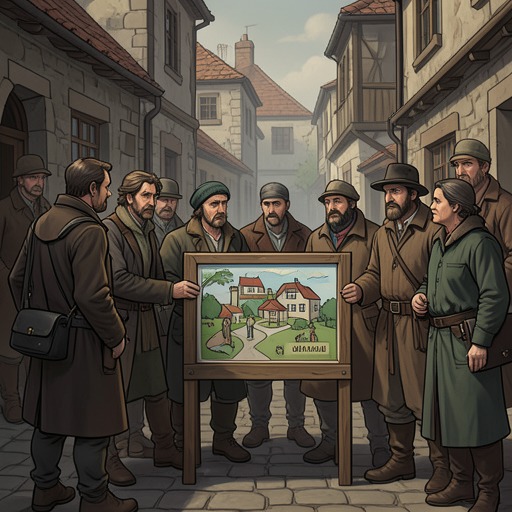
The next afternoon the committee makes its appeal. Anne pleads eloquently, while Jane and Diana support her. Judson is sleek and flattering, compliments them, and says he feels bad refusing such charming young ladies; nevertheless, he insists that business must come before sentiment in hard times. His concession is only about the color of the advertisements: he promises to tell the agent to use handsome, tasty colors such as red and yellow, and not blue. The answer preserves the commercial plan while pointedly treating the society’s concern as a matter of paint. The committee leaves defeated and angry.
A Withdrawal with an Unstated Cause
Public opinion turns against Judson once the facts become known, but it does not immediately move him. He chuckles and defies it, while the Improvers prepare themselves for advertisements along the road. At the society’s next meeting, however, Anne reports that he has instructed her to say he will not rent the fences to the company. Jane and Diana are astonished. The society’s strict parliamentary etiquette prevents them from demanding an explanation during the meeting, so they question Anne afterward.
Anne says only that Judson overtook her on the road the previous evening and told her he had decided to humor the society’s peculiar prejudice against patent-medicine advertisements. She maintains that this is all she knows, and the narration confirms that she is telling the simple truth as far as she goes. Jane nevertheless suspects that Judson’s change of heart has another explanation; the story confirms that her suspicion is also justified.
The preceding evening, Anne had visited Mrs. Irving on the shore road and was returning by a short cut through the shore fields and beech wood, emerging near the Lake of Shining Waters. At the entrance to the path, Judson was sitting in a buggy beside Jerry Corcoran, a Newbridge political agent active in the approaching general election. Anne heard Corcoran offer to return the note for a pair of harrows if Judson would vote for Amesbury. Judson accepted, saying that a man had to look out for his own interests in hard times. The conversation stopped when the two men saw Anne.
Judson soon caught up with her. Her cool refusal of his offer of a ride made him redden and twitch his reins; then prudence checked his anger. He wondered whether she had heard the exchange. The narrator makes his concern specific: being known to have accepted a bribe could cost him any hope of winning Louisa Jane, whose prospects as the heiress of a well-to-do farmer mattered to him. Against that background, his sudden decision about the fence follows Anne’s unexpected presence at the roadside conversation. He tells her that a society with the A.V.I.S.’s aims ought to be encouraged, but the narrative leaves the exact weight of civic sympathy, political exposure, and personal calculation unstated.
Character and Narrative Significance
Judson’s conduct gives the fence dispute its pointed reversal. At first, the Improvers’ public disapproval cannot stop him; his refusal to surrender a profitable arrangement seems to confirm their worst opinion. What changes the situation is not a successful argument from the committee but Anne’s accidental arrival at a conversation that could damage him. His later explanation recasts the reversal as generosity toward the society, while the reader has been given a more compromising context. That gap between the account he offers and the circumstances the narration discloses creates the episode’s irony.
The episode does not reduce Judson to a simple villain or establish a single, fully confessed motive. He is courteous in his dealings with the committee, refuses its request on commercial grounds, and later withdraws the plan. Yet his own acceptance of a political bargain and his concern about what Anne may reveal make his actions legible as self-protection as well as possible accommodation. His bland manner, business reputation, and sudden concession therefore work together: the character’s significance lies in the uncertainty between public improvement as a principle and public compliance as a convenient choice.