Kindred spirits
Anne of AvonleaKindred spirits are people who meet one another through a shared capacity for imagination, intuition, and emotional recognition. In Anne Shirley’s life, the idea describes both the privacy of an inner world that even a beloved friend cannot enter and the rare joy of finding others who can. Its meaning develops through Anne’s relationships with Diana Barry, Paul Irving, and Miss Lavendar Lewis: from a solitary path of fancy, it becomes a bond that can be recognized in a smile, entrusted with private imaginings, and sustained through friendship across generations.
Recognition and Difference
Anne’s readiness to look for kindred spirits is part of how she interprets other people. Her expectation is not simply that someone will share her interests; it is that another person may possess a similar inward responsiveness. The distinction matters when Anne imagines places and people through fancy. Such imaginative companionship can be intensely vivid, but it depends on a receptiveness that cannot be demanded of anyone, even someone dearly loved.
Diana Barry’s practical objection to imagining ghosts in the old Boulter house makes that limit clear. She recalls that imagining ghosts in the Haunted Wood once frightened her, and insists that flowers and songs could not have ghosts. Anne does not argue her friend into a different view. Instead, she suppresses a sigh: she loves Diana and recognizes their long companionship, yet has learned that when she enters the realm of fancy, she must go alone. The enchanted path to that realm is not one even her dearest friend can follow. Kindred spirits, in this early sense, are not simply the people closest to Anne; they are those who can share a particular way of seeing.
The contrast gives the concept a gentle tension. Anne’s friendship with Diana is genuine and lasting, but affection does not erase differences in imagination. Fancy offers Anne companionship of its own, while also making visible the boundaries between one person’s inner life and another’s. The idea of a kindred spirit names the exceptional connection that can cross those boundaries, not a requirement that every intimate friendship do so.
Paul Irving and Instant Affinity
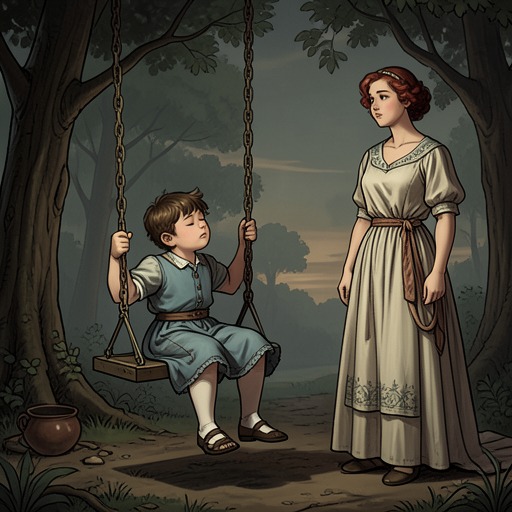
Anne’s first encounter with Paul Irving at the Avonlea school presents kindredness as immediate recognition. Before they speak, the meeting of their eyes gives Anne a thrill of discovery. Paul is ten, though he looks younger, and his fine, delicate features and chestnut curls frame a grave, meditative expression. When Anne smiles at him, his answering smile transforms his face, seeming to reveal a sweet, distinctive personality that had been hidden behind his seriousness. Their exchanged smiles make them fast friends before a word passes between them.
That silent beginning is important: their affinity is not established by shared history or by an explanation of their beliefs. Anne senses in Paul a soul akin to her own, and his unforced response confirms the recognition between them. The encounter turns a feeling Anne has long sought into a reciprocal relationship. What had been an inward hope—that another person might share her way of seeing—becomes visible in the smallest possible exchange.
Paul’s letter to Anne shows what that trust makes possible. Asked to write about interesting people he knows, he chooses his rock people, imaginative companions he has told only to his grandmother and father. He decides Anne should know about them because she understands such things; many people, he believes, would not. The letter describes Nora, who lives at Andrews’ Cove and knows stories of mermaids and water kelpies, and the Twin Sailors, who wander the seas and have seen more than the ordinary world contains. In one of Paul’s tales, the younger sailor follows the moon’s track across the water, enters a little golden door in the moon, and has adventures there. These details are not presented as experiences others must verify. They reveal how Paul’s imagination works and why he chooses to confide in a teacher he recognizes as receptive.
When Anne asks whether she could see his rock people if she went to the shore with him, Paul explains that they are visible only to him; she could see rock people of her own because she is the same kind of person. Their shared imaginative capacity does not make their private visions identical. Instead, it gives each the confidence that the other understands the possibility and value of such visions. Anne agrees with Paul’s delight in belonging to that kind, and the narration figures their common ground as a geography of imagination, a happy land where kindred spirits abound. The connection is thus both intimate and generous: each keeps an individual inner world, yet neither has to defend the existence of such a world to the other.
A Friendship with Miss Lavendar Lewis
Anne’s bond with Miss Lavendar Lewis extends the idea beyond childhood and beyond a single moment of recognition. After Anne’s first visit to Echo Lodge, she returns many times. She and Diana sometimes drive there together and sometimes walk through the woods; when Diana cannot come, Anne goes alone. In time, a fervent and helpful friendship grows between Anne and Miss Lavendar, joining a woman who has preserved the freshness of youth in her heart with a girl whose imagination and intuition supply experience she has not yet acquired.
The friendship brings something to both lives. Anne has found a real kindred spirit in Miss Lavendar. In turn, Anne and Diana carry the joy and exhilaration of the outer world into Miss Lavendar’s secluded, dream-filled life, which she has long shared at a distance from ordinary activity. Their visits bring youth and reality to the little stone house. Charlotta the Fourth greets them with her very wide smile, and the house becomes the setting for the lively high spirits of their late-autumn visits. Kindredness here does not mean that the two women are alike in age or experience; it means that imagination and intuition let them meet across those differences, while their friendship also reconnects Miss Lavendar with the world beyond her solitude.
Miss Lavendar’s curiosity about Stephen Irving’s son gives this connection a further turn. Hearing about Paul has given her a shock, and she asks Anne what sort of boy he is. Anne describes him as the dearest, sweetest child she knows and says that he pretends things just as she and Miss Lavendar do. Miss Lavendar wonders whether he resembles the little dream-boy who lives with her in imagination. Anne offers to bring Paul to visit, making a bridge between two people whose imaginative lives she has already recognized as kindred.
The Meaning of Shared Fancy
When Paul meets Miss Lavendar at Echo Lodge, their connection becomes tangible in a small gesture. She stoops and kisses him. Paul understands the wish behind her look by comparing it with the way his little mother used to look when she wanted to kiss him. Although he usually dislikes being kissed, he finds that he rather likes Miss Lavendar’s kiss and offers to return as her particular friend. Miss Lavendar accepts, then quickly goes inside; a moment later she is waving a cheerful goodbye from the window. Paul’s response joins perceptiveness with choice: he reads her affection, distinguishes it from unwanted attention, and willingly reciprocates it.
After they leave, Paul says that he likes Miss Lavendar, her stone house, and Charlotta the Fourth. His remarks show that his friendship is not an abstract match of personalities; it attaches to the people and place he has just encountered. He also imagines that Miss Lavendar would be more sympathetic than his grandmother to his way of thinking, while acknowledging that the foods she might offer him are not necessarily best for him. Even his playful comparison of their households is tempered by fairness. The visit makes room for his childlike preferences and his imaginative way of interpreting people without making him the sole measure of what is good.
Across these encounters, kindred spirits are recognized less through identical circumstances than through a shared openness. Diana remains Anne’s dear comrade without following her into every imaginative realm; Paul shares Anne’s confidence in fancy while keeping his own rock people; and Miss Lavendar meets Anne through intuition, then welcomes Paul through a tender, freely returned gesture. The idea holds together solitude and companionship: an inward world remains personal, but recognition makes it possible to share its value. In the novel, kindredness is therefore both a gift of seeing and a practice of friendship—attending to another person’s imaginative life without demanding that it become one’s own.