Mrs. Allan
Anne of AvonleaMrs. Allan, the minister’s wife in Avonlea, is both a participant in village life and a trusted mentor to Anne Shirley. Her influence is expressed less through formal authority than through practical support, attentive counsel, and the confidence with which she shares private sorrow. As Mr. Allan’s call to Charlottetown threatens to take the couple away, her attachments to the community become especially visible: they are rooted in friendships, service, and the memory of her child.
Identity and Place in Avonlea
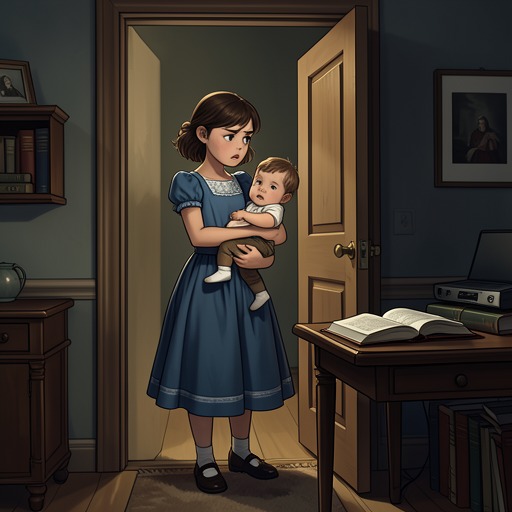
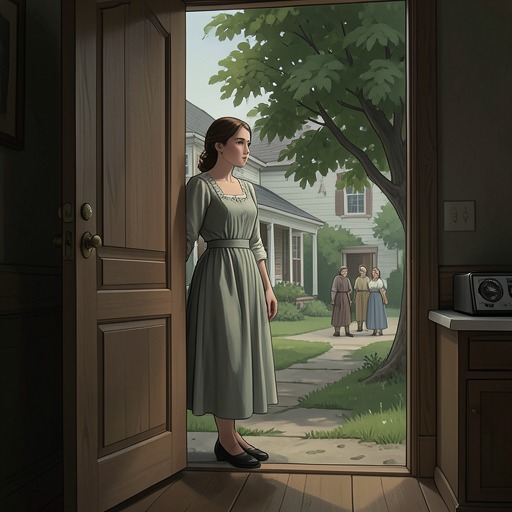
Mrs. Allan entered the community as a bride accompanying Mr. Allan to Avonlea. Five years later, her face carries patient lines associated with both the grave of her infant and a recent illness of her little son, though her familiar dimples and bright eyes remain. The description presents her character through a change in appearance: she has lost some girlish bloom, but gained tenderness and strength. Her place in Avonlea is consequently both public and intimate. She is the minister’s wife, involved in the village’s shared work, and a person whose kindness has made the community feel like a circle of lifelong friends.
Her practical participation is apparent in the Ladies’ Aid Society’s preparations for a fair and supper, with Rachel Lynde leading the enterprise. Mrs. Allan proposes an old-fashioned kitchen booth, with a supper of baked beans, doughnuts, and pie, and the organizers set about borrowing braided rugs, chairs, a glass-doored cupboard, brass candlesticks, and old dishes. She particularly hopes to find a blue willow-ware platter. The plan gives her a concrete role in shaping a communal event: she supplies its historical theme and helps turn household objects and local lending into a shared project.
She also supports the proposed Avonlea Village Improvement Society. Anne explains that the idea has approval from Mr. and Mrs. Allan, helping establish that the project is not simply a youthful whim. The society’s work is directed at improving the village itself, not its people. Mrs. Allan’s support places her among those who regard collective improvement as worthwhile, even while Rachel Lynde warns that residents may resent being improved. Her encouragement connects the community’s domestic and charitable work with a broader civic ambition.
A Mentor to Anne Shirley
Mrs. Allan’s relationship with Anne is marked by a combination of sympathy and clear-eyed encouragement. After Anne’s first year of teaching, Anne worries that she has failed to live up to her ideals. Mrs. Allan answers not by dismissing the disappointment but by placing it in a wider perspective: people do not perfectly fulfill their ideals, yet the effort to hold them matters. Anne’s theories as a teacher have been tested by experience, including her rule against corporal punishment, which Mrs. Allan recalls with gentle teasing. Their exchange allows Anne to acknowledge that some theories have failed without treating the failure as a reason to abandon aspiration.
Her counsel is similarly practical when Anne wonders whether college is possible. Anne feels bound by Marilla Cuthbert’s impaired eyesight and the care required by the Keith twins. Mrs. Allan urges her not to measure the richness of life solely by formal education: college may make it easier to shape a life, she suggests, but the breadth of a life depends on what a person puts into it. Anne names her work, Paul Irving, the twins, and her friends among the sources of her gratitude. Mrs. Allan’s advice does not diminish Anne’s ambition; it helps her recognize value in the life already built around work and responsibility.
Mrs. Allan also treats friendship as an ethical commitment rather than mere closeness. She warns Anne against allowing the name of friendship to excuse dishonesty or insincerity. Anne applies the principle to the intimacy between Gertie Pye and Julia Bell, which she sees as false because one speaks unkindly of the other behind her back. Mrs. Allan’s guidance thus gives Anne language for distinguishing genuine affection from social attachment without trust. Across these conversations, she acts as a mentor who invites reflection rather than dictating conclusions.
Grief, Care, and Community Ties
Mrs. Allan’s counsel is grounded in her own experience of loss. A tiny grave in the Avonlea cemetery accounts for some of the patient lines in her face. The child lived only three months, and the grave makes the family’s contemplated departure from Avonlea painful in a way that cannot be reduced to the inconvenience of moving. Mrs. Allan tells Anne that she has gone through the birch grove behind the manse nearly every night to sing a lullaby at the grave. She knows the child cannot literally miss its mother, but still feels the pull of that bond. The detail reveals grief as a continuing practice of remembrance, private yet shared when she confides it to Anne.
Anne already has a related habit of care: she places flowers on the infant’s grave while visiting Matthew Cuthbert’s. When Mrs. Allan and Anne meet in the cemetery, they walk home together. Later, Anne tells Diana Barry about Mrs. Allan’s nightly visits, and Diana promises to leave flowers on the baby’s grave, as well as on Matthew’s, while Anne is away. Mrs. Allan’s confidence therefore sets a chain of care in motion. The grave becomes part of the community’s shared memory, sustained not only by a bereaved mother but by Anne and Diana’s acts of remembrance.
The novel also places Mrs. Allan’s personal history beside the ordinary rhythms of service. She has recently come through an illness of her little son, and her face reflects both that experience and the earlier loss. Yet she continues to participate in village preparations, guide Anne, and support her husband’s ministry. Her steadiness is not presented as freedom from sorrow; rather, tenderness and strength coexist with visible reminders of what she has endured.
The Charlottetown Call and Departure
The possibility that Mr. Allan will accept a call to Charlottetown unsettles Avonlea. The community anticipates losing him, and Mrs. Allan herself feels deeply reluctant to leave people who have treated her kindly since she arrived as a bride. Her attachment to the place is sharpened by the child’s grave: she cannot imagine leaving it without pain, and admits to Anne that she has even sung to it at night. The impending move therefore tests the easy assumption that a minister’s household can simply transfer from one community to another. For Mrs. Allan, departure would mean leaving a network of friendships and a landscape holding the memory of her child.
The call also forms part of the changing circumstances around Anne’s future. Mrs. Allan has wished to see Anne go to college, while Anne has been reluctant to leave Marilla and the twins. Her counsel that people can make a rich life wherever they are does not settle that practical conflict, but it offers Anne a way to value both education and present attachments. Mrs. Allan’s own departure is anticipated rather than fully narrated in these episodes; the community discusses the call and its likely consequences, while her emotional response makes clear what leaving would cost her.
Narrative Role and Public Presence
Mrs. Allan’s scenes link the novel’s public and private forms of care. She supports a village improvement project and helps organize a charitable fair, but her most consequential influence on Anne comes through conversation: she reframes imperfection, gives friendship a standard of truth, and insists that a meaningful life is not confined to a particular educational path. Her authority remains personal and relational, rooted in example and trust.
Her presence extends to the marriage of Lavendar Lewis and Stephen Irving. In the absence of the Grafton minister, Mr. Allan performs the ceremony in the honeysuckle arbor, and Mrs. Allan is among the guests. She is part of a community gathering that joins old attachments and new beginnings, just as her own story holds together public belonging and private grief. The ceremony does not resolve the uncertainty surrounding her move, but it shows her still embedded in Avonlea’s shared occasions. Through these roles, Mrs. Allan serves as a quiet moral center: she helps others imagine how to live well while carrying obligations, disappointment, love, and loss.