Anne Shirley
Anne of Green GablesAnne Shirley, the red-haired, freckled, and endlessly imaginative orphan who arrives at Green Gables by mistake, is the central character of the novel. Her journey from a neglected, unwanted child to a beloved, accomplished young woman forms the emotional and thematic core of the story, exploring the redemptive power of love, imagination, and belonging. Through her vivid inner life, her passionate friendships, and her many misadventures, Anne transforms not only her own fate but also the lives of the Cuthberts and the entire community of Avonlea.
Identity and Background
Anne Shirley was born in Bolingbroke, Nova Scotia, to Walter Shirley, a teacher, and Bertha Shirley, also a teacher. Both parents died of fever when Anne was only three months old, leaving her an orphan. She was taken in by Mrs. Thomas, a poor woman with a drunken husband, who "brought me up by hand." Anne lived with the Thomas family until she was eight, helping to look after four younger children. After Mr. Thomas was killed under a train, Anne was passed to Mrs. Hammond, who lived up the river in a lonely clearing among stumps. Mrs. Hammond had eight children, including three sets of twins, and Anne helped care for them, finding the experience exhausting: "I like babies in moderation, but twins three times in succession is TOO MUCH." When Mr. Hammond died, Mrs. Hammond broke up housekeeping and Anne was sent to the Hopeton orphan asylum, where she spent four months before being brought to Prince Edward Island by Mrs. Alexander Spencer. Anne describes her life as one of drudgery and neglect, but she always tries to see the good in those who cared for her, saying of Mrs. Thomas and Mrs. Hammond: "Oh, they MEANT to be—I know they meant to be just as good and kind as possible." Her early experiences of being unwanted—"nobody wanted me even then. It seems to be my fate"—instill in her a deep hunger for love and a home.
Life and Plot Trajectory
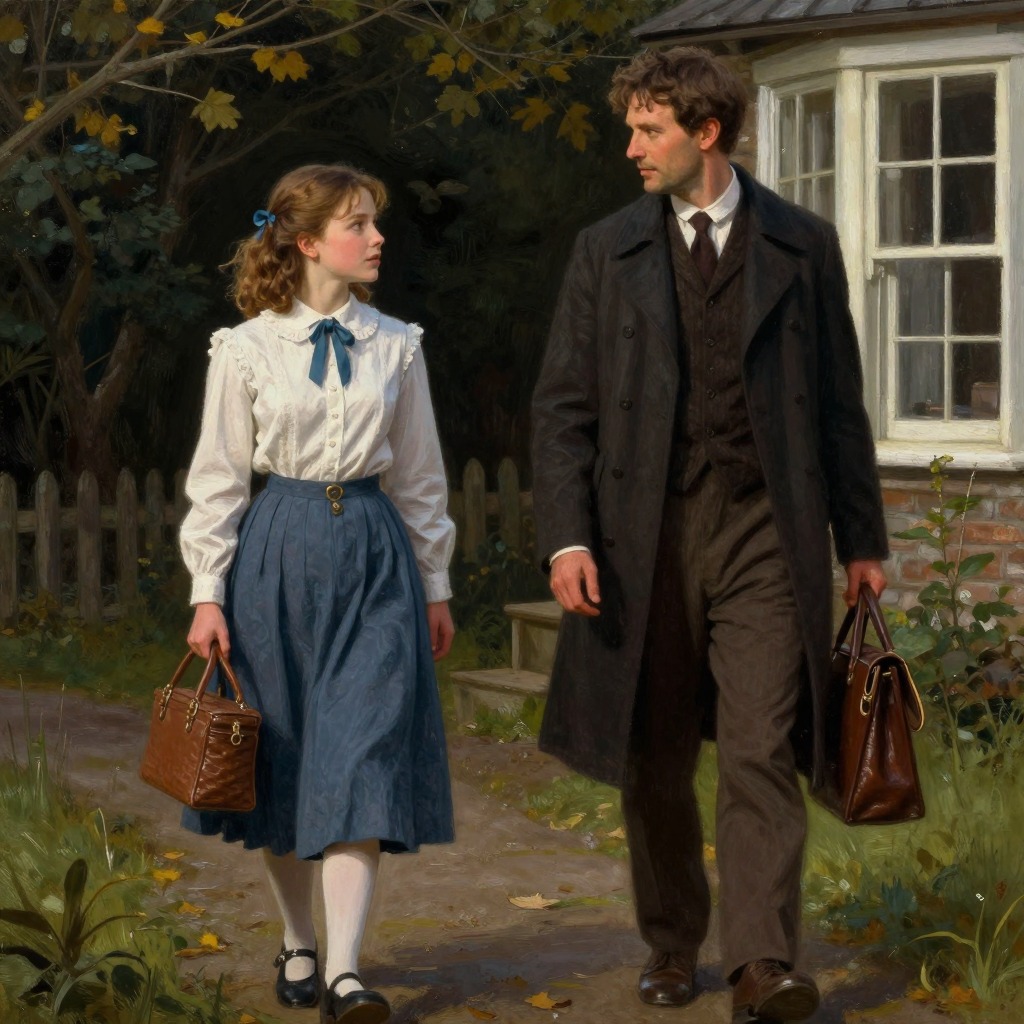
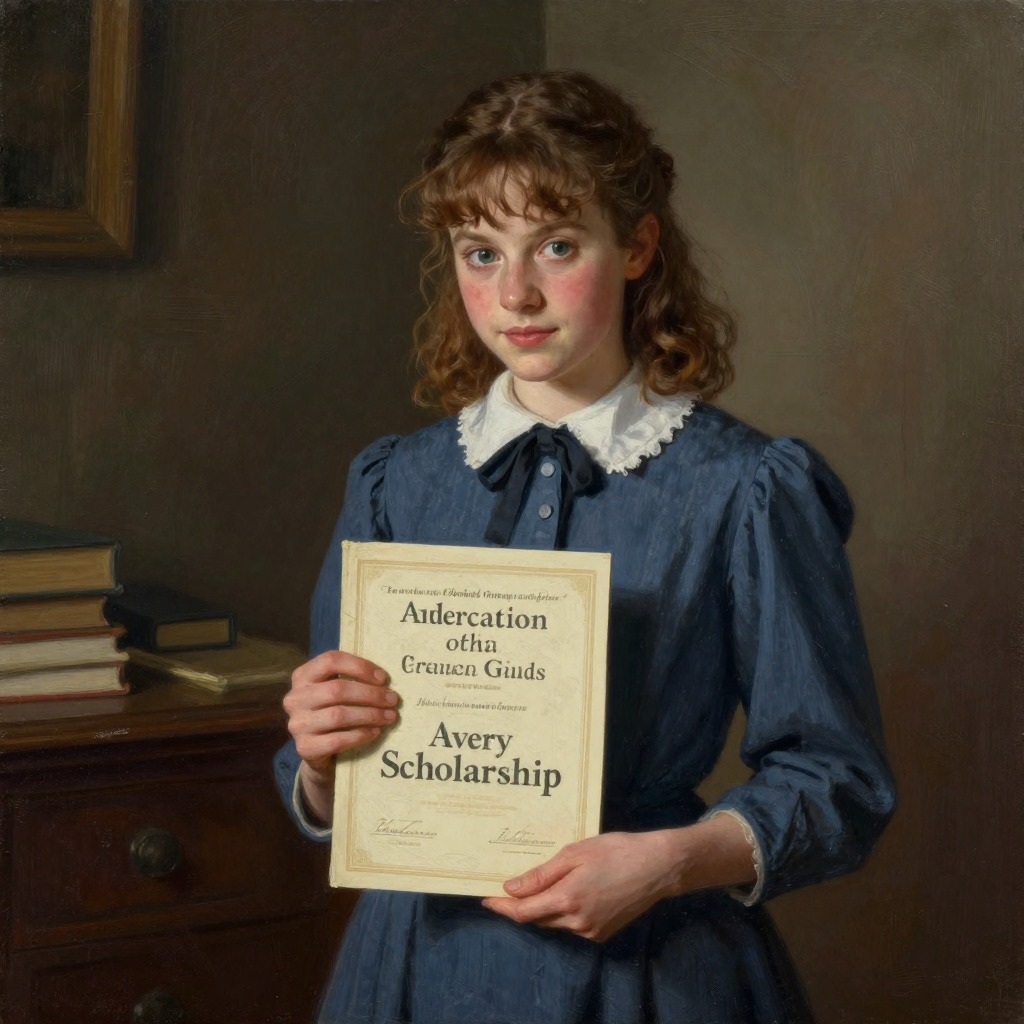
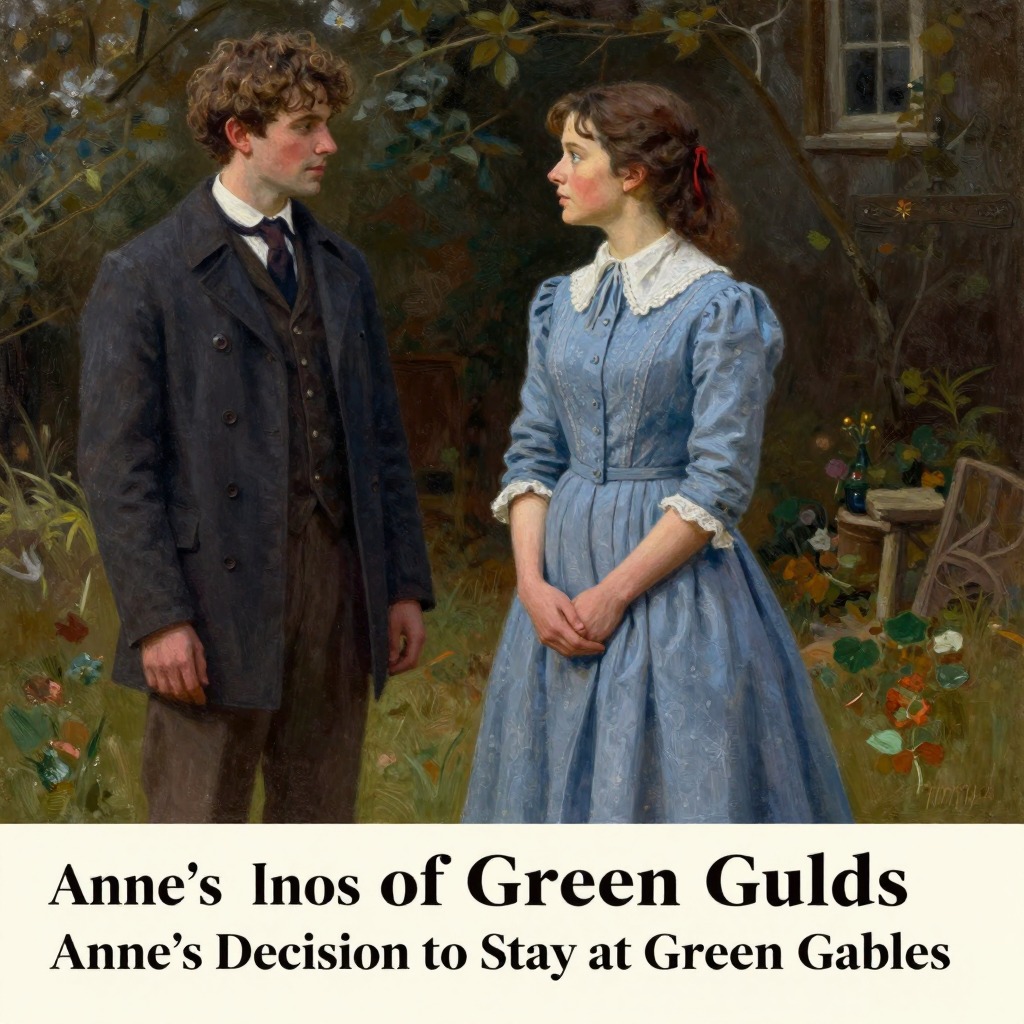
Anne arrives at Bright River station expecting to be met by Matthew Cuthbert, who has come for a boy to help on the farm. The mistake is discovered when Matthew finds a girl instead, but he is so taken by her eager, talkative nature that he brings her home to Green Gables. Marilla Cuthbert is initially determined to send her back, but Anne's passionate plea—"You don't want me because I'm not a boy!"—and her subsequent despair move Marilla. After a visit to Mrs. Spencer to sort out the error, and a near-miss with the harsh Mrs. Peter Blewett, Marilla decides to keep Anne. Anne quickly adapts to life at Green Gables, exploring every corner of the farm and naming its features: the "White Way of Delight" for the Avenue, the "Lake of Shining Waters" for Barry's pond, and the "Snow Queen" for the cherry tree outside her window. She begins school, where she forms a deep friendship with Diana Barry and a fierce rivalry with Gilbert Blythe after he calls her "Carrots." Anne's temper leads her to break a slate over Gilbert's head, resulting in humiliation when Mr. Phillips makes her sit with him as punishment. She refuses to return to school, but eventually goes back, channeling her energy into academic competition with Gilbert. Over the years, Anne matures through a series of misadventures: she accidentally gets Diana drunk on currant wine, loses Marilla's amethyst brooch and confesses falsely to gain permission to attend a picnic, dyes her hair green, falls off a roof while walking a ridgepole, and nearly drowns while playing Elaine. Each mistake teaches her a lesson, and she reflects that "each mistake has helped to cure me of some great shortcoming." She excels in her studies, joins the Queen's class, and wins the Avery scholarship for English, tying with Gilbert for first place on the entrance exam. After Matthew's sudden death from a heart attack brought on by the failure of the Abbey Bank, which wipes out the Cuthberts' savings, Anne decides to give up her scholarship to Redmond College and stay at Green Gables to teach, so that she can care for Marilla, whose eyesight is failing.
Key Actions and Objectives
Anne's primary objective throughout the novel is to find a home and to be loved and wanted. This drives her actions from the moment she arrives at Green Gables, where she pleads to stay: "Oh, please, Miss Cuthbert, won't you tell me if you are going to send me away or not?" She also seeks a "bosom friend," a kindred spirit to whom she can confide her inmost soul, and finds this in Diana Barry, with whom she swears a solemn vow of eternal friendship. Anne's imagination is her defining characteristic and her primary tool for coping with hardship. She uses it to transform her surroundings, naming places and creating elaborate fantasies. She also uses it to endure punishment, as when she is confined to her room for refusing to apologize to Mrs. Lynde: "I imagine a good deal, and that helps to pass the time." Her academic ambition becomes another key objective, especially her rivalry with Gilbert Blythe. She studies with fierce determination, wanting to "pass high" for the sake of Matthew and Marilla, and to prove herself. Her ultimate act of self-sacrifice is giving up the Avery scholarship to stay with Marilla, declaring: "Nothing could be worse than giving up Green Gables—nothing could hurt me more."
Relationships and Conflict
Anne's most significant relationship is with Marilla Cuthbert, who initially is strict and critical but gradually develops a deep, if undemonstrative, love for the girl. After Matthew's death, Marilla confesses: "I love you as dear as if you were my own flesh and blood and you've been my joy and comfort ever since you came to Green Gables." With Matthew Cuthbert, Anne finds an immediate kindred spirit; he is her sympathetic listener and supporter, buying her the coveted dress with puffed sleeves and always believing in her. His death is a profound loss. Anne's friendship with Diana Barry is the central peer relationship of her childhood. They share secrets, adventures, and a solemn vow of eternal friendship. Their bond is tested by the currant wine incident, which temporarily separates them, but is restored after Anne saves Minnie May's life. With Gilbert Blythe, Anne's relationship begins with bitter enmity after he calls her "Carrots" and she breaks a slate over his head. She refuses his apology and maintains a cold rivalry for years. However, after he rescues her from the pond during the Elaine incident, and later gives up the Avonlea school for her, they reconcile and become friends. Anne also has significant conflicts with Mrs. Rachel Lynde, whom she initially hates for calling her homely, but later apologizes to in a dramatic, theatrical fashion. With Josie Pye, Anne maintains a lifelong antagonism, finding her impossible to like.
Change and Ending
Anne undergoes a profound transformation over the course of the novel. She begins as a neglected, emotionally volatile orphan, prone to tantrums and despair, and ends as a mature, responsible young woman who chooses duty over personal ambition. Her physical appearance changes: she grows taller, her freckles fade, and her red hair darkens to auburn. Her character matures as she learns to control her temper, to apologize sincerely, and to think of others before herself. The novel ends with Anne deciding to stay at Green Gables to teach and care for Marilla, giving up her scholarship to Redmond College. She reflects on the change in her path: "When I left Queen's my future seemed to stretch out before me like a straight road. I thought I could see along it for many a milestone. Now there is a bend in it. I don't know what lies around the bend, but I'm going to believe that the best does." She reconciles with Gilbert Blythe, and they agree to be friends. The final image is of Anne sitting at her window, content with her decision, whispering, "God's in his heaven, all's right with the world."
Narrative Role and Evaluation
Anne Shirley is the protagonist and focal point of the novel, and her perspective shapes every aspect of the narrative. The story is told through her experiences, her emotions, and her vivid imagination. She is a round character in E.M. Forster's sense, capable of surprising the reader convincingly as she grows from a volatile child into a thoughtful young woman. Her narrative role is to embody the power of imagination, the importance of love and belonging, and the possibility of redemption. She is also a vehicle for social commentary, as her outsider status allows her to observe and critique the conventions of Avonlea society. Anne's enduring appeal lies in her combination of vulnerability and strength, her passionate nature, and her unwavering belief in the beauty of the world. She is both a source of comedy, through her many misadventures and dramatic speeches, and of pathos, through her orphaned past and her losses. Her journey from unwanted orphan to cherished daughter and community member is the emotional heart of the novel, and her decision to sacrifice her own ambitions for the sake of love solidifies her as a heroine of profound moral depth.
The character has been portrayed in numerous adaptations across film, television, and stage. The first film adaptation in 1919 featured Mary Miles Minter, but Montgomery strongly disapproved, calling the performance "sweet and sugary" and noting that the setting had been relocated to New England, complete with a skunk and an American flag—elements entirely foreign to Prince Edward Island. The 1934 film starred Dawn O'Day, who legally changed her name to Anne Shirley after the role; Montgomery found it superior to the 1919 version but still felt it failed to capture her vision. Scholar Faye Hammill argued that Hollywood adaptations stripped Anne of her Canadian and feminist dimensions, reducing her to a perpetually cheerful figure. On television, the 1985 CBC miniseries starring Megan Follows is widely regarded as the definitive portrayal, spawning sequels and the spin-off series Road to Avonlea. Stage adaptations include the long-running musical Anne of Green Gables: The Musical, performed annually at the Charlottetown Festival since 1965, which has been seen by over two million people and toured internationally, including a performance before Queen Elizabeth II.