Avonlea
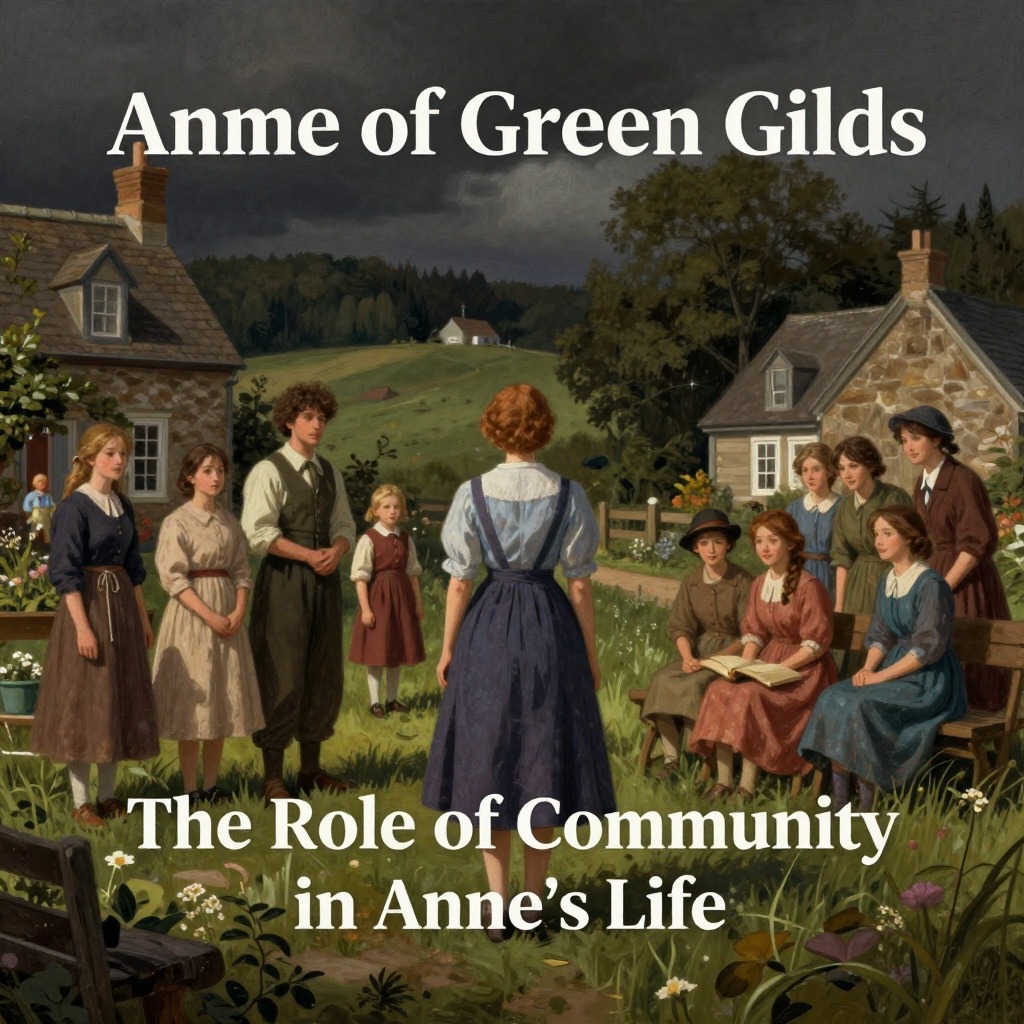
Anne of Green GablesAvonlea is the fictional rural settlement on Prince Edward Island that forms the entire world of the novel. It occupies a little triangular peninsula jutting out into the Gulf of St. Lawrence, with water on two sides, so that anyone entering or leaving it must pass over the hill road that runs the gauntlet of Mrs. Rachel Lynde's all-seeing eye. The community is small enough that everybody knows everybody else's business, and its social fabric is woven from church affairs, the Aid Society, the Sunday-school, the Debating Club, and the schoolhouse where generations of children have carved their initials into the desks. It is a place where a new minister or a visiting politician is a major sensation, and where the arrival of an orphan girl from Nova Scotia becomes the talk of the district for weeks.
Geography and Named Places
The landscape of Avonlea is intensely particular and deeply woven into Anne's emotional life. The main road dips down into Lynde's Hollow, fringed with alders and traversed by a brook that begins in the woods of the old Cuthbert place. Green Gables itself stands at the furthest edge of Matthew Cuthbert's cleared land, barely visible from the main road, set back along a deep-rutted grassy lane bordered with wild rose bushes. The property includes orchards of apple and cherry trees, a brook that runs below the house, a hollow with a deep icy-cold spring set about with smooth red sandstones, and a log bridge that leads up into wooded hills. Anne gives nearly every feature a name of her own invention: the Avenue becomes the White Way of Delight, Barry's pond becomes the Lake of Shining Waters, a little round pool in Mr. Barry's field becomes Willowmere, the spring by the log bridge becomes the Dryad's Bubble, and a spruce grove becomes the Haunted Wood. Lover's Lane opens out below the orchard and stretches far up into the woods to the end of the Cuthbert farm; Violet Vale is a little green dimple in the shadow of Mr. Andrew Bell's big woods; and the Birch Path is a narrow twisting path winding down through Mr. Bell's woods, fringed with slim young birches, ferns, and starflowers. These places are not merely decorative backdrops but active participants in Anne's inner life: she talks to the trees, names the geranium on the windowsill Bonny and the cherry tree outside her window the Snow Queen, and feels that the brook is laughing all the way up to the house.
Social Structure and Community Life
Avonlea's social world is organized around the church, the school, and a network of households that have known each other for generations. Mrs. Rachel Lynde is the community's unofficial overseer, a notable housewife who runs the Sewing Circle, helps run the Sunday-school, and is the strongest prop of the Church Aid Society and Foreign Missions Auxiliary. She sits at her kitchen window keeping a sharp eye on everything that passes, from brooks and children up, and she dearly loves to make a sensation. The schoolhouse is a whitewashed building, low in the eaves and wide in the windows, furnished with old-fashioned desks carved with the initials of three generations of scholars. The school trustees hire and fire teachers, and the community has strong opinions about education: Mrs. Lynde thinks a female teacher is a dangerous innovation, while Miss Stacy's field afternoons and physical culture exercises are viewed with suspicion by some. The Avonlea Debating Club meets fortnightly all winter and puts on concerts; the Sunday-school holds picnics in Harmon Andrews's field near the Lake of Shining Waters; and the church, after eighteen years under old Mr. Bentley, enjoys a variety of candidates before settling on the young Mr. Allan and his wife. Politics divide the community along party lines: most Avonlea people are Conservatives, and Mrs. Lynde is a red-hot Liberal who goes to town to hear the Premier speak even though she is on the opposite side.
Anne's Integration and Transformation
Avonlea is the place that transforms Anne from a homeless orphan into a beloved member of a community. When she first arrives, she is an outsider—a girl from an asylum in Nova Scotia, with no family, no history that anyone knows, and a way of talking that strikes the Avonlea children as queer. Mrs. Lynde's first verdict is that she is "terrible skinny and homely," and the other little girls stare at her with curious eyes. But Anne's imagination, her dramatic recitations, her skill at games, and her capacity for friendship gradually win the community over. She becomes the bright particular star of the Christmas concert, wins the Avery scholarship, and is offered the Avonlea school when Gilbert Blythe withdraws his application so she can stay with Marilla. By the end of the novel, Mrs. Lynde admits she was mistaken in her first judgment and calls Anne "a real pretty girl." The community that initially had no place for her has become the place she cannot bear to leave: when Marilla's failing eyesight and the family's financial ruin threaten to force the sale of Green Gables, Anne gives up her scholarship to Redmond College and decides to stay in Avonlea to teach, declaring that nothing could be worse than giving up Green Gables.
Narrative Significance
Avonlea functions as both a realistic setting and a symbolic space. It is a place of strict social norms—children should be seen and not heard, girls should not wear flowers on their hats to church, and a minister's wife should not dress too fashionably—but it is also a place where an odd, imaginative child can find a home. The landscape itself seems to respond to Anne's need for beauty and scope for imagination: the White Way of Delight, the Lake of Shining Waters, the Haunted Wood, and Lover's Lane are all projections of her inner life onto the external world. The novel's structure follows the rhythm of Avonlea's seasons—spring with its Mayflowers and violets, summer with its picnics and concerts, autumn with its red and gold glory, winter with its sleigh drives and skating frolics—and Anne's growth is measured by her deepening relationship with the place. The bend in the road that Anne contemplates at the end of the novel is both a literal road in Avonlea and a metaphor for the life she will live there, a life of sincere work, worthy aspiration, and congenial friendship, with flowers of quiet happiness blooming along its narrow path.