Avonlea Sunday-school
Anne of Green GablesThe Avonlea Sunday-school is a cornerstone of the community's religious and social life, deeply embedded in the rhythms of the village. Mrs. Rachel Lynde, a formidable presence in Avonlea, helps run the Sunday-school, underscoring its role as a pillar of local respectability and moral oversight. The institution is closely tied to the Avonlea church, where the superintendent, Mr. Bell, leads the opening exercises with lengthy prayers that Anne finds tedious, preferring instead to gaze out the window at the Lake of Shining Waters. The Sunday-school is also the setting for Anne's first formal religious instruction, where she is made to learn the catechism and the Lord's Prayer, though she approaches these texts with her characteristic imaginative flair, finding the phrase "infinite, eternal and unchangeable" to have a "roll to it—just like a big organ playing."
Anne's First Sunday at Sunday-School
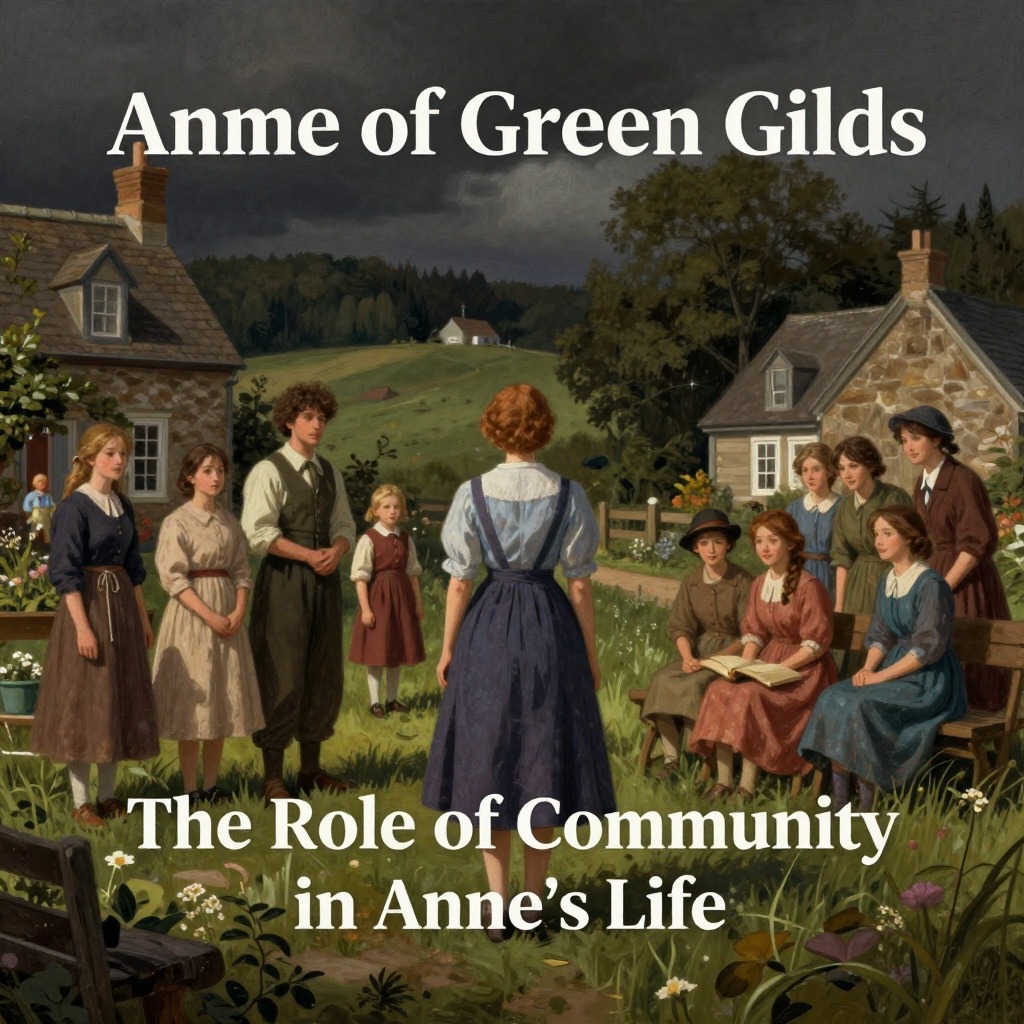
Anne's initial experience at the Avonlea Sunday-school is marked by acute social discomfort and a clash between her imaginative nature and the institution's rigid decorum. Dressed in a stiff black-and-white checkered sateen dress made by Marilla, Anne is acutely aware that every other girl in her class, taught by the stern Miss Rogerson, wears fashionable puffed sleeves. This sartorial disparity plunges her into misery, and she feels that "life was really not worth living without puffed sleeves." Her attempt to brighten her plain sailor hat with a wreath of wild roses and buttercups on the way to church results in a scolding from Marilla, who deems the adornment ridiculous. In class, Anne answers the printed questions promptly but finds Miss Rogerson unsympathetic, not a "kindred spirit," and she longs to ask her own questions rather than merely respond. She recites a paraphrase from the lesson, finding the lines "Quick as the slaughtered squadrons fell / In Midian's evil day" to be thrillingly tragic, even though she does not understand the words "squadrons" or "Midian."
The Sunday-School Picnic: A Community Event
The annual Sunday-school picnic is the most anticipated event of the summer for the children of Avonlea, and for Anne it represents a pinnacle of social belonging and joy. The picnic is held in Mr. Harmon Andrews's field, near the Lake of Shining Waters, and features the exotic treat of ice cream, which Anne has never tasted and can barely imagine. The event is organized by Mrs. Superintendent Bell and Mrs. Rachel Lynde, and Anne's desperate desire to attend drives her to make a false confession about losing Marilla's amethyst brooch. When Marilla discovers the brooch was never lost, she allows Anne to go, and Anne experiences a day of "perfectly scrumptious" delight, including a row on the lake and the sublime taste of ice cream, which she declares "words fail me to describe." The picnic thus becomes a symbol of both the community's collective pleasures and Anne's intense, sometimes reckless, emotional investment in social acceptance.
Religious Instruction and Moral Formation
The Sunday-school is the primary vehicle for Anne's formal religious education, a process that reveals the tension between her vivid imagination and the conventional piety of Avonlea. Marilla, horrified to discover that Anne has never said a prayer, immediately enrolls her in Sunday-school and borrows the "Peep of the Day" series from the manse. Anne learns the catechism at the asylum Sunday-school and recites it glibly, but her first private prayer at Green Gables is a unique composition thanking God for the "White Way of Delight" and the "Lake of Shining Waters" and asking to stay at Green Gables and become good-looking. Marilla is appalled but recognizes Anne's spiritual ignorance rather than irreverence. Later, under the influence of the new minister's wife, Mrs. Allan, Anne's view of religion transforms; she finds Mrs. Allan's faith "cheerful" and decides she would like to be a Christian "if I could be one like her." The Sunday-school thus becomes a space where Anne's innate spirituality is gradually shaped by the community's doctrines, even as she retains her own poetic and personal approach to the divine.
Social Hierarchies and Peer Relations
The Sunday-school is a microcosm of Avonlea's social hierarchies, where Anne's status as an orphan and her unconventional behavior are scrutinized by her peers. On her first day, the other little girls stare at her with curiosity, having heard stories about her "awful temper" and her habit of talking to trees and flowers. Anne feels isolated and miserable, acutely aware that she lacks the puffed sleeves that signify belonging. The Sunday-school also provides a stage for Anne's rivalry with Gilbert Blythe, who attends the same classes. When Gilbert teases her about her red hair, calling her "Carrots," Anne's explosive reaction—breaking a slate over his head—leads to a humiliating punishment that deepens her resentment. Yet the Sunday-school also offers opportunities for reconciliation; it is where Anne and Diana Barry, after their estrangement over the currant wine incident, can exchange notes and reaffirm their friendship. Through these experiences, the Sunday-school becomes a crucible for Anne's social development, teaching her about acceptance, rivalry, and the complexities of community life.