Anne Revisits Her Birthplace and Finds Her Parents' Letters
Anne of the IslandAnne Shirley’s visit to her birthplace in Bolingbroke turns a long-imagined address into a history she can touch: a room, a grave, and, most decisively, a packet of letters from Walter and Bertha Shirley. The visit does not restore the possessions lost after their deaths, but it gives Anne family memories and her parents’ own words, changing orphanhood from an absence without detail into a bond with a past she can claim.
The House and the Story of Her Birth
The house is a shabby yellow one on an out-of-the-way street, yet Anne approaches it with delight because it resembles the place she has pictured so often. Its yellow paint has survived, as have the muslin curtains; a lilac tree stands by the gate where she had imagined honeysuckle. The small differences matter less than the recognition: the dreamed-of setting is real, and Anne can enter it with Phil Gordon beside her.
A tall, thin woman who lives there confirms that the Shirleys rented the house twenty years earlier. She recalls that both parents died of fever, leaving a baby whom she assumes must also have died. Anne corrects her: she was that baby. The exchange brings a public, local memory of the family into contact with Anne’s own life. The former neighbor remembers her father’s red hair and says Anne resembles him in complexion, while her eyes and mouth recall her mother. Her recollection makes the parents more than names: they were known to others, and their brief life together had left impressions that endured.
The woman also remembers Anne’s mother as a pleasant young woman whose pupil had been devoted to her. She says Walter and Bertha were buried in one grave and that the School Board provided a headstone in recognition of their faithful service. These details establish a life cut short but not wholly forgotten. The couple’s deaths, the baby left behind, and the modest public marker form the history Anne has come to seek, supplied by someone who witnessed its traces rather than by documents or family possessions.
The East Room
Anne asks to see the whole house. The current resident gives her free rein, explaining that the home is small and that she has work to attend to. She points out the east room, where Anne was born, and recalls Anne’s mother saying she loved the sunrise. According to the woman, Anne arrived just as the sun was rising, its light falling on her face as the first thing her mother saw.
Up the narrow stairs, Anne enters the room with a full heart. The room becomes a private shrine in her imagination: the place where her mother had anticipated motherhood, where the newborn Anne and her mother shared the sunrise, and where her mother later died. The setting holds both the beginning of Anne’s life and the loss that defined its earliest years. Her reverence does not depend on the room having been preserved as it was; its importance lies in the events and hopes that the remembered details allow her to picture.
Anne reflects that her mother was younger than Anne is now when she gave birth. That comparison draws the past close without making it abstract: the young mother Anne has imagined was not only a figure in a story but a person whose age she can measure against her own. The emotion of the visit gathers around this recognition, as the ordinary east room acquires the weight of an intimate family history.
The Letters and What Survived
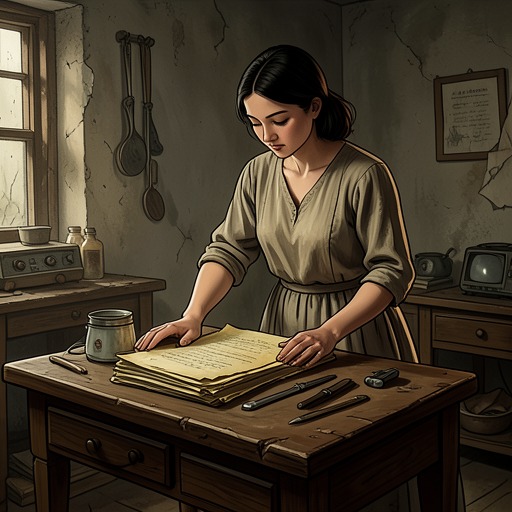
Downstairs, the woman gives Anne a small, dusty packet tied with faded blue ribbon. She had found it in an upstairs closet after moving into the house and never examined its contents. The address on the top letter names Bertha Willis, Anne’s mother’s maiden name, which leads the woman to offer the packet to Anne. Anne accepts it with joy: among the few remnants of her parents, these letters are something she can hold and read.
The former resident explains that the household furniture was sold to pay the doctor bills. Anne says she has nothing that belonged to her mother, and the letters therefore matter as more than historical evidence. They are a rare surviving connection to a parent whose clothes and small belongings had passed into another household and did not remain with Anne. The packet’s modest form—dusty, faded, and tied with old ribbon—contrasts with its importance to her: a fragment overlooked in a closet becomes the family inheritance she had never possessed.
Before reading, Anne makes a solitary visit to Bolingbroke Cemetery, carrying white flowers. She leaves them on her parents’ grave, then returns to Mount Holly and shuts herself in her room with the letters. The sequence links two forms of remembrance: the grave marks the parents’ shared death, while the packet restores their voices to the living. The letters, about a dozen in all, are yellowed, faded, and blurred by time. Because Walter and Bertha had seldom been separated during their courtship, they left only a small collection; its limited size does not lessen what it conveys.
Reading Her Parents into Reality
The letters contain no grand instruction or polished wisdom. Their force lies instead in lines of love and trust, and in the surviving presence of the people who wrote them. Anne finds them tender and intimate, their old words still carrying the sweetness of the lives they describe. Bertha’s letters in particular preserve a lively sense of their writer, so that the packet offers Anne not merely facts about her mother but an impression of her personality.
The most precious letter to Anne was written after her birth, when Bertha was briefly apart from Walter. It recounts the baby’s cleverness, brightness, and many small charms. In its postscript, Bertha writes that she loves Anne best asleep and better still awake. The affection is immediate and specific: Anne encounters her mother not only as the young woman who died, but as a proud parent attending closely to her child. The letter may have been Bertha’s last; her death was near. That knowledge lends the postscript a poignancy the words themselves do not need to announce.
That night Anne tells Phil Gordon that the day has been the most beautiful of her life. She says that she has found her father and mother because the letters have made them real to her, and that she no longer feels like an orphan. She compares the discovery to opening a book and finding yesterday’s roses preserved between its pages. The image gathers the event’s central contrast: time has faded the paper and carried the writers beyond reach, yet their affection remains legible. The visit ends not with a recovered household or a changed past, but with Anne possessing a clearer, more intimate understanding of where she came from.