Anne Shirley and Marilla Cuthbert’s Family Bond at Green Gables
Anne of the IslandAnne Shirley and Marilla Cuthbert’s family bond at Green Gables is expressed less through declarations than through the ordinary acts of noticing, worrying, and welcoming someone home. Marilla shares Anne’s grief when a familiar tree is lost, questions whether Anne is safe in a summer storm, and recognizes the force of her distress at alarming news. These domestic moments show Green Gables as a shared emotional home: a place where changes are felt together and where Anne’s return matters.
A home made meaningful by familiarity
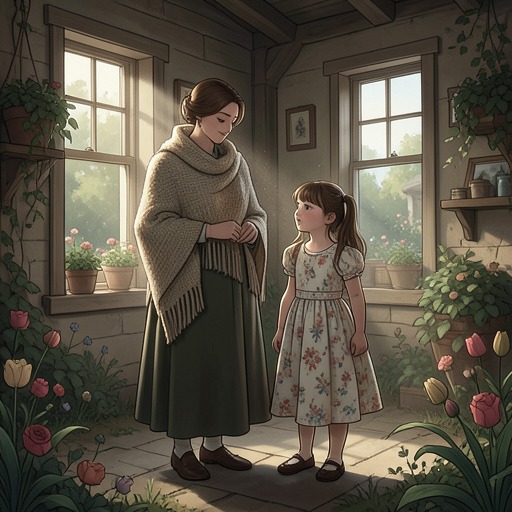
When Anne returns to Green Gables, the house and its surroundings carry the weight of years of attachment. On one homecoming, she comes down from the porch gable sorrowful and asks Marilla what has happened to the old Snow Queen. Marilla explains that the tree, which had stood there since she was a young girl, blew down in the March gale because it was rotten at the core. Her answer gives the loss a history that belongs to both women: the tree predates Anne, but its familiar presence has become part of the home Anne knows.
Anne grieves that she will miss it, and says the porch gable no longer seems the same room without it. She expects to look out its window with a continuing sense of loss. Marilla does not dismiss the feeling; she says she had felt bad about the tree herself. Their responses are not identical—Anne imagines the future absence from a familiar window, while Marilla remembers the tree’s long place in her own life—but both acknowledge that a changed landscape can alter the feeling of a room. Their shared sadness makes the loss a small, concrete instance of family attachment.
That same homecoming carries another absence. Anne says she has never returned to Green Gables before without Diana Barry being there to welcome her. Marilla answers that Diana has something else to think about, leaving Anne to ask for the rest of the Avonlea news. The exchange places the women together in the work of receiving a changed homecoming: Anne names who is missing, and Marilla supplies the local context before the conversation moves on. Anne then sits on the porch steps as the evening sunshine falls over her hair, physically at home even while noticing that home no longer looks or feels quite as it did.
Concern and Anne’s independent choices
Marilla’s concern also appears when Anne spends the summer visiting Ruby Gillis. Anne gives up a moonlight drive to White Sands to sit with Ruby, and returns to her repeatedly, even though she sometimes wonders whether the visits do any good. Ruby grows paler as the summer wanes; the White Sands school is suspended, and she becomes too tired to manage the fancy work she once enjoyed. Marilla, like Rachel Lynde, is dubious about Anne’s frequent visits. Rachel fears Anne will catch consumption, and Marilla shares the doubt.
This concern sits beside Anne’s decision to keep going. Ruby clings to her visits and asks her to promise she will return, while Anne struggles with the sadness of seeing Ruby’s cheerful talk of beaux against the reality of her worsening illness. The evidence does not show Marilla forbidding Anne to go or Anne arguing with her. Instead, it sets Marilla’s caution against Anne’s persistence: care for Anne’s safety and Anne’s sense of responsibility to a friend coexist without becoming a dramatic rupture between them.
Homecoming, weather, and practical care
A later return makes Marilla’s attention more immediate. On a bleak July evening, a fierce summer storm is beginning as Anne reaches Green Gables; the first raindrops strike the windowpanes. Marilla asks whether Paul Irving brought her home and why Anne did not make him stay the night. Her questions are specific to the danger of the evening: she is thinking about the road and the worsening weather, not merely observing that Anne has returned.
Anne replies that Paul should reach Echo Lodge before the rain grows heavy and says she has had a splendid visit, but is glad to see her dear folks again. She invokes the familiar saying, “East, west, hame’s best.” The homecoming therefore holds both sides of their bond: Anne has enjoyed being away, yet values the return, while Marilla’s first response is to check whether the journey has been safe. The exchange lets welcome and worry occupy the same moment.
Recognizing Anne in moments of change
Green Gables is also where Anne’s reactions become visible to Marilla. After Anne says she is glad to be home, Davy Keith tells her that Gilbert Blythe is dying. Anne stands silent and motionless, and her face turns so white that Marilla thinks she may faint. The news concerns Anne and Gilbert, not a conflict between Anne and Marilla; its relevance to their relationship lies in Marilla’s immediate recognition of how deeply it has struck Anne. The household sees the shock before Anne can explain it.
Across these episodes, the bond is conveyed through shared attention to what changes: a tree that has fallen, a friend who is absent, a storm threatening the road, or news that leaves Anne visibly shaken. Marilla does not supply a grand interpretation of Anne’s feelings. She responds to what is before her—with shared regret, questions about safety, and awareness of Anne’s distress. Anne, in turn, describes Green Gables as the place where she is glad to see her dear people again. Their family connection is thus grounded in reciprocal familiarity: Marilla knows when Anne needs concern, and Anne experiences home as more than a building or a view from a window.