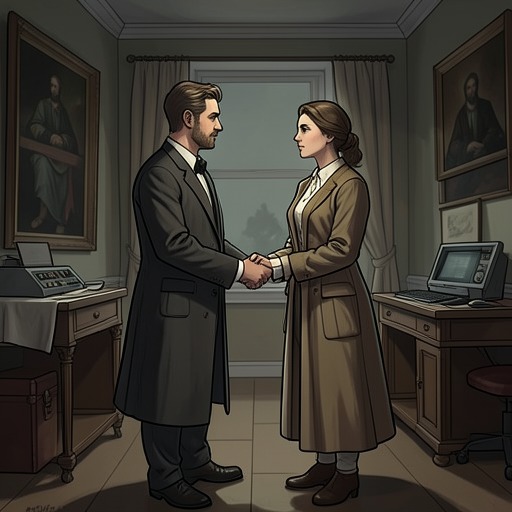
Anne Shirley and Roy Gardner's courtship
Anne of the IslandAnne Shirley and Roy Gardner's courtship tests the difference between an appealing romantic ideal and a love that feels necessary to one's life. For two years Anne believed she cared for Roy and allowed their relationship to develop toward marriage; when his sincere proposal finally came, she discovered that she could not accept it. The refusal unsettles their shared understanding of the courtship and exposes the gap between what Anne had imagined love should be and what she actually felt.
Courtship During Anne's College Years
Anne's relationship with Roy developed while she was studying at Redmond, a period shaped both by new friendships and by practical concerns about continuing her education. During her first year she resolved to win the Thorburn Scholarship so she could return without drawing on Marilla's limited savings. Later, as a Sophomore, she worried that she might be unable to afford another year at college. The courtship therefore belongs to a life in which marriage was not Anne's only concern: her studies and the possibility of earning her own way remained important pressures.
By the winter before Convocation, Anne had spent considerable time with Roy's family and grown close to Dorothy Gardner. College circles expected an engagement, and Anne herself thought it likely. She was deeply in love with Roy, or understood her feelings that way, though the experience did not match her former conception of love. The relationship had lasted two years, and Anne had encouraged Roy's attentions because she believed she cared for him. Her expectation of marriage was consequently not just gossip imposed from outside; she too had treated it as the probable next step.
The Convocation flowers quietly complicate that certainty. Anne took Roy's violets from their box, intending to carry them, but another box held lilies-of-the-valley sent by Gilbert Blythe. Gilbert had been largely absent from her social life that winter, and Anne wondered why he had sent them. Just before leaving for Convocation, she put aside Roy's violets and chose Gilbert's flowers instead, without being able to explain her own action. The moment does not itself resolve her feelings, but it places an unexplained attachment beside the engagement she expects with Roy.
The Ideal and the Relationship
Anne later identifies what first drew her to Roy: his good looks and talent for romantic compliments made him seem like the dark-eyed ideal she had once imagined. She had thought that being in love with him followed naturally from his fitting that image. Yet her affection remained qualified by a persistent sense that something was missing. She reasoned that real life rarely resembled imagination, and expected that she and Roy could still be happy together, even without the particular excitement she had once associated with love.
That uncertainty was difficult to distinguish from ordinary disappointment. Anne had already learned that a cherished expectation could lose its luster when encountered in reality; she compares her changing understanding of love to the childhood disillusionment of discovering that a diamond did not possess the splendor she had imagined. Roy was dear to her, and she did not regard the courtship as a deception. But the qualities that made him an apparently excellent match—his appearance, charm, and later the wealth and goodness others praised—could not settle the question of whether she truly wanted to marry him.
The Proposal and Refusal
Roy proposed in a small pavilion on the harbor shore, the place where he and Anne had first talked on a rainy day. Anne thought the choice of setting romantic. His proposal was carefully and beautifully worded, and its polish did not make it insincere: she understood that Roy meant what he said. The scene seemed to gather all the elements of the romance she had been taught to expect. Anne believed she ought to feel swept away and prepared to answer yes.
Instead, as Roy waited for her answer, she became intensely uncertain. She pulled her hand away and told him she could not marry him. At first she could offer no fuller explanation than that she had thought she could accept, but now knew she could not. When Roy asked why, she said that she did not care enough for him. His reaction was hurt and disbelief; he asked whether she had been amusing herself with him for two years and said that she had ruined his life. Anne protested that she had not been playing with his feelings: until that moment, she had genuinely believed that she cared.
The refusal is a reversal rather than the planned conclusion of a courtship Anne had always known to be false. Even at the pavilion, she had nearly said yes. The decisive change came when the choice became immediate: the polished proposal and romantic setting could not produce the feeling she thought marriage required. Her inability to explain herself to Roy makes the realization emotionally consequential, not a calculated withdrawal from a merely convenient match.
Conflict, Meaning, and Aftermath
Philippa Gordon challenged Anne sharply after the refusal. From Philippa's perspective, Anne had encouraged Roy for two years and then rejected him, an action that looked like scandalous flirtation. She also suggested that Anne had been attracted by Roy's money, since he was handsome, clever, rich, and good. Anne rejected that interpretation. She said she had never been thinking of his wealth and explained instead that she wanted someone who belonged in her life. His looks and romantic manner had initially swept her up; his resemblance to her ideal had led her to believe she must be in love.
Anne's account distinguishes deliberate deception from mistaken self-knowledge. She does not deny that she had accepted the courtship or that Roy had grounds to feel wronged; she insists that her feelings seemed genuine until they failed at the moment of decision. Her response to Philippa—that she knew her own mind, although it changed and then had to be known again—captures the painful uncertainty at the center of the relationship. The change does not erase the consequences for Roy, but it prevents the refusal from being reduced to financial calculation or casual manipulation.
The courtship also sits among sharply contrasting ideas of marriage. Philippa had earlier treated wealth as a practical necessity and feared the vulnerability of being in love. Mrs. Skinner, by contrast, chose the poor Thomas over the wealthier William Obadiah because she loved Thomas and believed affection necessary to a shared life. These contrasting choices clarify what Anne's explanation emphasizes: a match's external advantages cannot substitute for the sense of personal belonging she finds absent with Roy. Her rejection is thus both an ending to a two-year expectation and an important correction to her own romantic ideal. A handsome, sincere suitor and a flawless proposal are not enough to make a marriage feel right.