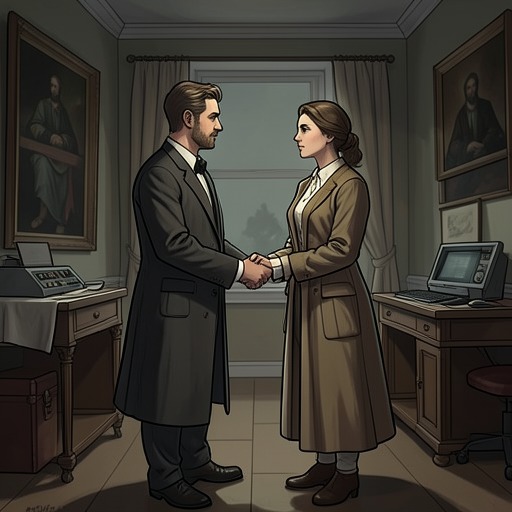
Anne Shirley rejects Roy Gardner’s marriage proposal
Anne of the IslandAnne Shirley rejects Roy Gardner’s marriage proposal in the harbor pavilion where they first met, overturning a courtship that seems to possess every outward mark of romantic inevitability. The proposal is sincere, elegant, and staged with care; Anne nevertheless finds that she cannot give the answer she had expected to give. Her refusal makes the gap between a flawless romantic scene and her actual feeling decisive, and leaves her ashamed but newly free.
Causes and Expectations
Before Roy asks, the people around Anne have reasons to read their courtship as a promising match. Stella Maynard tells Aunt Jamesina that she loves Anne and likes Roy, and observes that others regard the match as brilliant. Even Mrs. Gardner, Stella says, now finds Anne charming. Yet Stella doubts the apparent perfection of the arrangement. Her reservations anticipate the difference between what looks right from outside and what Anne can honestly feel, without giving away Anne’s eventual choice.
The surrounding conversations about marriage give that choice a social context. In one earlier discussion, a young woman says that two suitors mattered among the many who liked her, but that she must marry a rich man: she considers herself extravagant and unable to do useful work. She rejects love as a condition of marriage, fearing the vulnerability and power it would give a husband. Another account comes from a widow who weighs a wealthy suitor, William Obadiah Seaman, against Thomas, a poor man with a less impressive house. She chooses Thomas because she loves him and he loves her, deciding that wealth cannot make up for the absence of affection. These contrasting calculations make Anne’s refusal legible as a choice about feeling, not merely about whether a proposal is socially advantageous.
The Proposal and Refusal
Roy chooses the little pavilion on the harbor shore, the place where he and Anne had spoken on the rainy day of their first meeting. Anne finds the choice romantic. His proposal is beautifully phrased, and its effect is so polished that it seems to have no flaw; crucially, the narration makes clear that the polish does not mean insincerity. Roy means what he says. The scene therefore offers Anne no easy excuse: what fails is not his honesty, his tenderness, or the setting, but her own response.
Anne believes she ought to be thrilled, and initially opens her lips to say yes. Instead, she becomes physically unsteady, as though recoiling from a precipice, and pulls her hand away. The suddenness of the reversal matters: she does not enter the scene announcing a settled refusal, but discovers her answer at the instant she is about to accept. She tells Roy desperately that she cannot marry him, then explains that she had thought she could but does not care enough for him. When he asks whether there is any hope, she silently shakes her head. The refusal is therefore final, though it arrives through a moment of painful recognition rather than a rehearsed decision.
Separation and Immediate Aftermath
Roy turns pale and looks foolish; he had felt sure of Anne’s answer. He says he cannot understand or believe that she is not the woman he had believed her to be, but declines to trade reproaches with her. He tells her that she is the only woman he can ever love and thanks her for their friendship before saying goodbye. His response keeps the scene from becoming a quarrel: the relationship ends in hurt and incomprehension, but not accusation.
After Roy leaves, Anne remains in the pavilion for a long time, watching a white mist move landward across the harbor. The mist accompanies an inward aftermath the scene names as humiliation, self-contempt, and shame; beneath those feelings, however, Anne senses a strange recovery of freedom. The ending does not turn her refusal into immediate triumph. Its emotional force lies in the coexistence of pain and release: she has wounded Roy and feels diminished by the episode, yet she is no longer bound to a marriage she cannot sincerely choose.
Later, at dusk, Anne slips into Patty’s Place and escapes to her room, where Phil is waiting on the window seat. Anne tells Phil that Roy proposed and that she refused him, anticipating the scene before Phil has heard her explanation. The disclosure carries the event beyond the pavilion: Anne must now make her choice known to a close friend as well as to Roy. In another later conversation, Mrs. Harmon Andrews reports that Jane Andrews is marrying Mr. Inglis, a wealthy man, and will live in a mansion in Winnipeg with household staff. Anne jokes that she will become an old maid because she cannot find anyone to suit her. The contrast places her refusal beside a marriage celebrated for wealth and provision, while preserving the specific point of her choice: she has declined Roy because her feeling is insufficient, not because marriage itself has been proved impossible.
Narrative Significance
The scene turns on the collapse of an expected ending. Its setting, proposal, and polished language seem to promise a conventional romantic resolution, and Anne herself anticipates saying yes. The abrupt bodily recoil changes the meaning of those assurances: outward perfection cannot supply the inward attachment marriage requires. Roy’s sincerity makes the decision harder, not easier, because Anne cannot dismiss him as a false suitor.
The result is a separation rather than a reconciliation. Roy leaves believing that Anne is not the woman he thought he knew; Anne remains with shame, yet also with recovered freedom. That double consequence gives the refusal its importance in the story: it establishes that Anne will not let a brilliant-looking match, other people’s expectations, or the momentum of a romantic scene decide her marriage in place of her own feelings.