Anne Shirley's orphanhood
Anne of the IslandAnne Shirley’s orphanhood is both a fact of her early life and an enduring sense of absence, transformed when she visits the house where she was born and discovers her parents’ letters. The visit gives her what she had lacked: not a recovered family life, but tangible evidence of her mother and father as loving individuals, and a new way to feel connected to them. By the time she leaves Bolingbroke, she no longer understands herself as an orphan in quite the same way.
Identity and the Shape of the Loss
Anne’s orphanhood is sharply expressed in her realization that she possesses nothing that belonged to her mother. At her birthplace, she tells the woman who has kept the letters that she has not a single personal object of her mother’s. The house’s former contents had been dispersed: furniture was sold to pay the doctor bills, while her mother’s clothes and small belongings went to Mrs. Thomas. The hostess remembers that the Thomas children were destructive, and suggests that those possessions did not last. Anne’s loss is therefore not abstract. It includes the disappearance of the ordinary objects through which a child might have come to know a dead parent.
The visit also reveals how much Anne has carried in imagination where personal memory and material inheritance are absent. She has pictured the shabby yellow house before seeing it, and delights in finding it much as she imagined: the yellow paint remains, a lilac tree stands by the gate, and muslin curtains hang in the windows. The match between remembered vision and actual place does not restore a past she experienced; it brings her close to the circumstances of her beginnings. Her orphanhood is a condition inherited from events before she could remember them, yet the house gives those beginnings a location she can enter.
The Birthplace and Her Mother’s Story
A woman living in the house allows Anne to look through it and identifies the east room as the room where she was born. She recalls that Anne’s mother loved the sunrise and that the child was born as the sun rose, its light falling on her face as her mother first saw her. This account gives Anne a scene of welcome from before her own memory: her mother’s anticipation of motherhood, the moment of birth, and the mother’s death are joined to one small room.
Anne climbs the narrow stairs and enters the east room with reverence. She imagines it as the place where her mother had dreamed of the child she was expecting, and knows that her mother died there. The room becomes a shrine not because it contains family possessions—it does not—but because it locates her birth and her mother’s presence in a specific place. Anne observes that her mother was younger than she is now when Anne was born. The comparison makes the dead woman’s youth immediate to her, narrowing the distance between a parent she never knew and the adult Anne has become.
The Letters and the Parents Made Real
Before reading the packet, Anne makes a pilgrimage alone to the green corner of the old Bolingbroke cemetery, where her father and mother are buried. She leaves white flowers on their grave, then returns to Mount Holly and shuts herself in her room to read. The gesture connects the bodily place of their burial with the private encounter offered by their words: she honors them first at the grave, then approaches their lives through what they wrote.
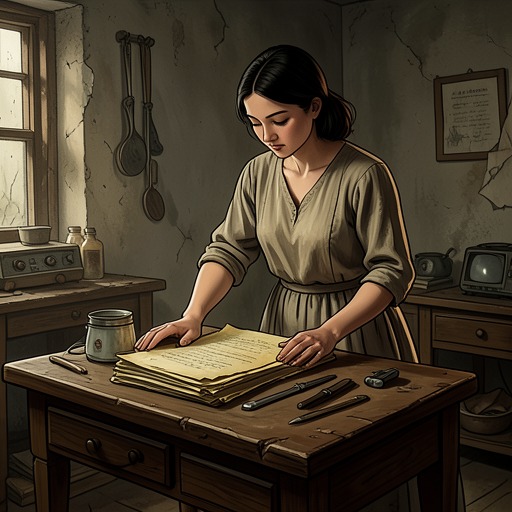
The packet contains a dozen letters, yellowed, faded, and blurred by time. Some are from Walter Shirley and some from Bertha Shirley; they had seldom been separated during their courtship. The letters offer no grand instruction or formal account of family history. Their force lies instead in the lines of love and trust, the intimate traces of two people who had been deeply attached to each other. Anne can sense her mother’s personality in the writing, while the hostess’s recollection adds that Anne’s eyes resemble her mother’s and that her parents were very much in love.
One letter, written after Anne’s birth during a brief absence from her husband, is especially dear to her. It is filled with a young mother’s delight in the baby’s cleverness, brightness, and many sweetnesses; its postscript says that Bertha loved the child best asleep and even better awake. Anne recognizes that this may have been her mother’s last sentence, since the end of Bertha’s life was near. The letter consequently preserves not just evidence that Anne had parents, but her mother’s expressed pleasure in her as a particular child.
From Orphanhood to Connection
That night Anne tells Phil that she has found her father and mother: the letters have made them real to her, and she no longer feels like an orphan. The change does not reverse their deaths or provide the household objects that were lost. Instead, it alters what their absence means. Before the visit, her parents belonged largely to an imagined past; after it, their handwriting, their affection for one another, and Bertha’s tenderness toward the baby give Anne a relationship grounded in surviving traces.
The image Anne uses to describe the discovery is of opening a book and finding yesterday’s roses preserved between its pages. It suits the letters’ condition and their effect: old and faded, yet still carrying the sweetness of lives and affections that ended long ago. Her orphanhood is not erased as biography, but its emotional terms shift. The visit makes family connection possible without pretending that lost time can be recovered, and gives Anne a sense of belonging to the love that preceded her memory.