Anne Shirley's emerging literary career
Anne of the IslandAnne Shirley's emerging literary career takes shape when she returns to a childhood manuscript, revises it, and submits it to Youth's Friend. Its acceptance brings her a ten-dollar check and an editor's request for more work: a modest first publication that turns private writing into a public possibility. The moment matters because it follows years of imagining and practicing stories, and because Anne's education has made earning her own way an urgent concern.
Education, Ambition, and Financial Pressure
Anne's writing develops alongside her studies at Redmond College, where she is intent on making her education sustainable. During her second term, she works toward the Thorburn Scholarship in English so that she can return the following year without drawing on Marilla Cuthbert's limited savings. The scholarship is not simply an academic distinction: winning it would help preserve Anne's ability to continue her course of study. Her literary ambitions therefore grow in a life where money can determine whether education remains possible.
At the start of college, that future feels uncertain. Anne describes the registration experience as leaving her insignificant in the vastness of Redmond, and she and Priscilla Grant spend their first weeks feeling like strangers. The Freshmen's victory in the annual Arts Rush helps the class acquire confidence and a shared identity, while the weeks that follow bring the college's classes, friendships, and activities into focus. These experiences do not directly produce her writing career, but they place her creative development within a broader transition: Anne is learning to make a place for herself in an unfamiliar institution rather than simply continuing life as she knew it at Queen's.
The pressure becomes personal during a winter visit home. After Davy Keith asks about the prospect of her marriage, Anne withdraws to the kitchen and sits alone by the window, worried that she may have to leave Redmond because she cannot afford to continue. She considers teaching at a district school until she has earned enough to finish her course, while reminding herself that she can earn her way if necessary. This passage makes the circumstances around her later success clear: a paid story cannot be assumed to solve her financial problem, but publication offers a new kind of possibility alongside scholarships and employment.
The Childhood Manuscript
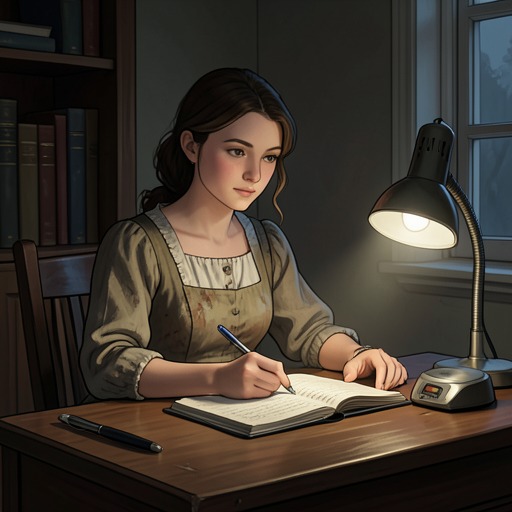
In her last year at Redmond, Anne and the other residents of Patty's Place settle into sustained study, each concentrating on her own subject. Anne works at English, but study sometimes leaves the young women discouraged and weary. One rainy November evening, she turns to old Story Club manuscripts, hoping to find something amusing. Their exaggerated tears and tragedies make them funny to her now, and reading them brings back the summers when the club wrote together at Avonlea, beneath spruce trees or among the ferns by a brook.
Among the papers she finds a sketch written on wrapping paper. Anne remembers that it began on the day she fell through the roof of the Cobb duckhouse on Tory Road. The remembered occasion links the manuscript to the untidy, inventive world of her childhood rather than to the formal work of college. Its form is a small dialogue among asters and sweet-peas, wild canaries in a lilac bush, and the garden's guardian spirit. After reading it closely, Anne sits looking into space; once Stella Maynard has left, she smooths out the crumpled pages. Her resolve to act follows this quiet rereading. The old work is not merely a keepsake: it is material she can reconsider and bring into a new stage of her life.
First Publication and Payment
Anne rewrites the old sketch and sends it to Youth's Friend. When a thin letter arrives among the mail for the other women at Patty's Place, nobody notices her flush as she takes it. A few minutes later, Philippa Gordon sees that Anne has been transformed by its contents. Anne reports that the magazine has accepted the sketch, which she sent about a fortnight earlier. The editor has enclosed a ten-dollar check and says that he would like to see more of her work.
The acceptance is especially striking to Anne because she had doubted that the piece could succeed without a plot. Her memory of the painful experience associated with Averil's Atonement informs that doubt, but this time the editor's response validates a different kind of writing: an old, imaginative sketch rather than a story built around the sort of plot she had thought necessary. The outcome gives her evidence, not just hope, that her work can find a reader beyond her circle of friends.
The payment also sharpens the distinction Anne makes between kinds of literary work. She jokes about spending the money on a reckless celebration, then contrasts this check with the payment for her Reliable Baking Powder story, which she regards as tainted. She had used that earlier money practically to buy clothes, yet disliked the clothes whenever she wore them. The new check is therefore both income and a source of pleasure less compromised by her feelings about the work that earned it. Philippa's excitement and Priscilla Grant's delight at having a real author in their house turn Anne's private achievement into a shared one, while Aunt Jamesina treats the distinction as a responsibility.
Achievement and Direction
Anne's first acceptance arrives in a year of sustained academic effort, not in place of it. After examinations, she takes High Honors in English; Priscilla Grant wins Honors in Classics, Philippa Gordon in Mathematics, and Stella Maynard earns a strong all-round record. Anne's achievement at Convocation shows that literary ambition and university study remain intertwined. Writing has begun to bring recognition and money, while her academic success confirms the seriousness with which she has pursued English.
The beginning of Anne's career is thus defined by a return and a revision. She finds the sketch among childhood papers, recognizes its value after rereading it, reshapes it for submission, and receives a response that invites her to continue. The magazine's request for more work does not establish the course of her future or remove the economic constraints surrounding her education. It does, however, change what she can reasonably imagine: the girl who once feared being insignificant at Redmond now has a published piece, payment for her work, and an editor waiting to read more.