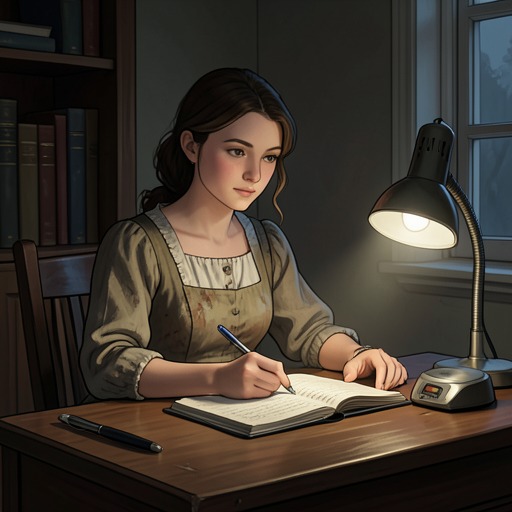
Anne Writes and Submits "Averil's Atonement"
Anne of the IslandAnne Shirley's attempt to write and publish Averil's Atonement turns an imaginative project into a first encounter with revision, criticism, and rejection. The story begins as a private creation shared with Diana Barry, becomes a manuscript repeatedly reshaped to satisfy an unsparing reader, and ends in a garret trunk after two magazines refuse it. Anne calls the effort the end of her literary ambitions, but Mr. Harrison's response makes the episode less a simple defeat than a debate over what, and whom, she should write.
The story takes shape
Anne first describes the project to Diana while the two are in a secluded hollow beside a brook. She has only a few pages written, but has already spent considerable time searching for a plot that fits her heroine. The name Averil feels so inseparable from the character that Anne cannot replace it; choosing names for the rest of her cast has also absorbed her, even keeping her awake. Her enthusiasm shows how seriously she takes the imagined people: their names and actions seem to belong to them, not merely to her plan.
That sense of independent character complicates the writing. Anne finds Averil difficult to manage, because the heroine says and does things Anne did not intend, forcing her to revise what came before. The difficulty is comic, but it also reveals the distance between an author's design and the story that takes shape on the page. Anne's eventual achievement is not a manuscript produced in one confident sweep, but one assembled through changes prompted by the characters she has imagined.
The story and its first readers
Once the manuscript is finished, Anne reads it to Diana in the seclusion of a porch gable. She watches Diana closely through the reading, hoping that the intended emotional effect will register. The story includes a pathetic scene that preserves Robert Ray, while Maurice Lennox, identified as the villain, is killed as punishment. Diana cries at the scene but is disappointed by Maurice's death and asks why he had to be killed. Anne defends the choice on the grounds that he was bad; their disagreement exposes the distance between her sense of plot justice and Diana's interest in what might have happened to him.
Diana nonetheless praises the story and predicts that it could make Anne famous. Her one specific objection is that Averil's cake-making seems insufficiently romantic because anyone might do it. Anne counters that the episode supplies humor and is among the story's best parts. The disagreement is revealing: Diana measures the heroine against romantic convention, while Anne values the ordinary domestic action as a source of comedy. The story's title, Averil's Atonement, reflects Anne's attention to sound as well as content; she chose it long before finishing the story because she liked its alliteration.
Criticism and revision
Mr. Harrison is a much more demanding reader. He objects first to the quantity of description and tells Anne to remove the flowery passages. Though she suspects he is right, she finds it painful to cut material she loves; it takes three rewritings to reduce the story to his satisfaction. She eventually retains only the sunset description, which she cannot bring herself to sacrifice. Mr. Harrison then challenges that surviving passage as irrelevant to the plot, and questions Anne's choice to set the story among wealthy city people, whose lives she does not know.
His criticism extends beyond setting and description to the characters' speech. In his view, they use overly elevated language: Perceval Dalrymple talks for two pages without allowing the girl a word. He argues that Anne's invented people do not speak like people in ordinary life. He also disputes her treatment of Maurice, suggesting that Averil could have reformed him rather than lose him to the story's punishment. The advice is blunt, but its particulars point toward a different method: write about familiar places and people, let them speak in everyday English, and do not make villains irredeemable by default.
Anne does not accept every suggestion. She resists moving the story to Avonlea, which she considers too dear to her to serve as a sufficiently romantic setting, even though Mr. Harrison insists that the place has had its romances and tragedies. She does accept his objections to the descriptions enough to make extensive cuts. The episode therefore shows revision as neither simple obedience nor effortless self-expression: Anne alters the manuscript repeatedly, preserves the sunset, and holds on to her judgment about what makes the story romantic.
Submission and rejection
Anne decides not to invite further criticism before trying to publish. She does not read the story to Gilbert Blythe, although she tells him about it, and says that he will see it if it succeeds but not if it fails. Marilla Cuthbert knows nothing of the venture. Anne instead imagines a future in which she reads a magazine story to Marilla, secures her praise, and then reveals that she wrote it. For now, the imagined recognition stays private.
Anne sends a long, bulky envelope to the biggest magazine she can think of, buoyed by what the narrative presents as youthful confidence and inexperience. Diana shares her excitement, expects a quick answer, and imagines Anne becoming famous. After a week of hopeful anticipation, the manuscript comes back. The editor gives no personal explanation, only a printed notice that it was not acceptable. Diana blames the magazine and urges Anne to try the Canadian Woman instead. Anne takes heart, agrees to submit it again, and decides to remove the sunset, accepting the particular criticism she had resisted.
The second magazine returns the story just as promptly. Diana suspects it was not read and threatens to cancel her subscription, but Anne responds with what she calls the calmness of despair. She locks the manuscript in the garret trunk where the old Story Club tales are kept, though she gives Diana a copy after yielding to her friend's entreaties. The trunk links this new disappointment to Anne's earlier imaginative writing, while the surviving copy means the story is not wholly withdrawn from others.
Discouragement and advice
Anne declares that her literary ambitions are finished and, when Mr. Harrison asks whether the story was accepted, answers briefly that it was not. He does not treat the rejection as a reason to stop. Instead, he advises her to write occasionally without pestering editors, drawing on people and places she knows, using ordinary speech, and allowing even a villain some decency. His counsel shifts the question from whether Anne can write to what habits might make her writing more convincing. It also answers the story's most conspicuous weaknesses as he sees them: an unfamiliar social setting, heightened dialogue, elaborate description, and a rigidly punitive villain.
Anne rejects the encouragement in the moment. She says that attempting the story was foolish and that after college she will teach, since she believes she can teach but cannot write fiction. Mr. Harrison replies by bringing up the prospect of marriage and criticizing his own delay in marrying. Anne marches home, irritated by his choice of words as well as his advice. Her response leaves no evidence that the submission immediately renews her confidence; the episode ends with her discouraged and angry. Yet the manuscript's completion, three rounds of revision, two submissions, and Mr. Harrison's concrete suggestions establish writing as a real practice in her life, not merely a daydream. The effort fails to secure publication, but it makes visible the tension between Anne's romantic imagination and the discipline of writing from observed life.