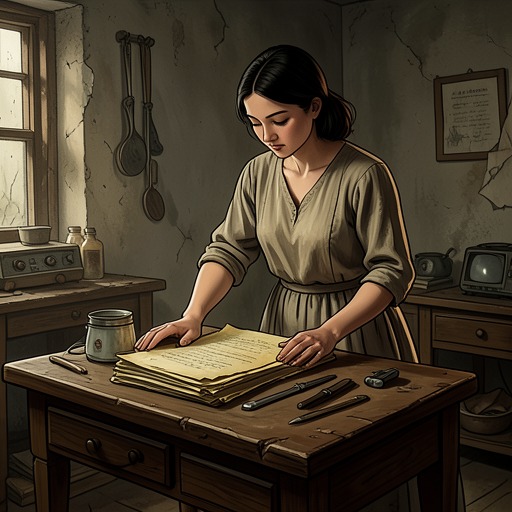
Anne's discovery of her parents' letters
Anne of the IslandAnne's discovery of her parents' letters is the emotional high point of her stay in Bolingbroke: a visit to the house where she was born leads to the recovery of a small family archive, and the lives behind her orphanhood become intimate rather than imagined. The letters do not restore her parents, but they give her words, gestures of affection, and a history she can claim as her own.
The birthplace and the east room
Anne turns into the gate of the little, shabby yellow house with Phil Gordon. Its appearance answers an old inward picture: there is no honeysuckle around the windows, but a lilac tree stands by the gate, and muslin curtains hang in the windows. Most important to her, the house is still painted yellow. The details matter because this is not simply a place to inspect; it is the setting Anne has long imagined as the beginning of her own life.
A very tall, thin woman opens the door. Anne identifies herself as the baby born there, and the woman recognizes a family resemblance. She says Anne has her father's complexion and red hair, but her mother's eyes and mouth. Her account also gives Anne fragments of her parents' lives beyond the house: her mother had been admired by the woman's daughter, who went to school with her; the couple were buried together, and the School Board had put up a tombstone in recognition of their faithful service. The woman remembers them as deeply in love and says that, although they did not live long, they were happy together.
Anne asks eagerly to see the whole house. The woman gives her permission and points out the arrangement: a parlor, two upstairs rooms, and the east room where Anne was born. She recalls that Anne's mother loved the sunrise and that the child was born just as the sun rose, its light falling on her face as her mother's first sight of her. In the small east room, Anne looks around reverently, thinking of her mother's hopes before the birth, the sunrise at that first meeting, and her mother's death. The room becomes a shrine to a life Anne never knew firsthand. Anne also notes that her mother was younger at her birth than Anne herself is now, making the lost generation feel close enough to compare with her own life.
The packet of letters
When Anne comes downstairs, the householder meets her in the hall with a dusty packet tied in faded blue ribbon. She had found it in an upstairs closet after moving into the house, had never examined it, and offers it because the address on the top letter names Miss Bertha Willis, Anne's mother's maiden name. The unlooked-at bundle is suddenly a family possession: Anne says she has nothing that belonged to her mother and receives the packet with gratitude.
Anne longs to read the letters, but first makes a pilgrimage alone to the green corner of the old Bolingbroke Cemetery where her parents are buried. She leaves the white flowers she has been carrying on their grave, then hastens back to Mount Holly, shuts herself in her room, and opens the bundle. There are twelve letters in all, some written by her father and some by her mother. They are yellow, faded, and blurred with age; the small number reflects that Walter and Bertha Shirley were seldom separated during their courtship. Their physical wear registers the passage of years, while their contents preserve what time had otherwise kept beyond Anne's reach.
A family made real through reading
The letters offer no grand wisdom. Their pages hold ordinary lines of love and trust, and the remembered tenderness of two young people who expected a shared future. Bertha Shirley's writing, as Anne encounters it, carries the writer's personality across the years. The letters feel intimate and sacred precisely because they preserve private affection rather than a formal account of the past.
The one Anne treasures most was written after her birth, when Bertha was briefly separated from her husband. It is filled with the proud young mother's reports about the baby: her cleverness, brightness, and many small sweetnesses. In its postscript Bertha says that she loves the child best when she is asleep and better still when she is awake. The passage gives Anne a direct trace of how her mother saw her, not merely a description passed along by someone who remembered the family. The narrative notes that this was probably the last sentence Bertha ever wrote; her death was near.
That night Anne tells Phil Gordon that the day has been the most beautiful of her life. She feels that she has found her father and mother because the letters have made them real to her; she no longer feels herself to be an orphan in the same way. She likens the discovery to opening a book and finding roses of yesterday, beloved and sweet, between its leaves. The image gathers the scene's tangible and emotional elements: the old letters are like pressed flowers, retaining the presence of a vanished time without undoing its loss.
Significance of the discovery
The event changes Anne's relation to her origins through a sequence of material encounters: the yellow house she had pictured, the east room associated with birth and death, the flowers placed at the grave, and finally the faded letters read in private. Each brings her nearer to parents previously known only through absence and imagination. The householder's memories supply family likenesses and public traces of her parents' lives; the letters supply something more inward, the parents' own expressions of affection.
The discovery does not erase bereavement. Anne knows from the woman that her parents died young, and the letter's postscript carries the poignancy of a mother writing shortly before the end of her life. What changes is the meaning of that loss for Anne: her parents are no longer only the missing figures at the beginning of her story. Their love for one another and for their baby survives in testimony she can hold and read. The episode therefore gives her a history as well as comfort, turning inherited silence into a remembered bond.