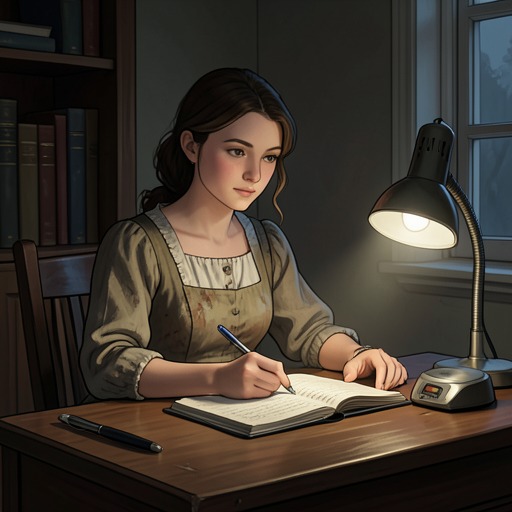
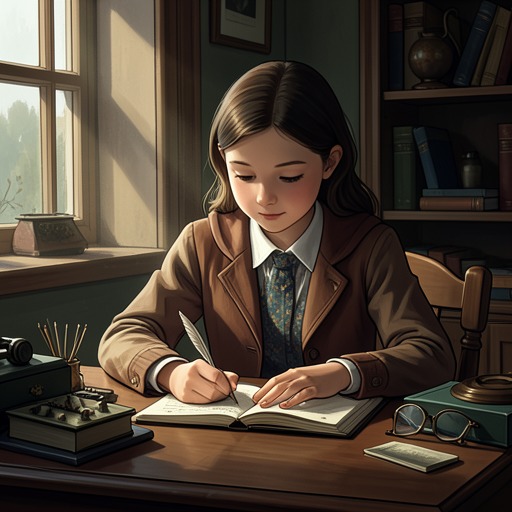
Anne's first accepted sketch
Anne of the IslandAnne Shirley’s first accepted sketch brings her a modest but consequential breakthrough: The Youth’s Friend accepts a piece she had nearly given up expecting anyone to want, pays her ten dollars, and asks to see more of her work. The scene makes the success tangible through an easily overlooked letter, then sets its pleasure against Anne’s memory of an earlier, commercially rewarded story she could not bear to wear, as it were, in the form of the clothes bought with its check.
The letter among the others
In Chapter 36, a batch of mail arrives for the women at Patty's Place. Phil Gordon announces letters bearing an Indian stamp for Aunt Jamesina, three for Stella, two for Priscilla, and a substantial letter from Jo for herself. Anne, by contrast, has received nothing but a circular—or so the first impression suggests. Phil tosses her a thin letter carelessly, and nobody notices Anne flush as she takes it. The contrast is small and domestic, but it shapes the reveal: Anne’s news is carried not in an impressive parcel or a letter anyone has been eagerly awaiting, but in the least promising piece of mail in the group.
A few minutes later, Phil looks up and sees that Anne has been transformed by what she has read. The physical change precedes the explanation; Phil’s affectionate question about what good thing has happened gives Anne the opening to share it. In the company of her friends, the private reading becomes a communal moment of recognition. Their attention shifts from the letters arriving for everyone else to the thin one that has made Anne’s face shine.
Acceptance and the work behind it
Anne reports that The Youth's Friend has accepted a little sketch she sent two weeks earlier. She tries to speak as if accepted work were an ordinary occurrence, but her effort does not quite succeed. That imperfect composure conveys how new the achievement is to her: she wants to meet success with a professional air, while the excitement of receiving it still shows.
The acceptance is not simply a favorable verdict on a freshly written piece. Anne explains that the sketch was an old one she found in her box, rewrote, and submitted. She had not truly expected it to be accepted because it had no plot. The circumstances make the outcome a reversal of her own estimate of the work: a piece she considered vulnerable on a basic matter of construction has nonetheless reached an editor. The evidence does not identify the sketch’s subject or describe the changes Anne made in rewriting it, but it does establish that the success followed both the recovery of an older draft and a deliberate act of revision.
The editor’s response extends beyond acceptance. The magazine sends a ten-dollar check, and the editor says he would like to see more of Anne’s work. Anne answers Phil’s questions about payment with pride and a promise of further writing: she will send more. The invitation matters alongside the money because it points beyond a single accepted piece; the exchange gives her encouragement to continue submitting her work, without establishing what she will write next or whether another piece will be accepted.
A check measured against an earlier one
Phil immediately turns the ten-dollar payment into a joke, suggesting that the group go uptown and get drunk. Anne takes up the spirit of the joke, declaring that she will squander the money in a wild, soulless revel of some sort. Her exaggerated plan makes the check a cause for celebration, but her next distinction gives the money a more personal significance: this is not, she says, tainted money.
By that she means the payment she once received for the Reliable Baking Powder story, which she calls horrible. She had spent that earlier check usefully on clothes, but hated the clothes every time she put them on. The contrast is pointed: sensible use did not make that money feel good, whereas the new payment seems to Anne free of the distaste associated with the story that earned the old one. Her joke about spending the new check recklessly therefore expresses more than a wish to celebrate. It marks a difference between being paid for work she despised and being rewarded for a sketch she is pleased to have sent, even though she had doubted its prospects.
A beginning shared with friends
Priscilla turns Anne’s news into a playful new identity for their household, imagining what it means to have a real, living author at Patty's Place. Aunt Jamesina calls that status a great responsibility with solemn comic seriousness. Their responses enlarge the occasion without making it grander than the evidence warrants: one accepted sketch has not yet made Anne an established writer, but the people around her treat the achievement as worth celebrating and as a reason to imagine what may follow.
The scene’s sequence—from the neglected thin letter, to Anne’s unhidden transformation, to the editor’s invitation and the friends’ teasing congratulations—makes recognition feel both accidental and earned. The sketch had been sitting in Anne’s box; she had rewritten it and risked submitting it despite expecting its lack of plot to count against it. Its acceptance answers that doubt with a check and an invitation, while the comparison with the hated baking-powder story lets Anne register the particular pleasure of this success. It is a first professional foothold, not a guarantee of a career, and the scene closes on Anne’s delight in having been recognized for work she can receive without the same regret.