Bolingbroke
Anne of the IslandBolingbroke is Philippa Gordon’s home and the place where Anne Shirley was born, making it more than a point of origin: it links two young women whose lives have taken them away from familiar surroundings, and gives Anne a rare chance to approach her family history through actual places and objects. For Philippa, Bolingbroke is a home where she is known; for Anne, it is the address of a past she can only partly recover.
Setting and Personal Identity
Philippa identifies herself as coming from Bolingbroke, Nova Scotia, when she meets Anne and Priscilla at Redmond. Anne immediately recognizes the name as the place of her birth. Their shared connection gives Philippa a sense of nearness to Anne, though Anne distinguishes birthplace from identity: she insists that being born in Bolingbroke has not made her a Nova Scotian, declaring her allegiance to the Island. The exchange establishes a telling contrast. Bolingbroke is part of Anne’s earliest history, but not the home she claims; it is Philippa’s home, and the source of the local belonging she misses after leaving.
That distinction also makes Bolingbroke a meeting point between different kinds of attachment. Anne knows the town first as a fact about her birth, while Philippa knows it as the place where her social identity and daily life are established. Their discovery of the connection quickly changes the tone between them: Philippa welcomes the idea of being Anne’s neighbor and treats the shared birthplace as a reason that confidences will feel less like disclosures to a stranger.
Philippa’s Home and Homesickness
The contrast between Bolingbroke and Kingsport emerges through Philippa’s account of her first days away. In Bolingbroke, she says, she is an important personage; in Kingsport, she feels like nobody. She has arrived there only recently and is already intensely homesick. Her loneliness is made concrete by the boardinghouse: the room looks onto an ugly, bleak back yard, and the nighttime cats there are a far cry from the comfortable cats she imagines before friendly fires. On her first night, she cries through the night, as do the cats, and wakes with a conspicuously swollen nose. Bolingbroke is not described through a catalogue of streets or buildings; its importance is registered in the sharp difference between being known at home and feeling anonymous elsewhere.
Philippa’s homesickness does not prevent her from making a connection in Kingsport. Anne and Priscilla live nearby, and Philippa is pleased to learn that they are within easy reach. The shared origin offers her a small bridge between her established life in Bolingbroke and the unfamiliar city where she has not yet found her footing. Her talkative, indecisive manner supplies comedy, but the emotional point is plain: leaving home has cost her the ordinary recognition that made her feel important.
Anne’s Return to Her Birthplace
Anne’s later visit to Bolingbroke with Philippa turns that shared origin into a physical journey. During a fortnight at Mount Holly, the beautiful old Gordon homestead, Anne has plenty to distract her: Philippa’s friends fill the house, and drives, dances, picnics, and boating parties follow one another in a busy succession. Yet the visit’s deepest significance lies elsewhere. Anne and Philippa go to the little, shabby yellow house in an out-of-the-way street where Anne was born, a place Anne has often imagined without ever seeing.
The house is close enough to her imagined version to move her: it remains yellow, has muslin curtains in its windows, and a lilac tree beside the gate, though it lacks the honeysuckle she had pictured. These particulars matter because Anne’s imaginative life has long supplied pictures of a past she could not verify. Here, memory-by-imagination meets the resistant details of a real dwelling. The house is small and unprepossessing, but Anne asks eagerly to see all of it. The woman who lives there permits her to look around and identifies the east room as the room of her birth.
The woman also recounts what Anne cannot remember: her mother loved the sunrise, and Anne was born as the sun was rising, with its light falling on her face as the first thing her mother saw. Anne climbs the narrow stairs and stands in the little east room. She imagines it as the place where her mother anticipated becoming a parent, where the sunrise marked Anne’s birth, and where her mother died. The room becomes a private shrine, not because it has been transformed, but because ordinary features of the house now carry the weight of family history. Anne reflects that her mother was younger than she is now when Anne was born, measuring the distance between the dead woman’s brief life and her own approaching adulthood.
The Cemetery and the Family Letters
Before leaving Bolingbroke, Anne makes a solitary visit to the old Bolingbroke Cemetery, where her parents are buried. She lays the white flowers she has carried on their grave. The gesture follows her visit to the birth house: first she enters the room associated with her mother’s life and death, then she goes to the place where both parents lie. The two stops give her journey a quiet progression from recovered beginnings to acknowledged loss.
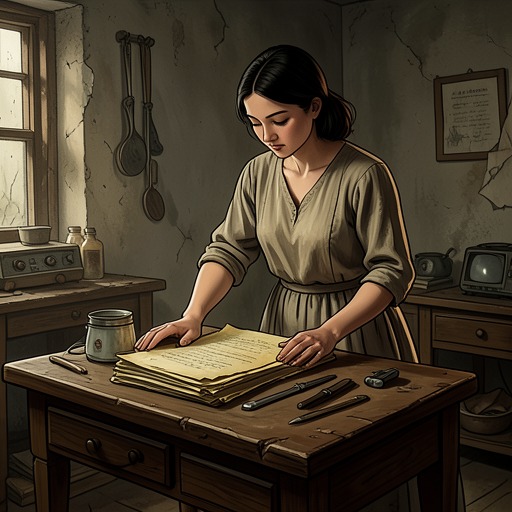
A woman from the house has also given Anne a small, dusty packet tied with faded blue ribbon. Anne has no possession that belonged to her mother, so the letters are especially precious to her. There are only twelve, some written by her father and some by her mother; the couple had seldom been separated during their courtship. Yellowed and dim with age, the pages contain no grand declarations of wisdom, but they preserve lines of affection and trust. Their value lies in the traces of their writers’ personalities and in the intimacy that survives the years.
The letter Anne cherishes most was written by her mother after Anne’s birth, during a brief separation from her husband. It describes the baby’s brightness and sweetness, and ends with Bertha’s expression of loving her daughter both asleep and awake. The passage makes the visit to Bolingbroke more than a return to a building or a grave. The house supplies the setting of Anne’s beginning; the letters give her evidence of how warmly that beginning was received. By reading them in private after her cemetery visit, she can connect the child her mother described to the young woman she has become.
Narrative Significance
Bolingbroke’s significance rests on its different meanings for Philippa and Anne. Philippa’s departure shows the emotional cost of losing the familiarity and recognition of home, while Anne’s return shows how a birthplace can remain emotionally distant until its spaces and surviving objects make it tangible. The town thus joins a present friendship to a recovered past without making the two women’s attachments identical: Philippa belongs to Bolingbroke through lived experience, whereas Anne approaches it through a house, a grave, and a small bundle of letters.
The contrast also gives the location a role in Anne’s understanding of belonging. She does not exchange her Island identity for the place where she was born. Instead, Bolingbroke adds something different: a room at sunrise, a mother’s remembered words, and the knowledge that she was loved before she could remember being loved. Its importance is not that Anne moves back or claims it as home, but that she can finally place part of her own story there.