Cats
Anne of the IslandCats give Patty's Place much of its domestic warmth and its comic disorder. Rusty, Joseph, and The Sarah-cat each enter the household with a distinct history and temperament; their struggles over shelter and rank eventually give way to an unlikely peace. Their changing fortunes also draw out Anne's compassion and Aunt Jamesina's practical, tolerant view of how creatures must learn to live together.
A Household of Cats
Three weeks after the friends considered themselves settled at Patty's Place, the house gathered its people and animals in the big living room at twilight. Anne Shirley, Priscilla Grant, Phil Gordon, Stella Maynard, and Aunt Jamesina were there with Rusty, Joseph, The Sarah-cat, Gog and Magog. Firelight moved over the walls, cats purred, and a bowl of chrysanthemums sent to Phil by one of the people she had helped cheerfully filled the room. The cats belong to the scene's picture of a home already made: its comfort is not separate from its animal inhabitants, but is heard in their purring and seen in their shared occupation of the rooms.
The household's harmony is not immediate. When Aunt Jamesina arrives, she brings two cats, and Rusty's existing claim on the house becomes a test of how far the new residents can accommodate one another. The human occupants have been organizing their establishment and adjusting their differing opinions; the cats undergo a parallel, more physical negotiation of space, authority, and companionship.
Rusty's Rescue and Adoption
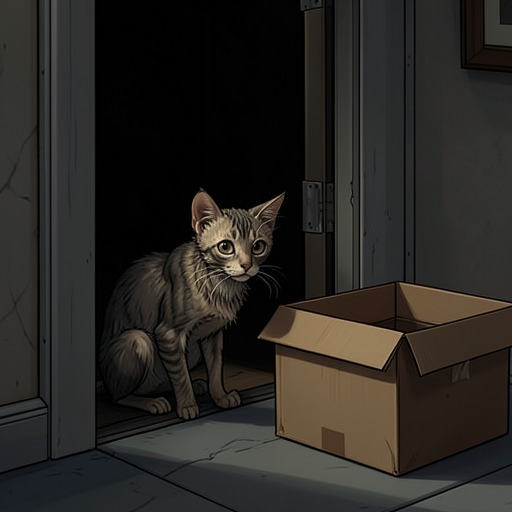
Before Aunt Jamesina's arrival, the housemates find Rusty difficult to place. Anne has him fed and put outside, but he stays on the doorstep and slips back in whenever the door opens. The others feed him too, and over the following week his eye and cheek recover, he grows less thin, and he begins washing his face. His attachment is already clear: he takes little notice of anyone but Anne. Yet the household expects another cat soon and fears that Rusty, a fighter by nature, will attack it.
The proposed solution is chloroform. When the plan is carried out, Rusty eats breakfast, licks his chops, and climbs into Anne's lap. His trust in her turns a proposed act of mercy into a moral crisis for her: she cannot accept being party to his destruction, and hurriedly hands him to Phil before fleeing. When Rusty survives, Anne ends the uncertainty by declaring him her cat and insisting the others make the best of it. The decision changes him from a troublesome stray whom the household intends to remove into a permanent member of the family.
Rusty thrives in that new status. He sleeps on a scrubbing cushion on the back porch and is well fed; by the time Aunt Jamesina arrives, he is plump, glossy, and more respectable in appearance. His nature, however, remains fiercely independent. He loves Anne alone, resists other people's attempts to stroke him, and fights the cats of Spofford Avenue one by one. His story is not a transformation into a mild pet: the household accepts him without requiring him to become sociable on human terms.
The Sarah-cat, Joseph, and a Change in Rank
Aunt Jamesina brings The Sarah-cat and Joseph in separate express boxes. The Sarah-cat, given to Aunt Jamesina by her washerwoman, is eight years old, a skilled mouser, and a large, sleek gray-and-white animal whose dignity is undiminished by her humble origin. Aunt Jamesina says she never fights. Joseph has been entrusted to her by a dear friend who moved to Vancouver and could not take him along. His many-colored coat—white legs spotted with black, a gray back patched with yellow and black, a yellow tail tipped with gray, and mismatched ears—makes him strikingly ragged in appearance. His disposition is meek and sociable. He is also content to be fed and cushioned rather than to catch mice.
Rusty's first encounter with The Sarah-cat immediately overturns his expectation that he can rule the newcomers. He rushes at her with his fur raised and his tail expanded; she knocks him rolling with one sweep of her paw, then calmly resumes washing her face. Rusty does not challenge her again. Joseph is a different matter. When he sits up and yawns, Rusty attacks, and the two fight repeatedly. Anne takes Rusty's side and detests Joseph, while Stella despairs and Aunt Jamesina laughs, expecting the rivals to work out their differences. Eventually they do: the former enemies share a cushion, curl their paws around each other, and wash one another's faces. The Sarah-cat remains the household's unchallenged authority, while Joseph and Rusty turn their rivalry into friendship.
Coexistence and Domestic Meaning
The cats' settlement gives concrete form to Aunt Jamesina's tolerance. She does not expect her young housemates to be supervised into good behavior, and she is equally unwilling to treat every conflict among animals as a reason for destruction. She maintains that a grown cat should not be killed, except in the case of one that sucks eggs; she also recognizes that Joseph needs exercise and Rusty must learn he is not the only cat in the world. Her response is neither to deny their hostility nor to force instant affection, but to allow time for their relationship to change.
That change recurs in the household after Anne returns to Green Gables. In a letter during cold weather, Aunt Jamesina reports letting the cats sleep indoors: Rusty and Joseph on the living-room sofa, The Sarah-cat at the foot of her bed. Her account makes the animals part of her own sense of company. The Sarah-cat's purring comforts her when she wakes at night and worries about her daughter in India, where she fears the snakes. The same cats who once threatened the peace of the shared house have become companions whose ordinary presence helps sustain a person living alone.
The cats also mark the difference between professed competence and experience. Phil had briskly assured the others that she could manage the chloroforming, but Anne later teases her about that confidence; Phil protests that the knothole was to blame. By the time the friends reflect that everyone has grown used to one another, Phil has also learned to wash dishes and sweep a floor. The animals' arrival and adjustment thus belong to a broader domestic experiment: people, like cats, have to negotiate shared life rather than simply assume they already know how.