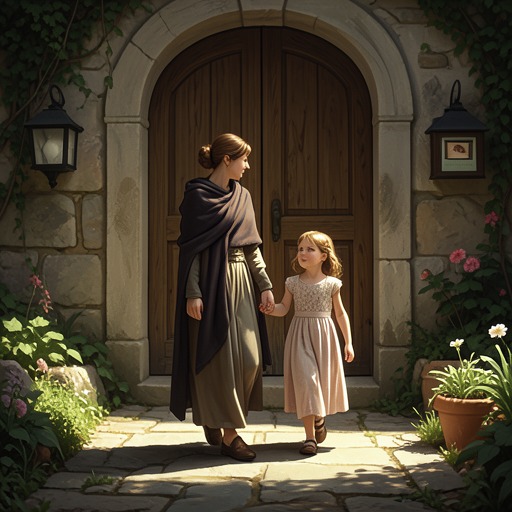
Diana and Fred Wright Marry
Anne of the IslandDiana Barry and Fred Wright’s wedding turns a childhood fantasy into a real ceremony, while showing that marriage need not mean the end of Diana’s friendship with Anne Shirley. Anne helps prepare Diana as her bridesmaid, honoring a sentimental compact made years before. The wedding also brings Anne and Gilbert Blythe together again after they left Kingsport, and the evening’s festivities restore some of their former ease with one another.
Preparation and the old promise
The preparations take place at Orchard Slope, in the westward-looking gable where Anne ties white ribbon around Diana’s bouquet. Pink roses, Anne says, are the only real roses: they stand for love and faith. Her choice gives the bridal flowers a meaning that reaches beyond decoration, joining the day’s romantic promise to the loyalty that has shaped her friendship with Diana.
Diana stands nervously in bridal white, her black curls veiled in white. Anne has arranged the veil in keeping with their sentimental compact from childhood, when they imagined Diana’s wedding and Anne’s role in it. The old picture has come true in outline: Diana is the bride, Anne her bridesmaid, and the veil is in place. Yet the scene is not quite the melodrama Anne once imagined. She recalls that she used to weep at the prospect of Diana’s inevitable marriage and their supposed parting; now she can laugh at the memory. She has neither the puffed sleeves of her youthful bridal fantasy nor a breaking heart, and she does not hate Fred.
The exchange makes the change in their expectations visible without diminishing their affection. Anne can tease Diana about the ceremony and encourage her to be brave, but when Diana is called downstairs, she asks for one last kiss as Diana Barry. Diana answers that her new married life will not erase the friendship: she will still be there as Diana Wright. The moment carries the tender unease of a threshold, but the two friends meet it with intimacy rather than a farewell in earnest.
Ceremony and celebration
Following the simple, old-fashioned custom of the time, Anne goes down to the parlor on Gilbert’s arm. She and Gilbert meet at the top of the stairs for the first time since they left Kingsport; he has arrived that day. He greets her courteously. Anne notices that he looks well, though rather thin, and that a flush has come to his cheek as she approaches in her soft white dress, lilies-of-the-valley shining in her hair. As they enter the crowded parlor together, their appearance draws a murmur of admiration from the guests.
Fred enters alone, red-faced, before Diana makes her entrance on her father’s arm. The ceremony proceeds without Diana fainting or any other untoward interruption. Its simplicity matters: the wedding is not staged as a crisis or spectacle, but as a familiar social rite surrounded by family and friends. Feasting and merry-making follow, carrying the occasion from formal vows into shared celebration.
As evening wanes, Fred and Diana drive through the moonlight to their new home. Anne walks with Gilbert back toward Green Gables. The departures make the day’s change concrete: Diana begins a household with Fred, while Anne returns to the place that remains home for her. But the scene does not present those paths as a severing of every old tie. Diana’s assurance that she and Anne will continue to love each other remains part of the wedding’s emotional meaning.
Friendship through change
Anne recognizes that marriage will alter the shape of her friendship with Diana. She expects Diana to have other interests and fears that she herself may be left on the outside; she also knows that things cannot remain quite as they were. Yet the wedding supplies a counterweight to that apprehension. The friends have kept their childhood oath faithfully, without quarrels, coolness, or unkind words, and Diana insists that the bond can endure her marriage. Their exchange holds both truths at once: affection persists, while the daily terms of friendship may change.
The scene also reverses Anne’s earlier idea of what Diana’s wedding would mean. The childhood version anticipated heartbreak and parting; the adult occasion makes room for affection toward Fred and for Anne’s own participation in Diana’s happiness. The change is not that Anne stops feeling the passage of time, but that she can accompany her friend into a new life without treating that life as a betrayal of their shared past.
Gilbert’s return and the evening’s aftermath
During the informal mirth after the ceremony, something of Anne and Gilbert’s old comradeship returns. Anne is glad to walk again along the familiar road with him. When they cross the bridge over Lake of Shining Waters, Gilbert asks to take a ramble up Lover’s Lane, and Anne readily agrees. In the moonlight the lane seems transformed into a fairyland, but the walk is no longer dangerous in the way it once might have been: Roy Gardner and Christine Stuart have made it safe. Anne thinks about Christine as she talks with Gilbert. She has met Christine several times and found her sweet, but their cordial acquaintance has not grown into friendship; Christine is not a kindred spirit.
Their conversation turns to Anne’s plans. She will not stay in Avonlea for the summer: she is going east to Valley Road to substitute for Esther Haythorne, who is unwell. Anne admits that she is beginning to feel like a stranger in Avonlea, where children have grown into young adults and now occupy places once filled by her and Gilbert’s group. The wedding, then, is set against more than Diana’s transition into marriage. It gathers Anne’s sense of changing friendships, changing generations, and a home that no longer feels quite as it did.
Gilbert answers Anne’s reflection on change with a practical acknowledgment that the world keeps moving. She wonders whether he is thinking of Christine, and the thought that Avonlea will be lonely without Diana sharpens her awareness of what the wedding has altered. Yet the walk itself offers a modest renewal: Diana has gone to her new home, while Anne and Gilbert have recovered a measure of companionship on a road they know well. The wedding’s significance lies in that balance—an ending to one version of life together, but not the destruction of friendship or the possibility of renewed closeness.