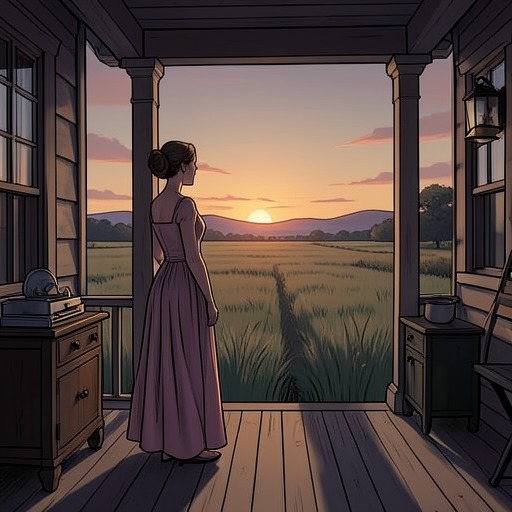
Home and a sense of belonging
Anne of the IslandHome and a sense of belonging gives shape to Anne Shirley’s departure, her adjustment to college life, and her return to Green Gables. The novel treats home as more than a cherished landscape: it is a set of attachments built from remembered places, daily intimacies, and the people whose love remains present across distance. Leaving Avonlea tests those ties; returning reveals how powerfully they endure.
Home as a remembered landscape
For Anne, the beauty of a new place cannot be measured apart from the place she already calls home. As she and Gilbert Blythe look around Avonlea, she wonders whether Kingsport can be more beautiful than the scene before them. The question makes belonging a matter of feeling as well as scenery: home seems loveliest because memory and affection have made it so. The prospect of distant lands does not cancel that attachment.
The landscape around Green Gables is densely personal. Anne’s memories gather around the little white porch room, the Snow Queen at the window, the brook in the hollow, Dryad’s Bubble, Haunted Wood, and Lover’s Lane. These are not interchangeable examples of picturesque countryside. Each spot holds the accumulated meaning of her earlier life, so that the thought of leaving turns familiar geography into a record of growing up. The old pond, too, carries shared memory: Anne and Gilbert stand beside it at dusk, at the place where she once climbed from her sinking boat while playing Elaine. The landscape makes past experience physically present as she faces a future elsewhere.
Departure and the fear of losing home
When Anne leaves Avonlea for Redmond, the weather seems to answer her reluctance. After an ominous east wind in the night, she wakes to rain on the window, a gray pond, and hills and sea hidden by mist. The dreary morning gives visible form to a loss she cannot readily put into words. She struggles against tears as she leaves the home she loves, with the sense that this departure may be final except for holiday visits.
What troubles her is not simply distance. Anne understands that coming back for vacations will not mean living at Green Gables as before: things will not be the same. The thought places growing up in tension with belonging. The little room over the porch, once sacred to her girlhood dreams, and the familiar paths and woods are still there, but her relation to them is changing. Her question about whether she can ever be happy elsewhere arises from that change, not from a belief that she is incapable of building a new life.
The farewells at Green Gables show how many people are caught up in her leaving. Davy Keith cries over his breakfast and later hides rather than say goodbye; Dora Keith manages her sadness more quietly. Diana Barry drives Anne to the station, while Rachel Lynde embraces her and advises her to take care of her health. Marilla Cuthbert appears brusque and tearless, but her eyes disclose the feeling her manner conceals. The contrasting responses make the household’s attachment legible: grief may be noisy, restrained, or nearly invisible, but departure matters to them all.
Distance, letters, and continuing attachment
At Redmond, Anne’s first weeks in Kingsport are not immediately made comfortable by college success. Her studies are easy in part because of the steady work she and Gilbert Blythe did in Avonlea, and she enjoys the social life available to her. Yet the happiest moments of her week are the arrivals of letters from home. Before the first letters come, Avonlea seems thousands of miles away; the correspondence brings it near and links the old life to the new.
The letters do not erase separation by making everything unchanged. Instead, they make the two parts of Anne’s life feel connected rather than hopelessly divided. The first batch includes letters from Jane Andrews, Ruby Gillis, Diana Barry, Marilla Cuthbert, Rachel Lynde, and Davy Keith. Their contents vary in significance and tone: Jane writes carefully about lace, the weather, a dress, and headaches, while Ruby reports that Anne is missed and asks about the young men at Redmond. The ordinary details themselves matter. Home reaches Anne not only through declarations of affection but through the particular news and habits of the people who remain there.
Return and the meaning of belonging
Anne’s account to Philippa Gordon of the homecoming she prefers to a possible social triumph in Bolingbroke gathers belonging into concrete particulars. She imagines the old farmhouse, faded among leafless apple orchards, the brook, the December fir wood, and the gray pond. She pictures the two older women in the house and the twins, including the mischievous Davy Keith. She also anticipates the small room over the porch and the feather bed, details that make home a lived domestic place rather than an abstract ideal.
Her description identifies love as the element that transforms the scene. The farmhouse may be old, the colors subdued, and the setting less dazzling than the social success Philippa imagines; what matters is the faithful affection waiting there. On arriving, Anne finds that affection embodied in a bonfire made for her by Davy, Dora Keith holding her hand, and Marilla Cuthbert waiting in the doorway. Marilla chooses the shadows because she fears that joy will make her cry, while Rachel Lynde stands behind her. At supper, the family and friends gather around a laden table, the rosebud tea set returns, and Diana stays the night. The welcome makes the home Anne imagined tangible again.
Narrative significance
The movement from departure to return gives the theme its central contrast: leaving is painful because home is precious, but distance also reveals that belonging can survive a change in residence. Anne’s college life does not displace Avonlea; letters let the two lives touch, and the eventual homecoming confirms that old ties remain a source of strength. At the same time, the novel does not pretend that return reverses time. Anne has grown, and a holiday homecoming is not the same as never having left.
Home therefore includes both place and relationship. Green Gables matters through its rooms, paths, pond, and orchard, but also through the people who make those places welcoming. The scenes of departure and reunion give emotional weight to ordinary gestures—a hidden child, a restrained greeting, a hand held, a familiar table. Belonging is shown as something remembered across absence and renewed through affection, even as the lives connected to it continue to change.