Imagination and the world of fairy tales
Anne of the IslandImagination and the world of fairy tales appear in two intimate lessons through which Anne Shirley both kindles wonder and names its loss. She gives Davy Keith a poetic answer to the mystery of an echo, while later explaining to Paul Irving that the enchanted companions of his childhood have not changed: he has grown beyond their world. In these scenes, fantasy is neither simply a mistake nor an escape from reality. It is a way of meeting the unknown—and a world that growing up gradually makes harder to inhabit.
The Echo as a Fairy-Tale Figure
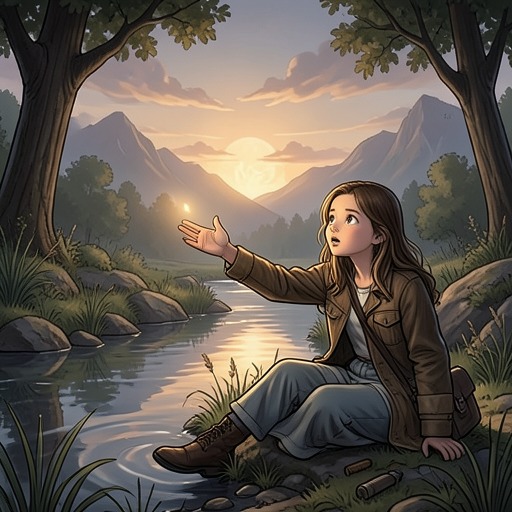
Davy has been fishing and chasing a cat, hunting for eggs, and shouting into the bush behind the Boulter barn, where he has heard a great echo. His question to Anne is direct: what is an echo? Instead of giving him a factual explanation, she imagines Echo as a beautiful nymph living in distant woods and laughing among the hills. Her description gives the voice a body without making that body available to sight: Echo has dark hair and eyes, snow-white neck and arms, and the speed of a deer, but no mortal can see her. People can hear her call at night or laugh beneath the stars; if they pursue her, she is always just beyond the next hill.
The tale follows the experience Davy wants explained. A voice answers from the bush, yet its source remains unseen; Anne turns that distance into the nymph’s elusiveness. The hills, night, stars, and imagined pursuit give a familiar sound the scale and atmosphere of a fairy story. The answer does not yet explain the physical cause of the echo. Instead, it offers Davy a vivid way to imagine what he has heard, making mystery itself the occasion for storytelling.
Wonder, Belief, and Truth
Davy does not accept the account without question. Staring at Anne, he asks whether it is true or a whopper. His suspicion exposes the difference between a fairy tale and a lie, a distinction Anne insists he ought to recognize. Her invention is openly imaginative, but Davy is still trying to determine whether she means it as fact. The exchange thus makes the boundary between make-believe and falsehood part of the scene, rather than treating a child’s credulity as an uncomplicated source of amusement.
When Davy presses again about what answers from the bush, Anne postpones a full explanation until he is older. The ordinary phenomenon remains unanswered within this conversation, even as her nymph story gives it emotional and imaginative shape. That delay preserves the echo’s mystery for the moment, but it also marks a limit: Anne’s fable is not presented as the literal account Davy is seeking. Imagination can accompany an explanation without being identical to one.
Paul’s Return from the Shore
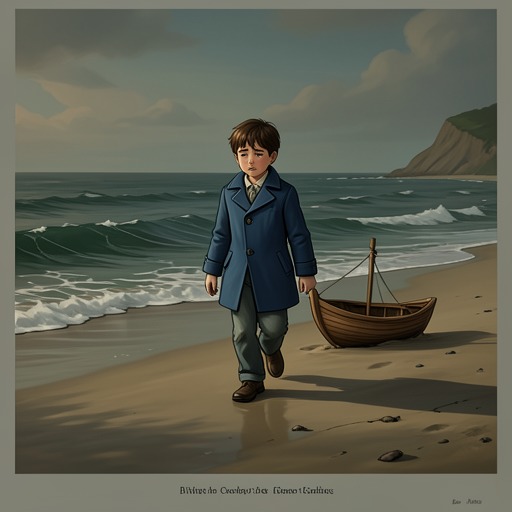
Paul’s experience shows what happens when a child’s imagined world no longer seems to match what he finds. During his first fortnight with his grandmother in Avonlea, Anne is there to meet him. He is eager to reach the shore, expecting Nora, the Golden Lady, and the Twin Sailors to be waiting. He can hardly wait to finish supper, imagining Nora’s elfin face peering around the point. Yet he returns from the shore at twilight sober rather than delighted: the Twin Sailors and the Golden Lady have not appeared, and although Nora was there, he feels she is changed.
Anne offers a reversal. It is Paul, she says, who has changed: he has grown too old for the Rock People, who choose children as playfellows. She foretells that the Twin Sailors will no longer come in their pearly, enchanted boat with a sail of moonshine, and that the Golden Lady will no longer play her golden harp for him. Even Nora, she warns, will not meet him much longer. The change is not described as a discovery that Paul’s childhood companions were once real and have now vanished; rather, Anne frames it as the loss of his ability to share their fairyland. His disappointment is real, but the explanation locates the turning point in growing up.
Growing Up and Leaving Fairyland
Paul’s disappointment makes the imaginative world more than a decorative game: it is something childhood can inhabit, and maturity can leave behind. Anne calls that departure the penalty of growing up. Her account joins a concrete absence at the shore—the missing Twin Sailors and Golden Lady—to a larger change in Paul’s relation to the world. The figures that once belonged to his eager expectation no longer meet him in the same way, and Anne presents the loss as part of becoming older rather than as a failure of the figures to keep faith.
The contrast with Davy’s conversation is telling. Davy hears an unexplained sound and asks what it is; Anne supplies a story, while acknowledging that he cannot yet be given the full explanation. Paul, by contrast, arrives with an established world of imagined companions and finds that it no longer answers his expectation. In one scene, fantasy opens a space around what remains mysterious; in the other, Anne uses fairy-tale imagery to describe the closing of a childhood space. Mrs. Irving dismisses Anne and Paul’s talk as foolishness, while Anne answers that becoming wise is a pity because it makes people less interesting. That exchange keeps the scenes from treating maturity as pure gain: knowledge may clarify the world, but the fairyland it displaces has its own value.