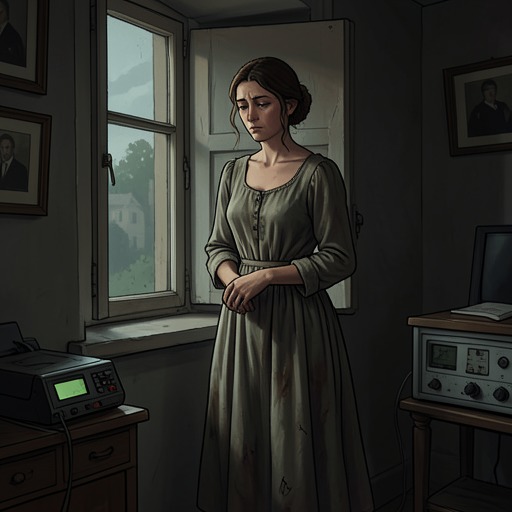
Janet Sweet's twenty-year wait for John Douglas
Anne of the IslandJanet Sweet’s twenty-year wait for John Douglas turns an apparently stalled courtship into a story of concealed obligation, prolonged misunderstanding, and hard-won forgiveness. For years, John’s visits offer Janet the constancy of a relationship without the assurance of marriage. She does not know that his silence is bound to a promise to his mother, and she would rather endure the uncertainty than give up the man she loves. The eventual explanation changes the meaning of those years, but it does not undo the hurt they caused.
A Courtship Without a Proposal
When Janet turns forty, she finally tells Anne Shirley what she has kept private: John has been coming to see her for twenty years but has never asked her to marry him. Her birthday sharpens the ache of the delay. Anne tries to comfort her, but Janet rejects the suggestion that John simply needs more time; in her view, he has already had twenty years to speak.
The courtship began before Janet’s mother died. As John continued to visit, Janet began making quilts and other things in preparation for a future she assumed might arrive. After eight years, her mother died. John was kind and helpful to Janet when she was left alone, but he still did not propose. His care could be read as evidence of attachment, yet without an explanation for his silence it could not give Janet the certainty she needed.
The long delay also exposes Janet to other people’s judgments. Some believe she herself is refusing John because his mother is chronically ill and Janet does not want the burden of caring for her. Janet says she would have loved to wait on John’s mother. She lets the false explanation stand because she would rather be blamed for refusing than pitied for being passed over. The concealment protects her pride in public, while leaving her privately unable to understand why the man she loves will not ask her.
Love, Patience, and the Limits of Anne’s Advice
Anne urges Janet to show more spirit and asks why she has not sent John away. Janet cannot do so: she has always been deeply fond of him, and she has never wanted anyone else. In her calculation, his continued visits are better than losing him, even though that arrangement leaves the central question unanswered. Anne believes that making him face the possibility of losing her might have forced a proposal; Janet’s attachment has instead kept her within the uncertain courtship.
The novel places Janet’s experience beside other ways of thinking about marriage. Philippa Gordon treats marriage as a choice to postpone while she enjoys college life, and speaks openly of wealth, appearance, and the difficulty of choosing between suitors she does not love. Amelia Skinner, recalling her own courtship, describes choosing the poorer Thomas because she loved him rather than the wealthier William Obadiah. Janet’s story turns on a different imbalance: she has made her choice, but the reason John cannot make his remains hidden from her. These contrasts distinguish practical calculations about a match from the emotional cost of being kept in uncertainty.
The Secret Behind the Silence
The explanation comes after John’s mother’s funeral. At sunset, as Janet and Anne sit on the porch steps, John enters the garden and walks straight across a bed of geraniums to ask Janet to marry him. His abrupt proposal seems to release words held back for years. Janet’s first response is not a simple acceptance: she asks why he did not ask sooner.
John explains that, nineteen years earlier, his mother suffered a severe illness and was thought unlikely to live. She made him promise not to marry while she was alive. He says she feared having any other woman in the household during her lifetime, and that she warned him he would be responsible for her death if he refused. Although the doctor had given her only six months, she recovered and continued to hold him to the promise. John says he had begged her to release him, but she would not; she also swore him on the Bible to tell no one. Thus the secret that might have explained his conduct to Janet became another obligation he was forbidden to disclose.
John’s account revises the apparent meaning of his visits. He had not stayed away from marriage because he lacked affection for Janet: he says he suffered through the years and had come to ask as soon as he could. But the promise explains his silence without erasing its consequences. Janet had endured the humiliation of believing that John might never choose her, while he believed himself bound to secrecy. The story’s delayed disclosure makes their separate suffering visible at once, after the death that finally removes the obstacle.
Resolution and Forgiveness
Janet asks why John did not tell her, and learns that the prohibition on speaking was part of the promise itself. She agrees to marry him, and they plan a quiet wedding for the following month. Janet anticipates that people may say she hurried to marry John as soon as his mother was gone. John wants the truth known, but Janet persuades him to keep the secret and refuses to let public gossip cast a shadow on his mother’s memory. Now that she knows the reason, she says, other people’s judgments no longer matter to her.
Anne reacts more harshly, calling the dead mother cruel and deceitful. Janet stops her: the woman is dead, and Janet will not speak ill of her. She also tells Anne that forgiveness comes more easily with age, contrasting her own outlook at forty with what Anne might feel at twenty. That response completes the change in Janet’s position. She moves from silently bearing a story others misunderstand to knowing the truth and choosing what to do with it. The account confirms their engagement and imminent wedding, not the wedding itself; its resolution lies in the recovered explanation, Janet’s acceptance of John, and her decision to keep the painful secret buried with the dead.