Love and courtship
Anne of the IslandLove and courtship in Anne Shirley’s story emerge through contrasts between affection and marriage, romantic fantasy and ordinary behavior, and a cherished friendship unsettled by new feeling. The narrative does not treat a proposal as proof of love: Anne’s response depends on the person, the manner of approach, and the meanings she has already attached to romance. Gilbert Blythe’s touch awakens a feeling she cannot comfortably name, while proposals from Billy Andrews and Charlie Sloane fall far short of the beautiful experience she had imagined.
Friendship at the Edge of Romance
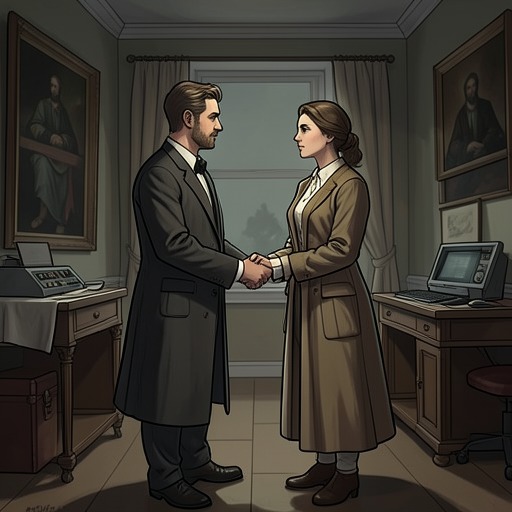
At a bridge in the dusk, Gilbert lays his hand over Anne’s as she stands beside him. The gesture appears to be the beginning of a declaration, but Anne snatches her hand away and abruptly says she must return home. She fills the walk back to Green Gables with ceaseless, inconsequential chatter, leaving Gilbert little chance to speak. Her haste restores the surface of their old companionship, but not its former ease: since a revealing moment in the garden of Echo Lodge, Anne has felt a new self-consciousness that seems to threaten the school-day friendship she wants to preserve.
Anne tells herself that Gilbert’s romantic interest is nonsense and that boys ought to be sensible. Yet the bodily memory of his hand remains with her, and she recognizes that its warmth was not unpleasant. That response sharply differs from her recollection of Charlie Sloane’s similar gesture at a White Sands party three nights earlier, which had made her shiver with distaste. The contrast suggests that Anne’s resistance to courtship is not a general rejection of intimacy. Her feelings are particular, though she has not yet reconciled them with her own insistence that Gilbert remain only a friend.
The strain eases when Anne invites Gilbert to pretend that they are children again and walk as the wind goes. She is especially kind after the previous evening, and Gilbert, learning restraint, returns to the role of schoolboy comrade rather than pressing his feelings. Watching from the kitchen window, Rachel Lynde confidently predicts that the pair will match someday. Marilla Cuthbert privately hopes for the same outcome but dislikes having the possibility turned into gossip; she answers that they are still children. Their different reactions frame courtship as both a private emotional development and a subject others are ready to interpret before Anne herself can do so.
The Proposal Anne Did Not Imagine
Anne’s first proposal reaches her indirectly. Jane Andrews explains that Billy wants to marry Anne but is too shy to ask her himself, so he has persuaded Jane to speak for him. His father has given him the upper farm in his own name, and, Jane says, nothing now prevents him from marrying; if Anne will not have him, Nettie Blewett may. The practical circumstances and the use of a sister as intermediary make the proposal feel less like a declaration between two people than an arrangement enabled by property and opportunity.
Anne lies awake after Jane goes to sleep, then laughs alone the next morning. She cannot share the joke with Diana Barry: she has promised Jane secrecy, and she believes Diana tells everything to Fred Wright. The secrecy makes the episode oddly solitary. Anne recognizes that she has received her first proposal, something she expected would happen eventually, but the fact that it comes by proxy makes the experience comical and leaves a sting beneath the laughter.
That sting comes from the romance Anne had privately rehearsed. She had imagined a first suitor as handsome, dark-eyed, distinguished, and eloquent. Whether she accepted him or declined, the scene would be beautiful: even a refusal would be delicately phrased, answered by his lifelong devotion, and preserved as a poignant memory. Billy’s request, conveyed by his sister and tied to his father’s gift of a farm, gives her none of that imagined grandeur. Anne laughs, then sighs at the thought that one small maidenly dream has lost its bloom and wonders whether experience will make everything prosaic. The scene makes her disappointment about more than Billy: it marks the first collision between a romantic script and the ordinary mechanics of courtship.
Rejection, Conduct, and Disillusionment
At Redmond, Charlie Sloane asks Anne to promise that she will become his wife someday. His direct proposal comes after Billy’s proxy attempt and is therefore less shocking, but it remains another disappointment. Anne is angry because she believes she has given Charlie no encouragement. She refuses as delicately and considerately as she can, even though she regards the proposal as presumptuous and the honor he imagines himself to be offering as no honor to her.
Charlie does not respond like one of Anne’s imagined rejected suitors. Rather than departing with graceful, enduring devotion, he becomes angry and says several nasty things. Anne’s temper rises; she answers with a cutting remark that wounds him, and he leaves with a flushed face. She then runs upstairs, falls twice over cushions on the way, and throws herself onto her bed in tears of humiliation and rage. She is distressed not only by Charlie’s behavior but by her own participation in the quarrel: she wonders how she could have been drawn into a fight with a Sloane and feels that his words have degraded her by making her angry.
The episode complicates Anne’s ideal of refusal. She had imagined that rejecting a suitor could itself become a graceful romantic scene, with the woman’s tact and the man’s devotion preserving its beauty. Charlie’s actual response makes that fantasy impossible. Anne’s careful refusal does not guarantee a graceful ending, and her anger gives the encounter an emotional consequence she had not planned. Courtship here exposes not simply whether Anne likes a man, but how each person behaves when desire is not returned.
Courtship as a Test of Friendship and Imagination
Gilbert’s presence at Redmond offers a different measure. He frequently visits Anne and escorts her to nearly all the college affairs; their names are coupled in college gossip. Anne resents the talk, yet she cannot bring herself to cast aside an old friend. Gilbert, who has become cautious about displaying his feelings, behaves again as her boyhood comrade. Anne finds him the most satisfying companion and tells herself she is glad he has abandoned his romantic ideas, while privately wondering why he seems to have done so. The gap between her declared relief and her repeated attention to his feelings keeps their relationship unresolved rather than converting friendship into an uncomplicated courtship.
Across these incidents, the distinction between love and the prospect of marriage matters. Billy’s proposal is mediated by Jane and accompanied by a practical alternative; Charlie’s is direct but followed by anger; Gilbert’s attachment is conveyed through a touch, a changed atmosphere, restraint, and the intimacy of longstanding companionship. Anne’s reactions register these differences before she can settle what she wants. The episodes therefore make courtship less a sequence of eligible offers than a test of whether romance can survive reality without damaging friendship, self-respect, or the imaginative hopes that first gave love its appeal.