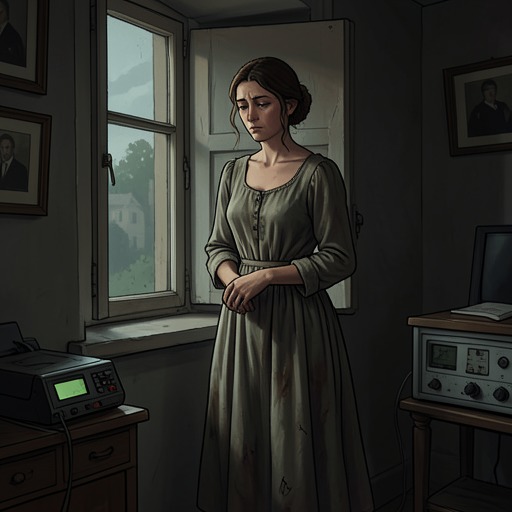
Mrs. Douglas's prolonged invalidism
Anne of the IslandMrs. Douglas’s prolonged invalidism shapes the household life of her only son, John, and holds his relationship with Janet Sweet in suspension for nineteen years. Her illness is described as a continuing source of suffering and anxiety, but it also becomes the reason John cannot propose: during a severe spell, she secures his promise not to marry while she is alive and not to reveal the promise. Her death ends the delay, while Janet’s decision to protect her memory keeps the cause of that delay secret from the community.
A Long Illness and a Household on Alert
Mrs. Douglas tells Anne Shirley that she has been a great sufferer for more than twenty years, and describes the period as one of prolonged decline. She recalls many nights when those around her expected she might not live until morning. The account establishes how she understands her illness: not as a brief crisis, but as an exhausting condition that has come to define her life and the expectations of the household.
Janet Sweet gives Anne a view of the practical consequences. Mrs. Douglas has severe spells, Janet says, and John is so worried that he is afraid to leave home in case his mother becomes ill while only the hired girl is there. His care for his mother therefore limits his freedom to be away, while the uncertainty of her condition weighs on the people around her. The illness is not described through a medical diagnosis; the narrative instead emphasizes its duration, its episodes, and the watchfulness it imposes on John.
Mrs. Douglas also presents herself as nearing the end of her life. When John takes Janet into the garden to gather roses, she tells Anne that it comforts her to know John will have a good wife to care for him after she is gone. She speaks warmly of Janet, praising her character and her housekeeping, and says that John’s happiness matters deeply to her. This approval sits uneasily beside the hidden history of the promise that has kept John from asking Janet to marry him.
The Promise Behind the Delay
The illness becomes a decisive obstacle during a severe spell nineteen years before Mrs. Douglas’s death. The family believes she may not survive; a doctor gives her six months. In that crisis, she begs John not to ask Janet to marry him while she is alive. John resists making such a promise, but his mother presses him by saying that refusal would mean she would die believing he had caused it. He agrees.
The promise is not limited to postponing the proposal. Mrs. Douglas also makes John swear on the Bible that he will tell no one about it. She continues to hold him to the agreement, although he later goes to her on his knees to ask to be released. The secrecy leaves Janet without an explanation for the delay, and John unable to answer her questions. His silence is not evidence that he has stopped caring for her: when he finally explains, he says he had not imagined the restriction would last so long and acknowledges the suffering it caused them both.
The difference between the period Mrs. Douglas describes as more than twenty years of illness and the nineteen years attached to John’s promise matters. Her account encompasses a long history of suffering; the marriage obstacle has a particular beginning in the crisis when the family expected her to die. Her illness continues beyond the six months predicted, turning what John may have understood as a short postponement into nearly two decades of waiting.
Death, Disclosure, and Aftermath
When word comes that Mrs. Douglas is seriously ill, Janet hurries to the house. She dies soon after Janet arrives. Before her death, she asks Janet whether she supposes she will marry John now. The question wounds Janet because it reveals that Mrs. Douglas has regarded the marriage as a possibility, yet Janet still does not know why John has never asked her. John is away at the time, and Janet is unable to answer.
After the funeral, John tells Janet the reason for the delay: his mother had made him promise, and had forbidden him to disclose that promise. He comes to ask Janet to marry him as soon as he can. Her first response is to ask why he did not tell her earlier; his explanation makes clear that the silence, too, was required by the agreement. The revelation gives Janet the missing cause of years of uncertainty, but cannot restore the time they have spent waiting.
Janet accepts the proposal and plans a quiet wedding for the following month. She expects people to assume she hurried to marry John as soon as his mother was out of the way. John wants the truth known, but Janet persuades him to keep the secret rather than cast a shadow on his mother’s memory. Her choice preserves Mrs. Douglas’s reputation while leaving the public account of the courtship incomplete. Janet observes that forgiveness comes more easily to her at forty than it would have at twenty, placing her response within the long span of waiting that the illness and promise have imposed.
Narrative Significance
Mrs. Douglas’s invalidism joins bodily vulnerability to family obligation without making the illness itself a complete explanation of the household’s choices. The story supplies concrete effects—John’s fear of leaving home, the repeated spells, the promise made during a crisis—then reveals how one such promise shapes the course of a courtship. Her approval of Janet and her concern for John’s happiness do not erase the fact that she has prevented their marriage while alive; the contrast makes her final question to Janet especially painful.
The illness also structures what can be known and when. Janet experiences the delay without its cause; John bears the explanation in silence; Anne hears Mrs. Douglas’s account of suffering and later sees Janet’s grief, but it is John’s eventual disclosure that connects the illness to the postponed proposal. After Mrs. Douglas dies, Janet chooses not to make that connection public. The result is a private resolution between the surviving couple, alongside a public story that conceals the promise. Mrs. Douglas’s prolonged invalidism thus remains both a lived burden within the family and the condition that determines the timing, secrecy, and emotional cost of John and Janet’s marriage.