Rusty
Anne of the IslandRusty is a stray cat whose stubborn attachment to Anne Shirley turns an unwanted doorstep visitor into a cherished member of her household. His story moves from apparent nuisance, through a threatened death and narrow survival, to a final separation shaped by Anne’s circumstances and Aunt Jamesina’s decision to take him home with other cats.
Identity and First Appearance
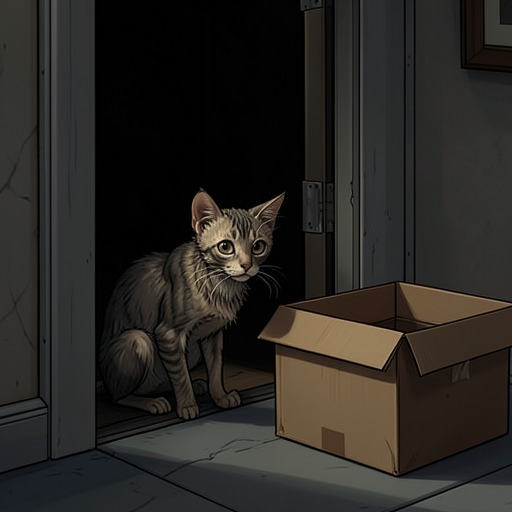
Anne first notices Rusty as she walks home from Redmond: people she meets are looking at her with amused indulgence, and she discovers the reason when she turns to investigate. A forlorn cat is trotting close behind her. He is well past kittenhood, lank and thin, with pieces missing from both ears, one eye temporarily out of repair, and a swollen jowl. His draggled fur is compared to the color of a black cat that had been thoroughly singed. The description makes his poor condition unmistakable, while the attention of passersby gives his entrance a comic edge: Anne has not yet seen the cat who has already become a public spectacle.
At first Anne wants nothing to do with him. She shoos him, but he sits back on his haunches and looks at her reproachfully with his one good eye; whenever she walks on, he follows. She shuts the gate of Patty's Place in his face, supposing that she has left him outside for good. Fifteen minutes later, however, he is still on the step. When Phil Gordon opens the door, Rusty darts inside and jumps into Anne’s lap with an appeal that is at once pleading and triumphant. Anne denies that he is hers and objects to his appearance, but his conduct has already made the connection between them visible to everyone else.
From Stray to Household Member
Priscilla Grant jokes that Rusty has adopted Anne. Anne rejects the idea, but Phil points to the immediate need beneath the joke: the cat is starving, and his bones are almost showing through his skin. Anne agrees to feed him, intending that the meal be temporary and that he then return to wherever he came from. The cat is put outside, yet the next morning he is still on the doorstep. He continues to wait there and slips inside whenever the door opens. He ignores the other residents and takes notice only of Anne. Although she remains cool toward him, the girls feed him out of compassion.
A week changes the practical circumstances of the problem. Rusty’s eye and cheek have recovered their normal appearance; he is less thin and has been seen washing his face. His visible improvement does not resolve what to do with him, and the household considers killing him with chloroform. The plan is put into action after the chloroform is procured. Rusty eats breakfast, licks his chops, and climbs into Anne’s lap. At that point Anne recognizes the trust involved: the animal loves and trusts her, and she cannot bear to take part in his destruction. She hurriedly hands him to Phil, says she feels like a murderess, and flees rather than stay for what she believes will happen.
The intended ending fails because there is a knot hole in the box, which Phil had not noticed. When it is lifted the following morning, Rusty springs out alive and leaps onto Anne’s shoulder, licking her face. The scene turns the earlier act of apparently helpless trust into an unmistakable reunion. Phil suggests that they must try again, but Anne refuses: Rusty is her cat, and the household must make the best of it. His survival is not simply a reprieve; it changes the decision about whether he belongs with them.
Temperament and Attachment
From then on, Rusty is one of the family. He sleeps at night on the scrubbing cushion in the back porch and lives comfortably. By the time Aunt Jamesina arrives, he has become plump, glossy, and tolerably respectable, a striking contrast to the emaciated creature Anne first encountered. His improvement records the practical consequences of the girls’ care as clearly as his earlier condition revealed his need for it.
His new home does not make him sociable. Rusty is described as walking by himself: he is hostile to other cats, and they are hostile to him. One by one, he defeats the aristocratic felines of Spofford Avenue. With people, too, his loyalties are sharply selective. He loves Anne and Anne alone; nobody else dares stroke him, since an angry spit and something resembling very improper language greet anyone who tries. Stella complains about the airs he puts on, while Anne cuddles him defiantly and calls him a nice old puss. The contrast between the household’s complaints and Anne’s protectiveness preserves his prickly character even after he is accepted as family.
Separation and Narrative Significance
Rusty’s presence returns at a moment when Anne and her companions are considering the end of their Redmond life. As he pads into the room, Phil asks what will become of him. Aunt Jamesina announces that she will take him home with Joseph and The Sarah-cat. She does not want to separate the animals now that they have learned to live together, and remarks that this is a hard lesson for cats and humans alike.
Anne is sorry to part with Rusty, but she explains why she cannot take him to Green Gables: Marilla Cuthbert detests cats, and Davy Keith would tease him relentlessly. Anne also expects not to be home long, since she has been offered the principalship of Summerside High School. Rusty’s departure therefore follows from more than a change in residence. Anne’s attachment to him is genuine, yet keeping him is not practical; Aunt Jamesina offers him a place with cats already accustomed to sharing a home. His trajectory—from the doorstep, to Anne’s lap, to a life among the family, and finally to another household—gives the comedy of his stubbornness a quiet counterpoint in care, belonging, and the difficulty of parting.