Walter and Bertha Shirley's letters
Anne of the IslandWalter and Bertha Shirley's letters are the only surviving personal keepsakes Anne Shirley receives from her birth parents, and their recovery changes her sense of herself: through their words, she finds a real connection to the loving family she had never known. A dusty packet tied with faded blue ribbon, they carry both the marks of time and the intimate voices of the young couple who wrote them.
Discovery and Provenance
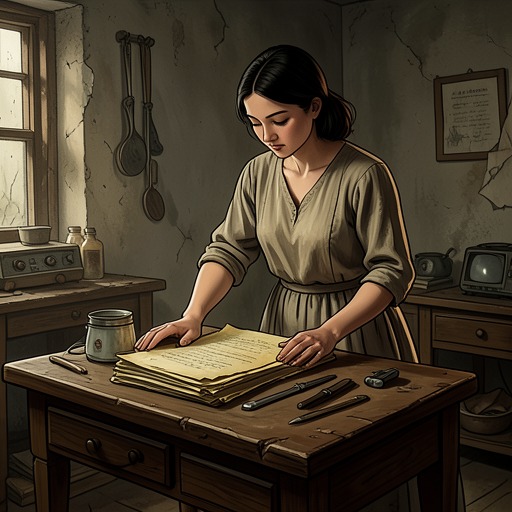
The packet comes to light when the lady of the house gives it to Anne after finding it in an upstairs closet. She has not read the letters; the address on the top one, to Miss Bertha Willis, identifies Anne’s mother by her maiden name. The discovery is therefore accidental, but the address makes an otherwise anonymous bundle legible as family history. Its faded ribbon and dust mark the long interval between the letters’ creation and Anne’s arrival, while their survival leaves her with something tangible from a past that had seemed inaccessible.
The packet is precious in part because so little else remains. The hostess explains that the furniture was sold to pay the doctor bills and that Mrs. Thomas received Bertha’s clothes and small belongings. Anne says she has not one thing that belonged to her mother. Against that loss, the letters are not simply old documents: they are the one surviving personal inheritance she can hold and read. The hostess also remembers that Anne’s eyes resemble her mother’s and that Walter and Bertha were deeply in love. Her recollections offer a living witness, but the packet lets Anne encounter that love in the parents’ own words.
Contents and Material Form
There are only a dozen letters in all, written by both Walter and Bertha. They had seldom been separated during their courtship, which helps explain the small number. The pages are yellow, faded, and dim, their writing blurred by the passage of years. Their material condition registers time as a force acting upon the evidence: the letters survive, but not pristine or untouched. They have to be read as remnants, not as a complete record of their parents’ lives.
The letters contain no profound wisdom or formal account of the past. What they preserve instead are lines of love and trust, along with the couple’s far-off imaginings and the particular personalities that remain perceptible in their writing. Bertha’s letters especially retain her charm through their words and thoughts, so that her presence comes across not as a portrait supplied by someone else but as a voice shaped by the act of writing. Their tenderness and intimacy give the packet its force: ordinary correspondence, kept across years of absence from Anne, becomes a private record of affection she can finally share.
The Letter About Anne
The letter Anne treasures most was written by Bertha to Walter during a brief absence after Anne’s birth. Its subject is the baby: Bertha recounts her cleverness, brightness, and many small sweetnesses with the pride of a young mother. In a postscript she says that she loves Anne best asleep and better still awake. The sentence makes the letters more than evidence that Anne’s parents loved one another. It records a mother addressing the father about their child, placing Anne inside their shared tenderness from the beginning of her life.
The postscript was probably the last sentence Bertha ever wrote; her death was near. That knowledge gives the affectionate attention to the baby a painful edge without changing its warmth. Anne has not recovered a set of belongings or a full biography of her parents, and the letters do not undo the loss that separated them. Instead, a few surviving pages establish something more intimate than bare facts: she was welcomed and cherished by the mother she never had a chance to know.
Anne’s Response and the Letters’ Significance
Before reading the packet, Anne visits the green corner of Bolingbroke Cemetery where her parents are buried and leaves the white flowers she has carried. She then returns to Mount Holly, closes herself in her room, and reads. The movement from the grave to the letters joins the parents’ physical absence to the written words that remain. The pages cannot bring them back, but they allow Anne to approach their lives through their own expressions rather than through absence alone.
That night, Anne tells Phil Gordon that the letters have made her parents real to her and that she no longer feels like an orphan. She compares her discovery to opening a book and finding yesterday’s roses pressed between its leaves. The image describes the letters’ double nature: they are fragile traces of a life long past, yet their affection remains capable of acting in the present. The packet does not restore the possessions sold to pay the doctor bills or erase the years in which Anne knew nothing of her parents. It changes what that past means to her. Through the letters’ worn pages and Bertha’s postscript, Anne finds not merely a record of her birth, but evidence of a bond that precedes and endures beyond her knowledge of it.