19 October 1975
Another Day of Life19 October 1975 was the chosen zero hour for Operation Orange, a coordinated advance toward Luanda intended to determine who would hold the capital when Portuguese rule ended. The date turned a staff-room timetable into a moving front: on the same Sunday that the operation began, Comandante Farrusco encountered an armoured column near Pereira d’Eça and was badly wounded. The plan assumed speed; the scene on the road showed that the opposing side was already in motion.
The objective and the timetable
Operation Orange aimed to occupy Luanda by 10 November 1975 at 18:00, when, under the Alvor Agreement, the last Portuguese units were scheduled to leave Angola. Its planners intended to announce independence the following day with power passing to an FNLA–UNITA coalition government. The date chosen for the operation therefore sat just three weeks before the deadline: the advance had to cover the distance to the capital and reach it before the Portuguese departure and the independence declaration.
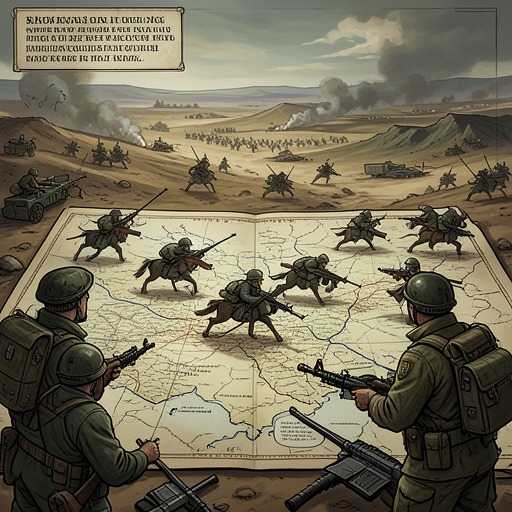
The staff considered two start dates. One group urged an earlier launch, arguing that resistance could delay the occupation and that the advancing army would need time as its supply lines for ammunition, fuel, and food grew longer. Others judged that two weeks would suffice, reasoning that the northern forces were already near Luanda and that little resistance was expected in the south. They proposed 27 October, calculating the driving time of Panhard armoured vehicles from Tsumeb and allowing for meals and sleep. The more cautious view prevailed: even an advance lasting three weeks, its advocates argued, would still be a blitzkrieg capable of dazzling the world. The resulting order fixed zero hour as Sunday, 19 October.
Three routes toward the capital
The plan divided the advance among three axes. From the south, motorized units of the South African Army were to move along the road from Tsumeb through Pereira d’Eça, Lubango, Benguela, and Novo Redondo to Luanda. Their supporting forces included Portuguese volunteers, FNLA and UNITA units, and the Daniel Chipenda force. This southern route placed the first reported encounter of the chosen day on a principal line of advance.
A northern strike was to run from Maquela do Zombo through Carmona and Caxito to Luanda, led by FNLA units with support from the Zaïre Army and Portuguese volunteers. From the east, another column was to travel by way of Nova Lisboa, Quibala, and Dondo toward the capital, with the same support arrangement as the northern flank. The scheme depended on simultaneous movement from several directions, turning the roads into operational arteries leading to a single political prize.
The first encounter on zero hour
Sundays in the country were usually described as days of near-inactivity. On 19 October, however, Comandante Farrusco had been searching for his driver, Antonio, since morning. When Antonio finally appeared, exhausted and sleepy, Farrusco ordered him to drive. They set out in the same red Toyota jeep that had brought the narrator back from Pereira d’Eça.
On the road through the bush, they noticed what first seemed almost like a phantom in the sunlight. It resolved into a long column of armoured vehicles, with a nearly motionless helicopter above it. Machine guns then opened fire. Farrusco was badly wounded, and Antonio was hit in the leg but remained conscious. He reversed the jeep and drove away in the opposite direction, carrying his wounded commander. The column continued toward Pereira d’Eça. Soldiers were concealed inside the vehicles, though young faces increasingly appeared through open hatches despite orders to stay inside. The planned timetable had thus met a visible, advancing force on its opening day.
Luanda’s fragile rear
The approach to Luanda was not only a matter of roads and troop movements. By early October, the city was already emptying as Portuguese residents converged on its airport, hoping to leave Angola. Refugees arrived in packed automobile caravans from distant parts of the country, first filling hotels and then establishing a makeshift settlement around the airport. The airlift was expected to carry half a million people away. Against that departure, the military plan to take the capital treated Luanda as an objective, while the city’s population and ordinary civic life were already draining away.
In October, water supplies were becoming precarious because the pumping stations stood on front lines and were repeatedly damaged during the fighting. Repairs could restore service only for the pumps to be destroyed again. Later, after three days without water, the hotel tap produced none; a kitchen worker gave the narrator water from a tin barrel. The episode made plain how quickly a military front could become a crisis of basic survival in the city. The city’s dependence on repair work was equally stark at the Bengo River pumping station: Alberto Ribeiro was the only person able to repair its pumps, and without them Luanda could last only five days without water. A shell-damaged station could therefore imperil the capital as surely as an advance along its roads.
Other services were disappearing as well. News reached the hotel that the police had left. The fire station stood open and empty, with its engines, ladders, hoses, and helmets abandoned; soldiers later used a pumper to carry water to the front, but it was hit and left in a ditch. The garbagemen’s departure was followed by mounting refuse, and the heat and moisture hastened decay. These were not simply signs of disorder around the operation: they were the material conditions of a capital whose capacity to sustain its remaining residents and defend itself was narrowing.
The date’s significance
The account places 19 October at the junction of plan and contingency. Operation Orange had a precise deadline, mapped routes, assigned forces, and a selected starting hour, but its opening movement immediately produced a confrontation that injured one of the MPLA’s field commanders and forced his driver to retreat. Meanwhile, the capital the operation aimed to occupy was already losing residents, water, and public services. The date marks the beginning of the advance as a military schedule, but the surrounding narrative measures its stakes through the roads, pumps, aircraft, and civic systems on which control of Luanda—and life within it—depended.