Camarada! · Irmão!
Another Day of LifeCamarada! / Irmão! is the high-stakes greeting at the center of a checkpoint encounter in Another Day of Life. With opposing armies dressed alike and control of the countryside shifting between them, a traveler cannot reliably identify the sentries by sight. The words used between the factions instead become a test of affiliation: the wrong greeting can turn uncertainty into mortal danger, while the right one briefly opens a way to speak, explain a journey, and ask passage.
Two Greetings, Two Allegiances
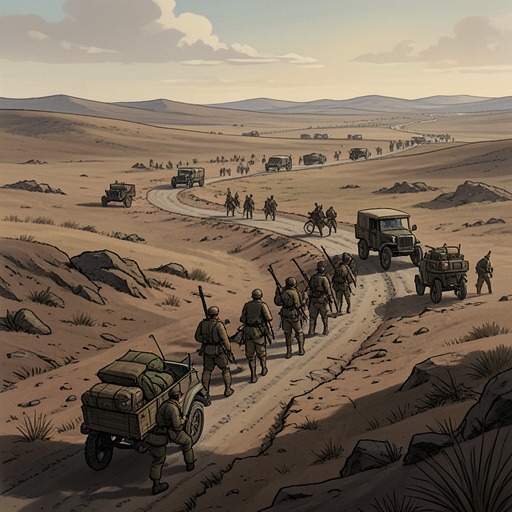
The narrator presents the encounter as a moment of mutual examination. Strangers remain at a distance, and neither side yet knows who the other is or what will happen next. In this unsettled space, the crucial question is not simply who the sentries are, but which word they use to recognize one another. The MPLA side, associated with Agostinho Neto, exchanges camarada; the forces of Holden Roberto or Jonas Savimbi use irmão. A greeting therefore does more than establish politeness. It signals which political and military community a speaker belongs to, and it lets a traveler attempt to identify the people who control the road.
That test is especially fraught because the front is not a stable line separating clearly marked territories. Large parts of the country are described as no-man’s-land, crossed by both sides as they establish checkpoints. The same clothing and the shifting locations of these posts leave travelers unable to tell the sentries’ allegiance in advance. The greeting has to do work that uniforms and geography cannot: it must make a claim of belonging before the speaker can be sure how that claim will be received.
The Risk in Speaking
The narrator describes the choice of greeting as a decision that may determine life or death. Established checkpoints are associated with the fate of people who made the wrong choice, giving the encounter a history beyond the immediate group of travelers. The danger is not presented as an abstract misunderstanding; the sentries’ response can expose a traveler to lethal treatment. Even before a pass is produced or a route explained, a single word places the speaker on one side or the other.
Because the choice is so consequential, the narrator’s account dwells on how the word is spoken. The traveler must make camarada audible enough to be recognized without making the sound so definite that there is no possibility of retreat if the sentries turn out to belong to the other side. The proposed strategy is a carefully indistinct utterance, one that could leave room to claim that heat, fatigue, or nerves muddled the speech. This is not a confident password delivered by someone certain of the audience. It is a calculated attempt to preserve an alternative at the instant when certainty is unavailable.
The narrator also distinguishes this cautious ambiguity from simply shouting both words. Calling out camarada and irmão together would present the speaker as an opportunist and invite suspicion. The tactic depends on restraint and judgment: a traveler must sound as though a genuine greeting has been offered, not as though allegiance is being switched to suit whoever answers. In the scene, the gap between a recognizably chosen word and a deliberately imprecise one becomes a narrow space in which survival remains possible.
Recognition and Passage
When the sentries respond with camarada, the encounter changes. Their faces brighten, and the travelers and sentries repeat the shared greeting aloud. For a moment, the word moves back and forth between the two groups as a sign of recognition. Its effect is immediate but limited: the travelers have passed the first test, yet they have not been granted permission to continue their journey.
The meeting then moves into explanation. The travelers state who they are, where they have come from, and where they are going, and present a general staff pass. The document describes Ryszard Kapuściński as a trusted friend and asks comrades at the front and in the rear to show hospitality and help him. Even this supportive credential does not settle the matter. Checkpoint sentries may refuse passage and order travelers to turn back, asserting the authority of the post in front of the broader authority of Luanda. The greeting thus initiates a negotiation rather than replacing it: recognition creates the possibility of being heard, while the pass and the account of the journey must still be tested.
The word also appears in less compressed exchanges elsewhere in the wartime narrative. Diogenes addresses the reporter as camarada while explaining that the road toward Pereira d’Eça runs through territory held by the enemy and that convoys have been lost in ambushes. In this use, the greeting marks a relationship of address between people travelling together, even as the conversation makes the danger of their route plain. At the checkpoint, by contrast, the same word must first establish whether such a relationship can safely be assumed.
A Word Beyond the Checkpoint
Camarada functions more broadly as a sign of belonging and standing within the MPLA world. Comandante Ju-Ju, a white Angolan whose family came from Portugal but who was born in Angola, is addressed as camarada by black Angolans, who treat him with respect. In that context, the word registers more than immediate military identification: it recognizes a claimed connection to Angola and a place within its political struggle. Its meaning depends on who speaks, to whom, and under what conditions, but it repeatedly makes affiliation audible.
The contrasting brotherhood implied by irmão also sits beside the narrative’s more uneasy account of relations between enemies. In a scene after battle, Comandante Ndozi orders the dead buried together, recalling a proverb that imagines earthly enemies as brothers in heaven. That reflection does not erase the practical danger of mistaking one faction’s greeting for another’s. Instead, the scenes hold two meanings of brotherhood in tension: a word used to identify one’s own side at a checkpoint, and a larger possibility of common humanity that death makes visible only after the fighting.
The expression’s force comes from this difference between a greeting as a sign and a greeting as an act. At the checkpoint, saying the word is a bid to be recognized, but its meaning is determined by the sentries’ answer. A shared response briefly changes strangers into people who can begin to explain themselves; it does not guarantee passage or safety. In a war where identity is hard to read from appearance and authority is divided across the road, two ordinary forms of address carry the burden of deciding who may speak, who may proceed, and who is understood as belonging.