Comandante Bota
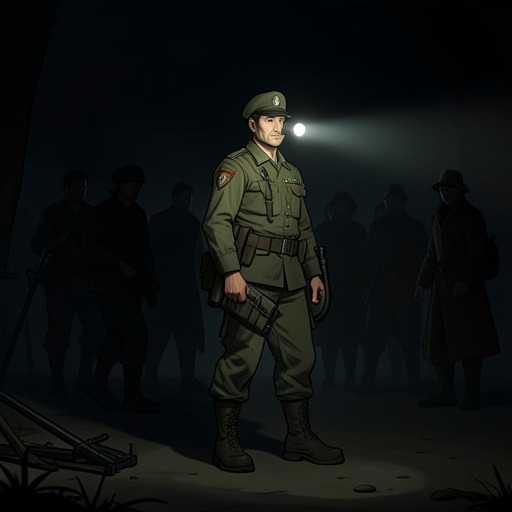
Another Day of LifeComandante Bota is a commander from front headquarters who appears in two sharply contrasting moments of wartime movement: a dangerous night drive from Lubango toward Benguela, and a later arrival at the narrator’s room after the southern front has collapsed. He is introduced drunk, a whisky bottle between his knees, but the journey draws him into acts of command and responsibility. His authority is neither remote nor polished: it is exercised in a car under fire, among exhausted men, and amid uncertainty about who controls the road ahead.
Identity and Introduction
Bota is travelling with Nelson, Nelson’s aide Manuel, and the first-person narrator in a grey Peugeot 504. The party sets out from Lubango at two in the morning for Benguela, although Manuel warns that Daniel Chipenda’s force is attacking and that the only unit ahead is led by Comandante Antonio, who has gone to Benguela to find weapons. The road offers no alternative route. Bota sits beside Nelson with a bottle of whisky between his knees; he takes a pull and passes it around, so the other travellers drink too. The brief shared drink eases the mood, but does not make the journey safer.
Bota’s drunkenness is immediately part of how the scene measures the strain of command. As the car approaches shooting near Caculi, Nelson switches off the lights and feels his way along the road’s soft shoulder. Bota, beginning to sober up, orders him to go slower. Manuel tentatively suggests that speed might be safer. Their disagreement is practical rather than abstract: neither pace can guarantee safety when gunfire and shells are landing on both sides of the road.
Command Under Fire
The danger becomes unmistakable when the travellers encounter a soldier beside a parked truck. He says that he has twenty men but cannot send them forward to hold Daniel Chipenda’s force because he has run out of gasoline. Nelson tells him to go to Lubango for fuel; the soldier protests that he has no way to move. Tracers pass overhead, grenades explode nearby, and the soldier warns that his men are being killed. Bota’s response is a terse order to move on. The car pulls away, leaving the stranded force behind. The episode shows the limits of Bota’s authority as clearly as its force: he can make the immediate decision to continue, but cannot supply the fuel that the soldier needs or resolve the wider military crisis.
At Quilengues, the group encounters two boys with old Mauser rifles running from the fighting. Bota orders them stopped and asks which unit they belong to. They identify themselves as soldiers from Comandante Antonio’s regiment. Bota recognizes their flight as desertion and commands them to return to the battle, warning that he will come to see whether they are fighting and will remember their faces. The boys stand frightened and subdued before disappearing back into the darkness. His intervention turns the car’s passage through the battlefield into a moment of discipline: the commander makes retreat visible and answerable, even as the men in his own vehicle are trying to get through the same danger.
Bota then says the road will become worse because they are trying to push through to Quilengues, where mercenaries are expected. The prediction sustains the sense that every stretch of road may bring a new encounter. At dawn, however, the shooting gradually falls quiet behind them. The travellers cautiously scout Quilengues, finding it apparently empty of people and animals. Bota’s command has carried the group through the night, but the town offers no clear sign of what has happened there or who may still be nearby.
Dawn and the Return
Once the group has returned to the car, Nelson straightens his shoulders and says, “Another day of life,” because the road to Benguela is now clear. He begins calisthenics, and Bota joins in, though he staggers unsteadily from side to side. The exercise proceeds through squats, stretches, a duck waddle, and jumping jacks as the sun comes out. The sequence does not erase the danger they have passed through; instead, it gives survival a bodily, almost absurdly energetic form. Bota, who had begun the journey with a bottle between his knees and ended the night issuing orders, now takes part in a collective routine that marks the immediate danger’s passing.
Bota reappears at the narrator’s door after someone pounds on it at two in the morning. The narrator initially fears the FNLA, but three filthy figures tumble inside: Nelson, Manuel, and Bota. They embrace, lay down their weapons, and ask to wash. Nelson falls asleep on the bed almost at once, while the others open the narrator’s saved can of meat. The scene reverses the earlier departure: the armed travellers who had driven into the night now arrive exhausted, dirty, and in need of shelter and food. Asked about the southern front, Manuel says there is no longer a southern front: the enemy is already outside Benguela, while a second column is heading for Luanda.
Narrative Role
Bota’s presence links military command to the precarious conditions of ordinary movement. He is at once a drunk passenger, a decision-maker under fire, and a commander who confronts fleeing boys with their duty. The journey repeatedly tests the reach of his authority: he can order the car onward and send two soldiers back, yet the stranded unit lacks gasoline, the expected mercenaries may be ahead, and the route remains dangerous until dawn. His later return with the others, followed by news that the enemy is outside Benguela, makes the reprieve at Quilengues temporary. The road has been cleared for a time, not secured.