Comandante Farrusco
Another Day of LifeComandante Farrusco is a former commando who crosses to the MPLA after deciding that he has been fighting on the wrong side. In southern Angola, he builds a small force, captures Lubango and Pereira d’Eça, and remains at the latter town with a unit isolated across an immense, poorly supplied region. His story joins military initiative to the limits of command: the unit can seize towns, but its survival depends on scarce weapons, a vulnerable road, and support that may not arrive.
Identity and Change of Allegiance
Farrusco’s earlier military service was on the opposing side. He explains the change in allegiance through a judgment formed while serving as a commando: he came to believe that he was fighting on the wrong side, and when the war began, he crossed over. The account gives no fuller biography or detailed explanation of the decision. Its force lies in the sequence it does provide: experience in combat precedes recognition, and recognition leads to a concrete change of position.
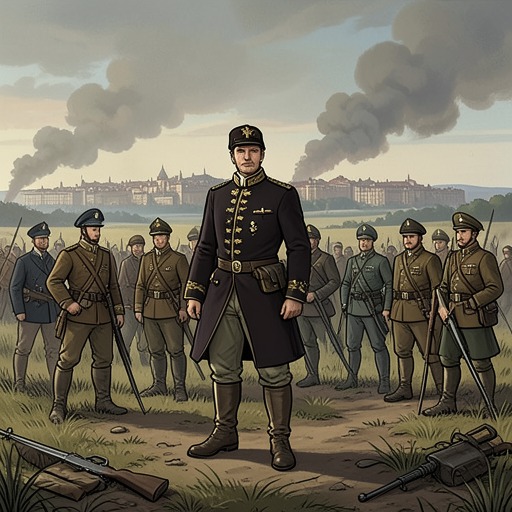
Nelson recounts Farrusco’s arrival at headquarters as a stocky, bearded man who offered to show the others how to fight. He then organized a unit in a period when the MPLA was fighting the FNLA and UNITA, including in Lubango. Farrusco appears, in this recollection, less as a commander inheriting an established force than as someone who volunteers his military experience and turns it into an organized presence. That account of his beginnings also gives the later defense of the southern front a practical origin: a decision to join the MPLA becomes a decision to train and lead others.
Building a Force in the South
Farrusco’s unit captures Lubango, then takes Pereira d’Eça and stays there. Nelson emphasizes how limited its weapons were: it had rifles and two 82-millimetre mortars. Farrusco and his assistant Carlos operated the mortars themselves, without their base; the work left both men with burned hands. The detail makes the unit’s shortage of equipment tangible. Its firepower depended not on a fully supported artillery service but on its commanders handling the weapons directly, at physical cost.
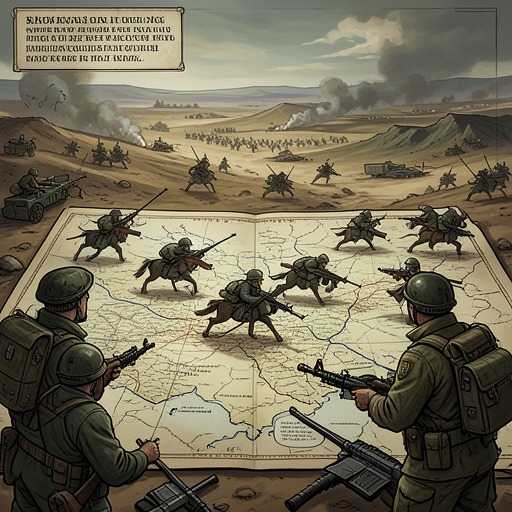
The small force held an unusually large area. Its 120 members were the only unit on the southern front between Lubango and the border, a distance of 450 kilometres, and between the Atlantic Ocean and Zambia, a span of 1,200 kilometres. The region covered roughly a third of Poland. Around it lay bushland without water or clear reference points; the road to Lubango was the sole route through this terrain. Retreat on foot was impracticable over such a distance, while the unit had too little transport to move everyone. Farrusco’s command therefore meant defending a position whose geographic scale far exceeded the strength available to hold it.
Isolation and the Fragility of Command
The road that connected Pereira d’Eça to Lubango was also a potential trap. In the early hours of the morning, the possibility that the enemy had taken the road on both sides of the town hangs over the unit. The account does not confirm that this encirclement has happened; it presents the danger as an immediate uncertainty. That distinction matters: Farrusco’s situation is defined not only by combat but by the lack of reliable information about whether the one route for movement remains open.
At the inn, Farrusco asks why the soldiers are not going to their posts, but gives no orders after asking. The others remain silent, and the question is understood as having no useful answer: taking up positions would not change the unit’s prospects. The scene places formal command beside practical helplessness. Farrusco remains the leader, yet the circumstances have narrowed what leadership can accomplish. Later, when the narrator says that what the Portuguese have reported is important, Farrusco agrees and identifies it as the beginning of an invasion. The exchange shows him receiving news as a commander with few means to alter the danger it announces.
Care Beyond the Unit
Farrusco’s authority is not expressed only through military decisions. Speaking of Esperança, the woman living among the soldiers, he says that they love her, although she is not exactly one of them. His explanation rests on everyday assistance: the soldiers have brought her water and wood. He describes her connection to the unit through the means of life and bread, and imagines that she may live as long as they do, or perhaps longer. This is not a report of what ultimately happens to her; it is Farrusco’s stated hope in a place where the unit’s own future appears uncertain.
He also asks the newcomers from Lubango to tell the others what they heard in Windhoek and along the road. The request draws distant reports into the company’s immediate world. Information, like water and transport, is a resource that must be carried to the isolated unit. Together, the appeal for news and the soldiers’ provision of basic necessities show a command community organized around more than combat, even as the threat of attack sets its limits.
Narrative Significance
Farrusco emerges through two kinds of testimony: Nelson recounts how he joined the MPLA and built the unit, while the narrator encounters him in the strained present at Pereira d’Eça. The retrospective account explains the origin of his authority; the scenes in the town expose the conditions under which that authority must operate. The two views resist a simple portrait of military triumph. Farrusco has captured and held towns, but his force remains small, geographically isolated, and dependent on a single road.
His character is shaped by a contrast between initiative and constraint. He volunteers to teach others to fight, organizes a unit with minimal arms, and recognizes the significance of reports about an invasion. Yet he cannot make the surrounding wilderness passable or guarantee the road’s safety, and there are moments when even asking soldiers to take their posts seems unable to improve their position. His care for Esperança offers another measure of leadership: amid the precarious defense of territory, the unit also carries water and wood to sustain a civilian life. The account leaves Farrusco not with a confirmed resolution, but within that unresolved balance of commitment, practical improvisation, and danger.