Comandante Ndozi
Another Day of LifeComandante Ndozi is an experienced guerrilla commander whose unit captures Caxito from the FNLA. His scenes make victory inseparable from its costs: the strain of battle, the work of burying the dead, the precarious evacuation of wounded soldiers, and the fear that can overwhelm inexperienced troops. Through his explanations, he also connects the immediate conflict to a much longer history of warfare and depopulation in Angola.
Identity and Command
Ndozi has years of guerrilla warfare behind him, while many of the soldiers he leads are new to combat. That difference shapes his role. He does not describe battle as a matter of courage or firepower alone; he sees the inexperienced soldier’s confusion as a problem that can consume attention and distort action. His authority rests partly on having learned, through experience, how fear and battlefield conditions affect what a unit can do.
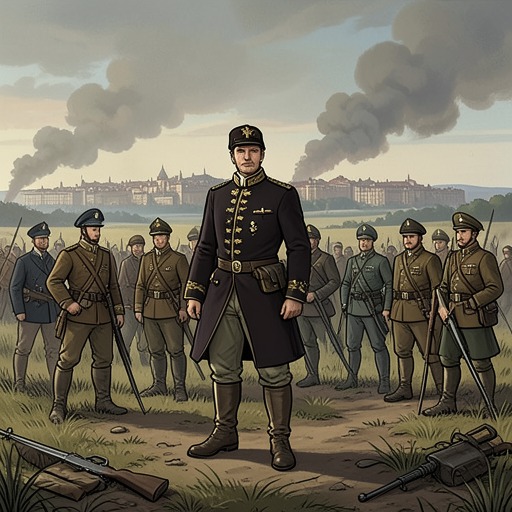
His unit is identified with the MPLA campaign at Caxito, where it takes the town from the FNLA. Comandante Ju-Ju, political commissar of the MPLA general staff, informs the narrator that the battle has taken place at dawn and that Ndozi’s unit has seized the town. The capture is a military success, but the scenes after it refuse to let the word victory stand by itself.
The Capture of Caxito and Its Immediate Costs
After the battle, Ndozi stands in the shade of a mango tree and wipes his face. He compares winning a battle to cutting down a forest: it demands physical effort. He then orders soldiers to bury the dead, allowing friend and foe to be interred together. The gesture follows his view that death has ended the distinctions the fighting enforced, and that former enemies may be understood as brothers beyond it.
The aftermath is also governed by a delay in transport. Ndozi asks whether a truck carrying wounded soldiers has left for Luanda, but its driver is waiting for gasoline. The wounded remain aboard, and there is no doctor on that front. Ndozi recognizes that if the fuel does not arrive, some of them may not survive the wait. The episode places the consequences of the battle in plain view: taking a town does not itself provide the means to evacuate or treat those who have been hurt.
Even the sounds of celebration are uncertain. Ndozi sends an orderly toward nearby gunfire to determine whether it marks a skirmish with the withdrawing enemy or soldiers firing salutes for the victory. He suspects that the troops may be wasting ammunition. In the immediate aftermath, then, command means distinguishing threat from celebration and trying to keep scarce supplies from being spent without purpose.
Teaching Soldiers to Fight Through Fear
Ndozi describes inexperienced soldiers as frightened by the sense that danger is everywhere. Unable to judge the range or direction of fire, they may shoot indiscriminately; in his account, the firing can be less an effective attack than an attempt to suppress their own terror. Fear narrows their attention, keeping them from assessing the battle or considering how their unit might win it. Ndozi frames the struggle with fear as a battle the soldier must face even while the larger engagement continues.
He recalls running up to a soldier who was aiming a bazooka into the air and correcting him to aim forward. The anecdote makes his instruction concrete: a weapon and the willingness to fire are not enough when a soldier does not understand how to use them. Ndozi’s attention is directed both to the immediate action and to the judgment that inexperienced troops have yet to develop.
He also recounts the gap between what supply officers ask and what the fighting has achieved. Asked how much ammunition has been shared and how many enemy soldiers have been killed, he answers that half a ton of cartridges has been fired and two people killed. He argues that there was no need to kill more because the objective was to take the town, and the town has been taken. His account criticizes quartermasters who assess ammunition use without coming to the front to see how inexperienced soldiers fight.
In Ndozi’s description, those soldiers may move close to enemy positions at night and open fire just before dawn, producing a great deal of noise. The firing can signal that a force is approaching and is intended to create fear in the opposing side. He considers this tactic to have a rationale because the enemy, too, may be unfamiliar with war and gunfire. His explanation does not make the firing precise; it shows how, in a battle fought by inexperienced troops, noise and intimidation can become substitutes for confidence and practiced judgment.
His Account of Angola’s Past
Ndozi insists that his side did not want the war, then names attacks from Holden Roberto in the north and Jonas Savimbi in the south. His account reaches further back, describing Angola as a country shaped by centuries of warfare beginning with Portugal’s arrival. He links that history to the slave trade: people were captured for export to Brazil, the Caribbean, and other destinations across the ocean. He says that Angola supplied more enslaved people to these markets than anywhere else in Africa and invokes the name Black Mother of the New World for the country.
He contrasts that history with the Angola of his own time. In his telling, the country had once been populous and settled but was emptied over the course of the slave wars, which continued for three centuries or more. He attributes a role in the trade to powerful local chiefs, who attacked weaker groups and sold captives. His account is a commander's explanation of the war rather than an impersonal historical survey: it places the conflict he is fighting within a long history of external demand, local violence, and human loss.
Narrative Role and Limits of Victory
Ndozi’s scenes bring military success down to its material and human conditions. Caxito has been captured, yet fuel is still needed to move the wounded; ammunition has been expended, yet its use cannot be judged apart from the soldiers’ inexperience; and the enemy’s retreat does not mean every nearby shot is a threat. Each task after the battle—burying the dead, checking the gunfire, arranging transport—extends command beyond the moment of attack.
His reflections also shift the scale of the narrative. A newly won town belongs at once to the immediate struggle between the MPLA and FNLA and to Ndozi’s broader account of Angola’s past. The result is not a portrait of a triumphant commander separated from the consequences of combat. Ndozi appears instead as a veteran trying to impose purpose and judgment on a green force, while the delays and uncertainties surrounding victory show how little a captured town can resolve on its own.