Cuban military intervention in Angola
Another Day of LifeCuban military intervention in Angola began amid an escalating war in which the MPLA faced scattered, inexperienced forces, weak communications, and the threat of better-equipped opponents. The account traces Cuban involvement from instructors already working with MPLA units to the arrival of soldiers by air and their rapid dispatch to the front. Its defining contrast is between the intervention’s eventual role in a counteroffensive and the uncertainty surrounding its first days: neither the scale of future aid nor the time available to build an effective army was clear.
Instructors in a Fragmented War
Before the arrival of armed Cuban units became visible at the Luanda airport, Rysiek learned that Cuban military instructors were already in Angola. Two men who visited his hotel identified themselves as members of an army training group. One said that about a dozen instructors were in Benguela. Rysiek had seen people in Cuban uniforms there but had assumed they were MPLA soldiers, since uniforms in the country came from varied sources and were worn across the scattered forces.
The instructors had only recently arrived and were supposed to train the MPLA’s forces. Rysiek’s account makes clear how much stood between that task and the creation of a conventional army: the MPLA had loose units distributed around the country, not a unified force in the ordinary military sense. He questioned whether there would be time to organize them before the enemy advanced. The instructors could not say whether more assistance would come, or when. Their presence therefore signaled a new source of support, but not a settled or readily measurable change in the balance of forces.
The doubts were sharpened by the military situation as Rysiek understood it. He warned that South African forces might already be deep inside Angola, and described their armor and artillery as advantages the MPLA could not match. In Lubango, he said, there were no heavy weapons; Comandante Farrusco’s unit had only two mortars and a few old rifles, while the one armored vehicle formerly in Benguela had been put out of action by mercenaries. The Cuban instructors acknowledged the difficulty. The exchange presents intervention not as an effortless arrival of decisive strength, but as an answer to a severe imbalance under a rapidly closing deadline.
Arrival at Luanda
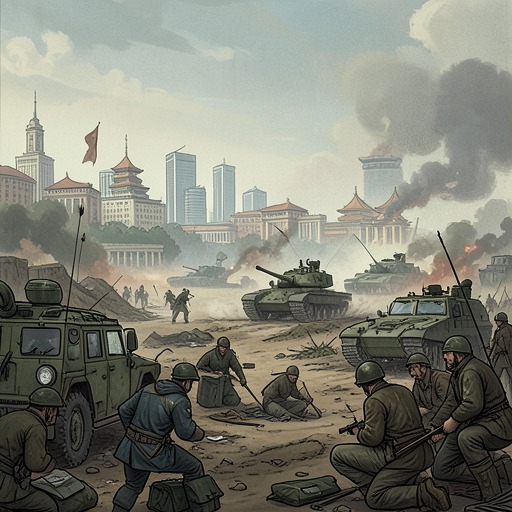
A chronology in the book records that the first Cuban army unit arrived in Luanda on October 19, 1975. A later eyewitness scene, dated Wednesday, November 5, shows another significant arrival at the airport. Rysiek went there with Gilberto, a friend of Oscar who worked in the control tower. In heavy rain, they watched four Cubana Airlines planes land and taxi into position on the illuminated runway. Cuban soldiers carrying packs and weapons disembarked, formed two lines, and walked to trucks waiting nearby. Gilberto gripped Rysiek’s shoulder as they watched.
The scene takes place in a city strained by the refugee influx and by the approaching transfer of power. The airport terminal, which had been used by half a million refugees, stood empty and uncleaned. The arrival of soldiers therefore punctuated a setting marked by both mass displacement and the unraveling of ordinary administration. The next day, the soldiers went to the front. The account gives no further detail about their immediate assignment, but the short interval between landing and deployment makes the urgency of their arrival plain.
The airport scene also gives physical form to a change that had previously reached Rysiek through an uncertain conversation in a hotel room. There, the instructors could not promise additional aid or specify when it might come. At the airport, armed personnel and transport were visibly present; by the following day, the soldiers had been sent into combat. The shift from an unknown timetable to an observed arrival does not erase uncertainty about the intervention’s scale, but it records a concrete movement from training assistance toward direct front-line deployment.
A Front Shaped by Scarcity
The intervention entered a war in which even existing MPLA operations were constrained by basic supplies and transport. In the north, Comandante Ndozi’s unit had seized Caxito, but ammunition was running short, and a truck carrying wounded men could not leave until gasoline arrived. Ndozi described inexperienced soldiers firing large quantities of ammunition, sometimes more to master their own fear than to hit an opponent. In one operation, the unit used up its ammunition before discovering that the enemy had already left the town. Such episodes establish the practical conditions into which Cuban assistance arrived: forces had to contend not only with opposing armies but also with shortages, inexperience, and the difficulty of coordinating movement and supplies.
Farther south, Comandante Farrusco’s unit numbered 120 and was the only MPLA unit across a vast region between Lubango and the border. Its limited transport and dependence on a single road made it vulnerable to isolation. On a convoy journey, Rysiek and Diogenes passed wrecked trucks and the remains of earlier convoys. Diogenes explained that movement through the area involved an unavoidable danger: leaving the road meant risking thirst and becoming lost, while staying on it exposed a convoy to ambush. The intervention thus unfolded against a landscape where reinforcements and matériel could be as difficult to move as troops were to train.
Communication was another constraint. In Luanda, the Cuban instructors could not say whether further aid was on its way; elsewhere, the fate of units and towns depended on fragile links. The MPLA’s only plane in Luanda, an aging DC-3 flown by Ruiz, carried ammunition and food to besieged places and returned serious casualties. It flew without reliable air-control support, sometimes approaching an airport first to discover who held it. This account does not identify Ruiz’s flights as part of the Cuban intervention, but it shows the wider logistical environment in which any military assistance had to operate: transport, information, and the ability to keep isolated units supplied could affect whether they held or surrendered.
Counteroffensive and Significance
The chronology places the intervention within the decisive weeks surrounding Angolan independence. On November 11, the MPLA proclaimed the People’s Republic of Angola in Luanda. The chronology then records the start, in November, of an MPLA counteroffensive supported by Cuban Army units; during December and January, the armies of the FNLA and UNITA were destroyed. These entries establish the broad military consequence of Cuban support, while the eyewitness episodes describe its uncertain opening phase. The book does not make the intervention’s early scale appear self-evident: when Rysiek first spoke with the instructors, they had just arrived, the MPLA forces remained dispersed, and the enemy was reported to be only twenty kilometres from Luanda.
Rysiek’s account therefore holds two scales of history together. At the level of the chronology, Cuban forces became partners in a counteroffensive that altered the course of the war. At the level of lived experience, their arrival was a sequence of limited, visible steps: instructors whose task was to train a fragmented force, soldiers landing in the rain, and deployment to the front the next day. The distance between those scenes and the later military outcome is part of the event’s significance. Intervention appears not as a completed solution delivered at once, but as a commitment made under pressure, within a war whose immediate demands exceeded the resources and organization then available.