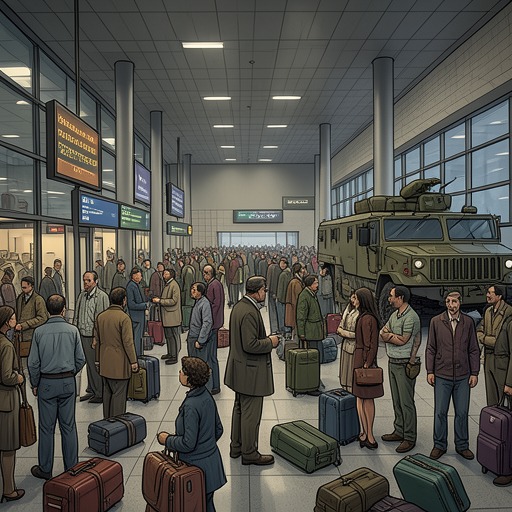
Cuban military intervention in Angola in 1975
Another Day of LifeThe Cuban military intervention in Angola in 1975 is depicted as a growing presence whose importance lies both in what it brings and in how exposed it remains. Cuban instructors are already working in the country when Rysiek learns who they are; later, Cuban soldiers arrive by air at Luanda and leave for the front the next day. Their deployment unfolds amid reports of Cuban deaths at Benguela and an MPLA war effort strained by shortages, vulnerable routes, and a rapidly shifting battlefield.
An unfamiliar presence
The intervention first becomes visible to Rysiek not as a formal announcement but as a correction to his own assumptions. In Benguela he has seen people in Cuban uniforms, but the variety of uniforms worn by MPLA soldiers has led him to take them for local troops. A conversation with members of an army instructor group establishes that some are Cuban. One of the men confirms that the group has roughly a dozen people in Benguela. The discovery makes plain that Cuban involvement is already present on the ground, though it has not been readily distinguishable to an outside observer.
That small number acquires significance from the military situation around it. Rysiek doubts that a dozen instructors can substantially alter the balance against a well-equipped South African Army, which he fears may already have advanced deep into Angola. He describes the MPLA’s weapons as scarce: Farrusco’s unit has two mortars and a few old rifles, while Lubango has no heavy weapons. The armoured vehicle once in Benguela has been lost to mercenaries. These are the correspondent’s assessments and apprehensions, not a complete inventory of the forces involved; they nevertheless show how the Cuban presence is first understood, through the gap between urgent need and limited visible means.
Benguela and the cost of the front
A later report makes that presence more perilous. At the headquarters of the Cuban advisers, in a one-storey villa, a soldier brings Pablo a pencilled message on a torn notebook sheet. Pablo reads it, goes pale, and withdraws to the veranda, where he sits silently and wipes his forehead before explaining what it says: Benguela has been captured, and the Cubans who fought for the town have died. The information has come from a wounded signalman.
The report changes the scale of the intervention in the narrative. The Cubans are not simply advisers identifiable by their uniforms or a prospective reinforcement discussed in strategic terms; they are already caught in combat and subject to its losses. The message also carries an immediate warning about the next stage of the advance. Benguela lies six hundred kilometres from Luanda, and Pablo sees no strongpoints or defensive lines along the route. If the advancing force moves rapidly, he fears it could reach the capital by the following day. The account gives this as a stark estimate of danger, not as a prediction that is confirmed within the scene.
The air arrival at Luanda
On the evening of November 5, Rysiek goes to Luanda airport with Gilberto, a friend of Oscar who works in the control tower. The terminal, previously used as a camp by half a million refugees, is now empty, dirty, and uncleaned. In heavy rain, Rysiek and Gilberto watch the illuminated runway from the second floor. A Cubana Airlines Britannia lands; then three more aircraft arrive. The planes taxi into a row and shut down their engines.
Cuban soldiers emerge carrying packs and weapons. They form two lines, then walk towards trucks waiting nearby. Gilberto grips Rysiek’s shoulder throughout the scene, a small physical response that registers the tension without interrupting the arrival’s quiet, observed sequence. The soldiers are not left in the capital for long: the account states that they go to the front the next day. It does not specify their number, destination, or subsequent actions, so the landing marks a deployment in motion rather than a complete account of the force’s operations.
Deployment within a strained war
The aircraft make the intervention legible as transport and movement, not just as a political presence. Elsewhere in the account, the MPLA’s ability to sustain isolated positions depends on precarious supply lines. A lone DC-3 flown by Ruiz carries ammunition from Brazzaville, delivers cartridge boxes and flour to besieged towns, and brings seriously wounded people back to Luanda. The plane’s worn condition, uncertain access to airports, and lack of spare parts make each journey consequential. This is not identified as the means by which the Cuban soldiers arrive; rather, it shows the wider logistical fragility into which their deployment enters.
The same material limits shape the southern front. Comandante Farrusco’s unit numbers 120 and is the only MPLA unit across a vast region extending between Lubango and the border, and between the Atlantic and Zambia. The account describes a single road through largely barren bush, with too little transport to move the whole unit and no easy route of retreat. In another journey, Diogenes explains that a unit in Pereira d’Eça has gone a month without a convoy getting through, while trucks have been lost in ambushes. These scenes do not establish where the newly arrived Cubans are sent, but they give context to the front they enter: the need for trained personnel is inseparable from the difficulty of moving people, ammunition, food, and casualties.
Narrative significance
The intervention is presented through successive disclosures rather than a single panoramic explanation. First come the uniforms that Rysiek misreads, then the confirmation of a small Cuban instructor group, then the message about Benguela, and finally the aircraft and soldiers at Luanda airport. Each stage revises the meaning of the last. The initial impression of a limited advisory presence gives way to evidence of combat losses and then to the arrival of troops bound for the front.
The sequence also sets strategic language against specific, vulnerable circumstances. A captured city, a pencilled message, four aircraft landing in rain, and soldiers walking from the runway to waiting trucks make the intervention concrete, while the larger military outcome remains unresolved in these scenes. The arrival signals support at a moment of acute danger, but it does not by itself settle the imbalance of weapons, the loss of Benguela, or the insecurity of the roads. The account therefore treats Cuban intervention as both a consequential change in the forces present and one element in a war whose course remains dependent on transport, supplies, territory, and the survival of isolated units.