Guerrilla-to-conventional warfare transition in Angola
Another Day of LifeThe transition from guerrilla warfare to regular warfare in Angola describes a change in the scale and character of the conflict, not a clean break between two neatly separated phases. The book contrasts an earlier, primarily domestic war fought with light weapons with the growing role of regular armies and heavy equipment after the South African Army intervened. That shift exposed how much military capacity depended on more than courage or numbers: training, ammunition, fuel, transport, communications, and the ability to concentrate forces all shaped what could happen at the front.
From local fighting to a wider war
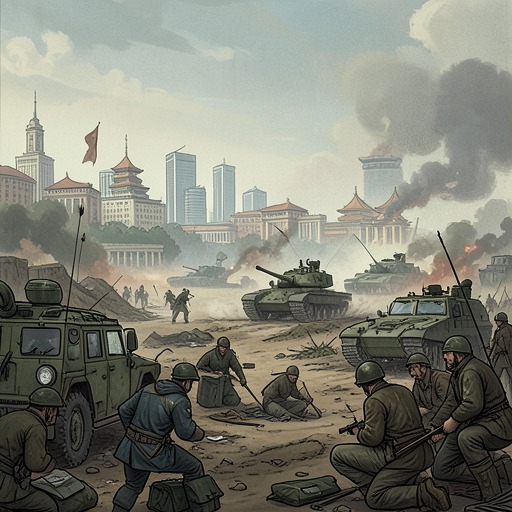
The account identifies the war’s earlier form as primarily guerrilla, domestic, and fought with light weapons. South Africa’s intervention altered that pattern, bringing regular armies and heavier equipment into a conflict whose young republic remained in a difficult military position. The change mattered not simply because the weapons were larger, but because it raised the demands placed on organization and supply. A force accustomed to local, limited engagements now faced a contest in which sustained movement, coordination, and the concentration of military strength became increasingly consequential.
The book’s account of the early battles shows the limits from which the MPLA’s forces were developing. Comandante Ndozi describes green soldiers who fired in fear and often used up ammunition without aiming effectively. In one action, the unit’s intense opening fire helped drive an unfamiliar enemy from a town; in another, the soldiers had spent their cartridges before reaching the objective. Taking ground did not automatically mean possessing the means to defend it. Ndozi’s unit had only existed for a month, and its commander’s experience of guerrilla warfare could not instantly make inexperienced recruits into disciplined troops.
The material conditions of combat remained stark. At one front, wounded soldiers waited in a truck for fuel before they could be taken toward Luanda, while the unit had no doctor and feared its ammunition was running short. Farther south, a unit of 120 faced responsibility for an immense region with only one road as a practical route of movement. Convoys had disappeared in ambushes, and an isolated garrison had gone without a successful supply convoy for a month. These circumstances show the transition not as a simple replacement of light weapons by heavy ones, but as a widening mismatch between the scale of the battlefield and the resources available to hold it.
Logistics and the limits of military reach
Transport and supply recur as decisive constraints. The southern journey toward Pereira d’Eça depended on a dilapidated truck moving along a road vulnerable to ambush. The surrounding country offered few alternatives: the road was dangerous, but leaving it could mean losing the route through a sparsely inhabited, waterless landscape. The remains of earlier convoys underscored the cost of the route’s exposure. Even when a unit could reach a position, its ability to remain there depended on whether food, fuel, ammunition, and reinforcements could follow.
The MPLA’s only plane in Luanda made that dependence visible from the air. Ruiz flew an aging DC-3 between Luanda, Brazzaville, and besieged or isolated towns, carrying ammunition and food outward and returning with serious casualties. With no reliable air-control system, he sometimes had to establish whether an airport remained in friendly hands before landing. Cities and garrisons waited for these flights; a mechanical failure could interrupt supply and evacuation alike. In a war increasingly shaped by regular forces and heavier equipment, the old aircraft’s repeated journeys show how fragile the infrastructure supporting military operations remained.
The same fragility affected communications and the interpretation of the war. Comandante Ju-Ju’s radio communiqués described changing conditions at the front, but their tone itself became a signal: reports were brief when events were going well and more elaborate when the situation worsened. The narrator heard the lengthening broadcasts from the streets of Luanda and took their duration as an indication that something had gone wrong. Elsewhere, leaflets circulated claims about Holden Roberto’s army and the impending capture of Luanda, while later official communiqués could project imminent victory despite a grave military situation. These competing accounts do not alter the material state of the fronts, but they show how the struggle to describe events accompanied the struggle to control them.
Consolidation and counteroffensive
By the time the narrative announces that the war had changed in character, it also reports that the Angolan Army leadership was consolidating its forces to go on the offensive. This marks a change in orientation as well as in the kind of warfare being fought: the account moves from scattered units trying to hold exposed positions toward an effort to assemble forces for coordinated action. The republic remained in a difficult military predicament, so the statement describes an opportunity and a developing capacity, not an effortless or already-secured victory.
The later chronology gives that consolidation a concrete military outcome. In November 1975, the MPLA army began a counteroffensive supported by units of the Cuban Army. During December and January, the armies of the FNLA and UNITA were destroyed. The transition therefore leads from early limitations—green troops, ammunition wasted in panic, isolated garrisons, and perilous supply routes—to a concentrated offensive capable of defeating opposing armies. The sequence does not imply that every earlier constraint vanished; rather, it records a change in the MPLA’s ability to organize and apply military force.
Meaning of the transition
The shift from guerrilla warfare to regular warfare gives the book a way to connect battlefield scenes with the larger military history. The early fighting is rendered through immediate shortages and improvised decisions: a commander checks whether ammunition remains, a convoy risks the road, and a plane becomes a vital link between separated forces. The later description of regular armies and heavy equipment enlarges the scale, but does not make the basic dependencies disappear. Military reach still rests on people, transport, supply, and coordination.
The transition also sets the official language of mobilization against the uneven evidence of the front. Communiqués can celebrate a victory or insist on confidence; dispatches can announce a changed military character and a coming offensive. Yet the narrative repeatedly returns to the practical test behind such claims: whether a unit can hold a town, whether ammunition can arrive, whether a wounded soldier can be evacuated, and whether scattered forces can be brought together. In this account, the move toward conventional warfare is significant because it changes what the armies can attempt—and because the capacity to attempt it has to be built under pressure, amid the material limits the earlier scenes make plain.