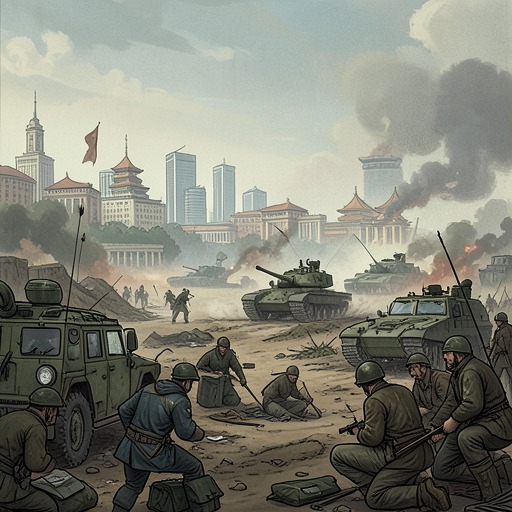
MPLA–FNLA conflict
Another Day of LifeThe MPLA–FNLA conflict is one of the armed rivalries that engulf Angola in the months before independence. In the book, it is not a distant contest between political organizations: its shifting front reaches toward Luanda, shapes what the city hears about the war, and places young soldiers and captured opponents on either side of an uncertain struggle for power. The narrative sets military claims against observed conditions, showing how combat and its competing accounts both erode the possibility of trust.
Background and Stakes
The conflict takes shape in the unsettled transition that follows Portugal’s overthrow of the Salazar dictatorship. In the spring of 1975, the new Portuguese rulers grant Angola and the other former colonies the right to independence. Angola’s armed political parties then fight to control the country, with the struggle described as cruel and unpredictable: no one can be sure who will die, or when and where. The correspondent’s account presents the MPLA–FNLA fighting as part of this wider contest, not as an isolated dispute with a settled front or a secure outcome.
The stakes are political, but the costs fall well beyond the combatants. The account depicts people fleeing across the country and gathering in Luanda, while the city’s institutions and basic services begin to fail. These developments have more than one cause and cannot all be assigned to the MPLA–FNLA conflict alone. They establish the conditions in which its military advances, threats, and public claims are received: a population already facing displacement and uncertainty has little reliable information about what may happen next.
Caxito and the Treatment of Captives
A report from Caxito gives the rivalry a specific location and immediate military consequence. Caxito lies more than sixty kilometres north of Luanda. After a dawn battle, Comandante Ndozi’s MPLA unit has taken the town from the FNLA, making it possible for the correspondent to travel there. The seizure is presented not as a conclusive victory but as a change in control within a war whose outcome remains uncertain.
The unit takes 120 FNLA prisoners. Comandante Ju-Ju, the MPLA general staff’s political commissar, questions them one at a time beneath a large chestnut tree, seated on an ammunition crate containing grenades captured from the enemy. His manner is described as shy and his speech as polite, even deferential. He nevertheless frames the interrogation as a political lesson: he appeals to a prisoner’s shame and guilt for fighting with the FNLA, which he characterizes as an agent of imperialism, and hopes to lead him toward what he considers the right course. The scene joins custody to persuasion; the captured men are not only opponents to be held but subjects of an argument over which side represents Angola’s political future.
Claims, Communiqués, and the City
The conflict is also fought through messages aimed at Luanda’s residents. In September, an unmarked black plane drops leaflets claiming that Holden Roberto’s army is outside the capital and will enter soon. The leaflets urge people to kill Eastern Europeans said to be commanding MPLA units and blamed for the country’s misfortunes. The account notes that the correspondent was then the only person from Eastern Europe in Angola. The threat therefore makes a political accusation personally dangerous, while the absence of functioning authorities leaves those targeted with little protection. Gangs from PIDE also move through the city seeking information about hotel guests, adding to the atmosphere of insecurity.
MPLA broadcasts offer a contrasting version of the war. Comandante Ju-Ju reads the daily communiqué at eight in the evening, and the correspondent observes that its style changes with the fortunes it reports. When the news is good, the statements are brief and calm; when circumstances worsen, they grow longer and more strident, with more adjectives, self-praise, and denunciations of the enemy. Even from a distance, the length of the broadcast becomes a clue: a short reading suggests that MPLA forces are holding or gaining ground, while an extended one signals that something has gone wrong. The communiqué is at once a report and an effort to maintain support, but its rhetoric can make the military situation harder, not easier, for listeners to judge.
That disparity becomes sharp as the pressure on Luanda mounts. Holden Roberto announces that he will enter the city and asks its inhabitants to remain calm; the accompanying leaflets present him as a figure of authority. The correspondent, meanwhile, hears artillery and sees panic in a city only fifteen minutes by car from the front. These details do not establish that Luanda has fallen; they show how claims of imminent entry and the sounds of battle narrow the distance between the front and civilian life. The opposing messages promise control while the city experiences uncertainty.
Civilian Consequences and Uncertain Outcomes
The account also records the conflict’s human cost away from the immediate line of combat. On a journey with local journalists to Lucala, four hundred kilometres east of Luanda, the correspondent sees the aftermath of an FNLA unit’s withdrawal toward Samba Caju, seventy kilometres to the north. Villages along the route have been burned and their inhabitants killed; the destruction has left the journey through a populated region marked by the absence of living residents and intact homes. The episode conveys the consequences of the fighting without resolving the larger contest or implying that every act of violence in the country belongs to this one rivalry.
At the same time, the MPLA’s own public account remains strongly optimistic. Even when the correspondent judges that half the country is in enemy hands, the evening communiqué makes the MPLA appear close to victory. The mismatch matters because public appeals to defend Luanda coexist with assurances that things are going well. In the account, this contradiction risks weakening confidence: if the audience is told both that the situation is urgent and that success is nearly assured, it may no longer know which message to trust or how seriously to respond.
The conflict’s significance therefore lies both in control of towns and in the struggle to make events legible. Caxito changes hands; prisoners are questioned and urged to adopt the victor’s political interpretation; leaflets threaten a targeted group; and broadcasts turn military fortunes into competing narratives. Meanwhile, Luanda’s deteriorating security and the devastation reported along the road to Samba Caju expose the limits of those narratives. The book presents the MPLA–FNLA conflict as a contest for Angola’s future whose battlefield extends into civilian movement, public speech, and the fragile ability to distinguish reassurance from warning.