Nelson
Another Day of LifeNelson is a young white Angolan political commissar at the MPLA front headquarters in Lubango, where a cheerful welcome quickly turns into an order sending Rysiek toward the front. His abrupt decisions set people and vehicles in motion before they can fully understand the danger or destination. Later, he drives through the night toward a battle and reappears with Manuel and Comandante Bota, exhausted but alive. In these episodes, Nelson is both a personal presence and a force of acceleration in a war defined by uncertain routes and sudden encounters.
Identity and Introduction
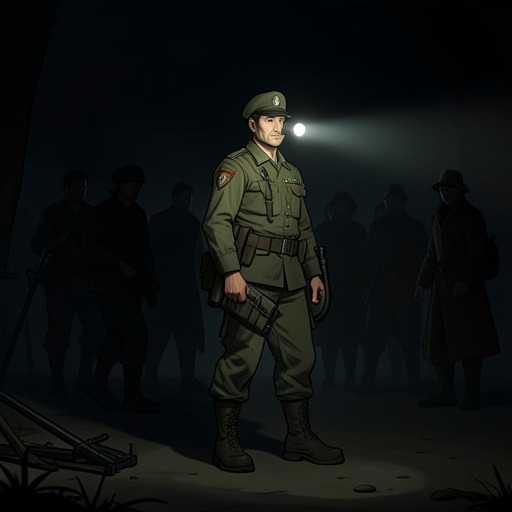
Nelson is introduced at the front staff headquarters, a residential quarter on a hill in Lubango. He greets Rysiek with conspicuous pleasure, as though the correspondent were an expected guest. That welcome is immediately undercut by what follows: Nelson sends him on a journey the narrative describes as approaching certain death. The contrast establishes Nelson’s characteristic effect without resolving his intentions. He can make a stranger feel received, yet his welcome offers no shelter from the risks of the front.
The circumstances of their meeting help explain how quickly Nelson gains control of Rysiek’s movements. Rysiek has arrived in Lubango by chance, does not know how he will leave, and has reached headquarters through an encounter at the airport. When Nelson asks what he wants, Rysiek says he wants to go to the front. Nelson writes him a pass at once. The decision is swift enough that Rysiek has little time to understand what is happening before Nelson pushes him outside toward a waiting truck.
The First Expedition
The truck is already being started by a thin civilian driver, and its load leaves little room: rifles, ammunition boxes, gasoline barrels, sacks of flour, and six soldiers riding atop the cargo. Nelson puts Rysiek in the cab with the driver; Diogenes, who leads the expedition, joins them moments later. Nelson’s part in the departure is direct, but the destination is not explained to Rysiek. The sequence makes the journey less a planned assignment than the result of a pass, an order, and a vehicle already in motion.
The contrast between Nelson’s quick dispatch and Rysiek’s uncertainty is central to the episode. Rysiek does not know where the truck is going and cannot bring himself to admit it to Diogenes. He has met Nelson only moments earlier and knows almost nothing about him; the truck has already carried him out of town and onto a road bordered by thorny bush. In the narrator’s account, events have proceeded so quickly and decisively that he has had no time to think or refuse. Nelson thus shapes the journey not through an explained strategy, but through the force of immediate action.
Driving Toward the Battle
Nelson appears again in a different vehicle and at a different hour: at two in the morning, after a pounding at Rysiek’s door, he is driving a grey Peugeot 504 toward Benguela. Comandante Bota sits beside him with a bottle of whisky, while Manuel rides in the back with Rysiek and carries an Uzi machine pistol. The car, its passengers, and the hour give the episode a different texture from the heavily loaded truck, but the movement is again abrupt. Rysiek wakes, gets into the car, and only afterward learns that a battle lies ahead.
Manuel explains that Daniel Chipenda’s force is attacking and that the only unit ahead is led by Comandante Antonio, who is in Benguela looking for weapons. The account does not give Nelson’s reason for driving toward the fighting. The car continues, and at the crossing in Caculi the passengers hear gunfire and explosions nearby. Nelson turns off the lights and slows, proceeding in the dark; Comandante Bota calls for a slower pace, while Manuel suggests that going faster might be preferable. Their disagreement leaves the danger unresolved as they continue along the road.
At the last moment, Nelson sees a parked truck and prepares to swerve around it. A man jumps from the ditch and tells him that he has twenty people but no gasoline with which to send them forward against Daniel Chipenda. Nelson directs him to Lubango for fuel; the man answers that he has no way to get there. The exchange exposes a practical impasse rather than offering a solution. Nelson can issue a direction, but the other man’s lack of transport makes that direction unusable. In this encounter, the movement Nelson repeatedly initiates meets the limits imposed by shortages and a fragmented front.
Reunion and Narrative Role
Nelson’s next appearance is at Rysiek’s door at two in the morning. Rysiek initially fears that the visitors may be from the FNLA; instead, Nelson arrives with Manuel and Comandante Bota. The three men embrace and shout with Rysiek, put their weapons on the floor, and ask to wash. Nelson then lies down and falls asleep almost immediately, while the others open the single can of meat Rysiek had saved for an emergency. The scene replaces the earlier image of Nelson propelling others into danger with one of a companion returned in a state of exhaustion.
When Rysiek asks about the southern front, Manuel says there is no longer a southern front: the enemy is already outside Benguela, and a second column is heading for Luanda. The report gives the reunion its larger context, but the narrative does not show Nelson responding to it; he is asleep. His appearances instead mark a pattern of sudden transitions: the pass that sends Rysiek away, the night drive toward gunfire, the encounter with a unit short of fuel, and the return to a room where immediate rest takes precedence over discussion. Nelson’s limited portrait does not explain his motives or establish a broader history. It shows how, in a conflict where a road may become a front and even basic supplies can determine whether men move, his impulsive decisions help carry the narrative from one uncertain situation to the next.