South Africa–MPLA conflict
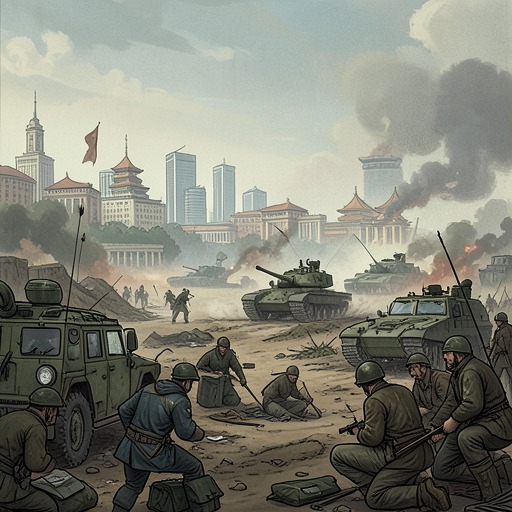
Another Day of LifeThe South Africa–MPLA conflict is presented as an invasion whose approach is first difficult to distinguish from rumor, then visible in the movements of armored columns and the retreat of MPLA forces. Its course is shaped not only by disparities in firepower but by the immense distances, fragile roads, limited supplies, and uncertain information that leave southern units exposed. Across the narrative, warnings travel ahead of the advancing army, while the front itself remains too scattered to form a stable line of defense.
Warnings and the approach of invasion
In the southern borderlands, news of a possible South African advance reaches Comandante Farrusco through Portuguese refugees. A baker’s son returning from Windhoek and Tsumeb reports that Portuguese exiles expect the South African Army to enter Angola and drive out the MPLA. He recounts that South African officers in Windhoek had asked men at a camp about their military service and willingness to join forces preparing to strike Angola. In Tsumeb, he had also heard that armored vehicles were assembling. At this stage, these accounts are testimony relayed by refugees, not yet a battlefield confirmation; their repetition makes it difficult to dismiss them but does not tell the isolated MPLA unit precisely when or where the advance will come.
Farrusco takes the warning seriously. The narrator wants to return to Lubango and continue to Luanda so he can report the news to Warsaw, but the road cannot safely be used at night: lights would reveal a vehicle, and an ambush could block the only route. The danger is intensified by the unit’s isolation. Farrusco commands 120 men across a southern region described as one-third the size of Poland, with hundreds of kilometres between the border and Lubango and a vast, sparsely inhabited area extending toward the Atlantic and Zambia. The road is not merely a route through the front; it is the unit’s narrow connection to supplies and retreat, and it might already have been cut.
A front without a continuous line
Farrusco describes the southern front as a changing collection of vulnerable points rather than a boundary that can be drawn on a map. Water determines where soldiers can remain: where there are no springs, units cannot hold out, and the next source may be a hundred kilometres away. Each unit therefore guards its own water and occupies an isolated position. If it encounters an enemy force, a potential front becomes an actual battle; elsewhere, the intervening land may be empty of both armies. On this terrain, a road can become a front without warning, and a small unit moving along it can be exposed before it knows where the enemy is.
The journey north makes these abstractions concrete. Earlier convoys had disappeared into ambushes; the narrator and Diogenes pass burned-out trucks and the remains of abandoned loads. The wreckage marks the cost of relying on the road, but leaving it offers no reliable escape across dry bushland. Diogenes reasons that the heat at midday sometimes makes an ambush less likely, so movement depends on reading conditions as much as on following a plan. The convoy later encounters armed people directly in the road; neither side fires, and the exchange of shots into the air allows the vehicles to stop. Such uncertain encounters underscore how quickly movement through the country can become a military contact.
The first confirmed advance
The warnings become immediate on Sunday, 19 October. Farrusco has been looking for his driver, Antonio, and the two set out in a red Toyota jeep along the bush road. They encounter a long column of armored vehicles accompanied by a helicopter. Gunfire follows: Farrusco is badly wounded, and Antonio, hit in the leg but still conscious, turns the jeep around and carries his commander away from the advancing force. The column continues toward Pereira d’Eça. The encounter establishes that the anticipated South African advance is no longer a rumor at the border; armored forces are moving into the region held by the MPLA.
The imbalance is also practical and local. Farrusco has warned that the unit lacks anti-tank weapons and that even one armored vehicle could paralyze the road at Humbe. As he and the narrator travel north, he asks that Luanda be told to send men and arms, warning that his force cannot hold the ground if troops move in from Namibia. The request links the fate of a small southern unit to decisions and resources far away: without reinforcements, weapons, or a dependable route, the unit can observe the danger but has little capacity to stop it.
Retreat and widening pressure
Later, the news from the southern front is blunt: there is no longer a southern front, and South African forces are already outside Benguela. A second column is headed for Luanda. Manuel explains that the South African side has extensive armor and artillery and that MPLA soldiers are not prepared to face a regular army on those terms; the MPLA is withdrawing because the forces are unequal. A dispatch sent to Warsaw reports that the South African Army, supported by mercenaries and the FNLA and UNITA, has occupied Benguela. The advance thus appears not as a single isolated clash but as a widening offensive involving allied forces and multiple axes of movement.
The pressure on the MPLA is sharpened by logistical weakness. Earlier, at Caxito, Comandante Ndozi’s unit has taken the town from the FNLA, but even after a victory its wounded wait in a truck for fuel, while ammunition is running short. Ndozi describes inexperienced soldiers firing heavily and sometimes blindly; the volume of fire can frighten an equally inexperienced opponent into withdrawing, but it can also leave the MPLA without ammunition for the next attack. In the south, the same scarcity is compounded by long distances and the loss of convoys. These details distinguish a battlefield success from the ability to hold territory: taking a town does not ensure that it can be supplied or defended against a better-equipped force.
Luanda, reporting, and the stakes of the conflict
The approach of the southern columns coincides with growing danger around Luanda. During the artillery attack described in the narrative, Holden Roberto announces that his forces will enter the capital, and the city responds with panic as the front is reported to be only a short drive away. The episode conveys the confusion of a conflict in which different forces threaten the MPLA from different directions; it does not make the South African advance and Holden Roberto’s forces interchangeable. Reports about the South African Army’s occupation of Benguela and movement toward Luanda give the southern threat its own distinct military course.
Wartime communication is itself part of the struggle. Comandante Ju-Ju’s radio communiqués grow longer and more emphatic when events are going badly, while their optimistic claims can conflict with the narrator’s view that much of the country is in enemy hands. At the same time, the decrepit DC-3 flown by Ruiz carries ammunition and flour to besieged cities and brings seriously wounded soldiers back to Luanda. In a country with little transport or communication, the aircraft is a precarious link between the capital and distant garrisons; a motor failure could interrupt supplies and change the course of the war. The conflict therefore unfolds not only through advances and withdrawals but through the contest to move reliable information, food, ammunition, and wounded people across a fractured landscape.
The narrative places this military pressure beside the declaration of the People’s Republic of Angola and the independence celebrations in Luanda. Political independence is proclaimed while South African columns are still advancing and the MPLA faces severe military and logistical disadvantages. That contrast gives the South Africa–MPLA conflict its larger significance in the book: the new state’s survival is tested at the moment of its birth, and the campaign is experienced not as a settled front but as a shifting struggle over roads, towns, supplies, and the ability to know what is happening beyond the next stretch of bush.