South African Army in the Angolan campaign
Another Day of LifeThe South African Army in the Angolan campaign was the principal military force on Operation Orange’s southern flank. Its advance formed part of a coordinated effort to reach Luanda before the end of Portuguese rule and shape who would hold power at independence. The account sets the army’s organized, armored movement against a war in which distance, unreliable information, and fragile supply routes repeatedly determined what forces could do.
Strategic purpose and timetable
Operation Orange was planned at staff headquarters in Pretoria, then in Windhoek and at the front headquarters in Tsumeb. The goal was to occupy Luanda by 6 p.m. on 10 November 1975, the hour set for the last Portuguese units to leave Angola under the Alvor Agreement. On the following day, the plan called for independence to be announced with power passing to an FNLA–UNITA coalition government. The timetable therefore joined a military objective to a specific political outcome; the planned advance was not presented as an operation separate from the contest over who would govern.
The start date was debated. One group urged an earlier opening because resistance and lengthening supply lines could delay the advance, while another argued that the operation would take less than two weeks and that the northern force was already near Luanda. Its preferred date was 27 October. The more cautious proposal prevailed, and the recorded zero hour was Sunday, 19 October. The planners still expected a rapid campaign, but the earlier start allowed more time for the operation than the later proposal did.
Three axes and allied forces
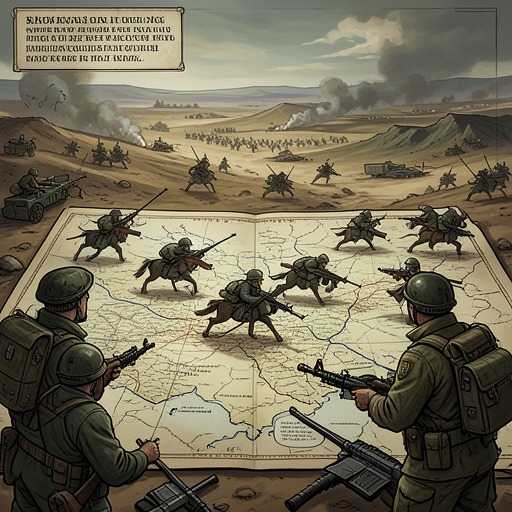
The plan coordinated three approaches toward the capital. On the southern axis, motorized units of the South African Army in the Angolan campaign were to travel from Tsumeb through Pereira d’Eça, Lubango, Benguela, and Novo Redondo toward Luanda. The northern thrust was to proceed through Maquela do Zombo, Carmona, and Caxito; an eastern thrust was to run through Nova Lisboa, Quibala, and Dondo. Each route converged on the same objective, making the operation a multi-front advance rather than a single column moving north.
The southern force was to receive support from Portuguese volunteer units, FNLA and UNITA units, and the Chipenda force. On the northern flank, FNLA units were supported by units of the Zaïre army and Portuguese volunteers; the eastern flank was assigned the same supporting forces as the northern one. The account thus distinguishes the South African motorized units from the allied formations on the other axes, while placing them within a wider coalition operation. The plan’s geographic reach depended on coordinating these forces along separate routes and bringing their advances together at Luanda.
Intelligence, rumor, and the opening
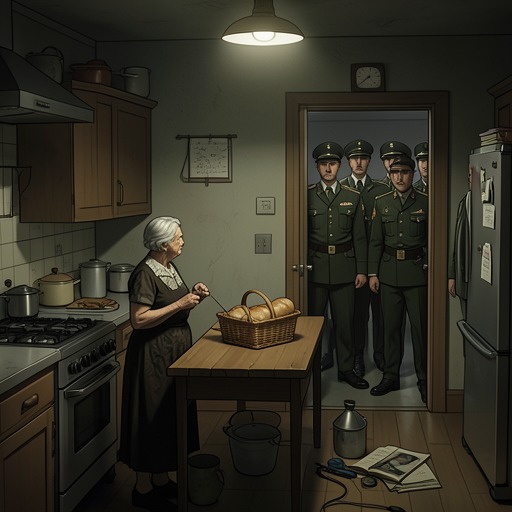
Before the advance, warnings circulated among people moving through the region. Humberto, the baker’s son, reported that Portuguese refugees in Windhoek and Tsumeb expected the South African Army in the Angolan campaign to enter Angola and drive out the MPLA. He said South African army officers had visited a camp in Windhoek to ask who had served in the army and who might enlist for an attack on Angola. At a Tsumeb gas station, a white man had told him that the town was full of armored vehicles expected to move across the border. These were reports passed along by travelers, not a staff briefing; their repetition shows how anticipation of an advance spread before the narrator encountered the force itself.
The account’s described opening comes on 19 October. Comandante Farrusco had been searching for his exhausted driver, Antonio, and eventually set out with him in a red Toyota jeep. On the road through the bush they encountered a long column of armored vehicles, with a helicopter above it. Gunfire followed; Farrusco was wounded, and Antonio drove him away. The scene brings the planned southern movement into the immediate experience of the MPLA’s small, exposed units, without suggesting that those units had the resources to match an armored column.
Advance, logistics, and reported gains
The southern route crossed a landscape in which control of the road was crucial. Diogenes explained that MPLA-held cities such as Lubango and Pereira d’Eça were separated from one another by countryside held by the enemy, and that convoys attempting to reach the unit at Pereira d’Eça had been lost in ambushes. Another account describes Farrusco’s force as the only unit on a southern front extending 450 kilometres between Lubango and the border and 1,200 kilometres between the Atlantic and Zambia. These details do not establish that every lost convoy or road danger was caused by the South African Army in the Angolan campaign. They do show the conditions in which its southern advance took place: sparse forces, long distances, and a route on which supply and movement were inseparable from exposure to attack.
A dispatch reports that, within the preceding twenty-four hours, the South African Army in the Angolan campaign, supported by mercenaries and FNLA and UNITA units, had occupied Benguela. Later, the account describes two mobile, powerful armored columns moving from the south toward Porto Amboim and onward. Together these reports show the southern offensive passing from its planned route into a sequence of reported gains and continued movement toward Luanda. They do not establish that the operation achieved its stated deadline or political objective; the narrative presents the columns still advancing, with the outcome of that advance unresolved in these passages.