The wooden city
Another Day of LifeThe wooden city is the immense, temporary settlement of crates built in Luanda by Portuguese residents preparing to leave as war approached. More than a practical response to departure, it becomes a portable version of the homes being abandoned: first a new center of daily attention, then an assembled harbor landscape, and finally a cargo carried across the Atlantic. Its journey makes the exodus visible while sharpening the contrast between possessions transported abroad and Angolans left to inherit the emptied city.
Construction and the exodus
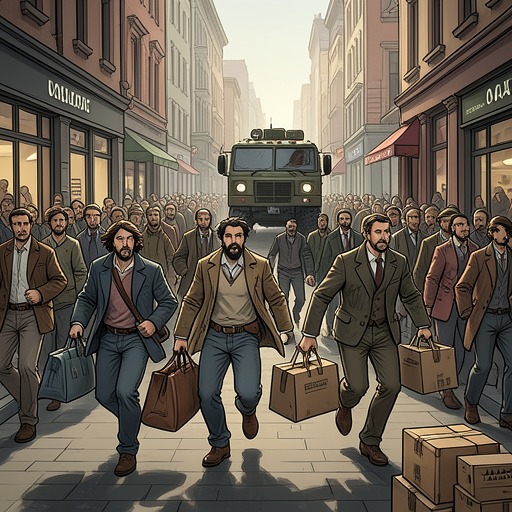
At the end of September, as people hurried to settle their affairs and escape Luanda, crates became the overriding practical concern. Boards and plywood arrived in great quantities, and the price of hammers and nails rose. Residents exchanged advice about construction and reinforcement; improvised crate specialists, architects, schools, and styles appeared. The account describes this activity as a second city taking shape inside the existing Luanda of concrete and brick. The streets became a building site, with discarded planks underfoot and projecting nails catching at clothing.
The crates also reproduced the inequalities of the society building them. Their size and finish marked status: the richer the residents, the larger the crates they erected. Millionaires’ containers were built from costly tropical woods, with beams and sailcloth linings, and polished details. Their contents extended far beyond necessities. Furniture and appliances went alongside clothing, tableware, ornaments, artificial flowers, and framed family pictures. Residents tried to pack the accumulated evidence of domestic life together with provisions, tools, toys, and other practical or cherished objects. The effort to take everything made each crate less a simple box than a condensed household.
A new measure of home
Construction continued from dawn to twilight, in changing weather, and involved adults and children alike; children made crates for their dolls and toys. Much of the packing happened at night. The darkness offered privacy in a city where some residents feared that people serving the MPLA would report what others were moving or how much they had packed. The transfer from houses and apartments into crates demanded sustained physical work, as the contents of the larger stone city had to be fitted into smaller wooden enclosures.
As packing progressed, the two kinds of city changed places in residents’ minds. The stone city lost value, while the wooden one became the object of attention. People spoke of checking their crate rather than going home. This change of vocabulary registers a change in what home meant: the permanent residence was already becoming an empty place to leave, while the container holding its contents carried the promise of departure. The account presents the old Luanda as an alien stage set, its ordinary domestic life withdrawn before its buildings had disappeared.
The harbor city and its departure
The wooden city existed for months, then began to vanish quarter by quarter as trucks carried it to the port. There it formed a disordered landscape beside the sea, lit at night by harbor and ship lights. In daylight, people moved through its makeshift streets and put their names and addresses on small plates, as if establishing ordinary homes. That resemblance was necessarily temporary: the crates’ residents had shut them up because they had to leave in haste, not because they were settling into a new neighborhood in Luanda.
By the time conditions in the stone city had deteriorated and the remaining inhabitants were waiting for its destruction, the crates were carried away in a large flotilla. The account describes their sudden departure as the seizure and escape of a treasure. At dawn, the crates still lay offshore in a confused, uninhabited mass. Angolan soldiers and homeless Black children watched from the shore. One soldier said that everything had been taken, then turned to cut a pineapple, which was the group’s only food. He added that they nevertheless had a home now, because what belonged to them had been left behind; he then fired his rifle into the air. The wooden city’s departure thus coincides with a claim of belonging to Angola, even as the people left in Luanda face scarcity.
The Atlantic dispersal
The account insists on the literal journey of the crates while also presenting it as the journey of a city: the wooden city sails out in search of its former inhabitants. Those inhabitants, the Portuguese who had left Angola, had scattered across Europe and America, with some reaching South Africa. The contrast is pointed. The stone city remained in place, with its walls, roofs, roads, and benches, but its departing residents had packed their homes into wood and taken them away; cars were left rusting and gathering dust in the streets.
During the Atlantic crossing, the wooden city divided into three sections. The largest went to Lisbon, another to Rio de Janeiro, and a third to Cape Town; all reached their destinations. The account supports these landfalls through different kinds of evidence: Maria wrote that her crates had arrived in Brazil, newspapers reported the section in Cape Town, and the narrator saw vast stacks of crates near Lisbon’s port at the mouth of the Tagus. The scene there made the largest portion of Luanda’s wooden city appear abandoned, though it had reached the European coast.
Meaning and narrative function
The wooden city turns departure into a visible, material process. Its making records the residents’ urgency, their unequal resources, their attempt to preserve entire households, and their expectation that they must leave. Its changing importance also gives the exodus a domestic scale: the crisis is registered not only in the emptied streets but in the transfer of photographs, furniture, food, and small keepsakes from one kind of home to another.
At the same time, the crates make the meaning of home unstable. For the departing residents, home becomes something portable and addressed elsewhere; for the people watching in Luanda, the departing cargo marks both loss and the possibility of claiming the country left behind. The city’s final form is therefore neither simply a neighborhood nor merely freight. It is a temporary architecture of flight, broken into sections and scattered across distant ports, while the stone city remains as the shell of the life from which its contents were removed.