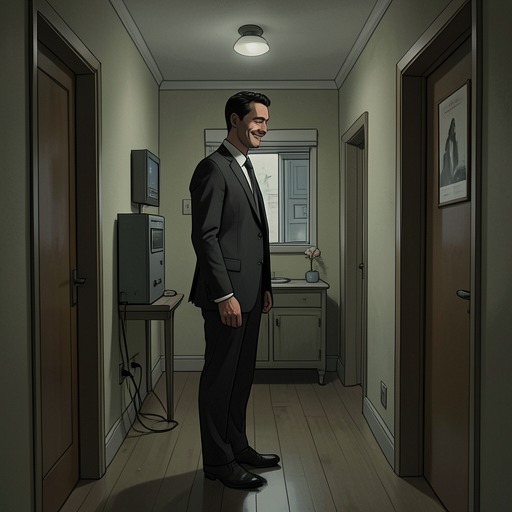
All the apartments that aren’t for sale
Anxious PeopleLennart’s answer, “All the apartments that aren’t for sale,” is a compact expression of his faith in love and a counterpoint to the novel’s recurring treatment of housing as a financial asset. He offers it when Zara asks what he bases that faith on, after she has accused him of profiting from other people’s marital unhappiness. The line does not prove that every unsold home is a happy one; instead, it makes the homes outside the market stand for lives and attachments that cannot be reduced to a sale price.
The exchange with Zara
Zara’s challenge emerges during a conversation with Lennart, who is inside the rabbit costume. She argues that he is trying to get rich while Anna-Lena is trying to make him happy, and that their relationship is merely postponing a divorce. In her account, the breakup would suit Lennart because the couple would then need to buy two apartments. Her accusation links his work and their marriage to the same property market: conflict, separation, and another transaction appear to reinforce one another.
Lennart raises his voice to reject that conclusion. When Zara presses him to say what he believes, he answers, “Love.” He explains that after attending two thousand apartment viewings, he has seen too much love in the world to believe that people’s relationships are simply a source of profit or eventual divorce. Zara asks what supports that claim. His answer is the phrase itself: all the apartments that are not for sale.
The exchange changes its emotional direction without resolving their disagreement. Zara has been waiting ten years for someone to ask what she believes, and Lennart’s response catches her off guard. She cannot answer his evidence, and admits to herself that it is not entirely ridiculous. Her irritation remains, but the conversation moves from accusation toward a moment of shared ease: she offers him a cigarette, and he singes the rabbit costume’s nose while lighting it. The phrase belongs to that brief opening between them, where his unembarrassed romanticism unsettles her more than a neat argument would.
What the unsold apartments signify
Lennart’s observation reverses the usual emphasis of a viewing. A viewing presents an apartment as something available to be inspected, priced, and bought. His answer directs attention to the far larger category of homes that never enter that process. Their absence from the market becomes, for him, evidence of people continuing to inhabit lives together, rather than evidence that the housing market has exhausted the world’s meaning.
The sentence is deliberately broad, not a statistical demonstration. Apartments may remain unsold for many reasons, and the novel does not establish that each one represents a loving household. Its force comes instead from the contrast it draws: what can be listed and traded is visible, while what people keep is harder to count. Lennart’s answer treats that remainder as meaningful. It offers Zara a way to imagine that the world contains more than the betrayals, calculations, and separations she has learned to notice.
Housing as asset, housing as home
The phrase gains weight against the novel’s account of housing insecurity. A person without savings or a job cannot readily buy an apartment, because banks are reluctant to lend to someone who lacks money. Renting is not an easy alternative: in the town described, a tenant without employment must provide four months’ rent as a deposit. The rules make shelter hardest to secure for people who most urgently need it, turning a home into both a basic necessity and a financial threshold.
That pressure reaches the bank robber, who needs 6,500 kronor for rent and fears that, without a home, her husband’s lawyer may take the girls from her. Her earlier marriage has already left her separated from the apartment where the children live. She does not contest the divorce or fight for the home, partly because she does not want the girls to be caught between parents at war. The housing market’s abstract barriers thus become a question of whether she can maintain a place in her children’s lives.
The same tension appears in the account of Man on the bridge. He trusted supposedly secure investments, used them as security for loans, and borrowed again to repay earlier debts. When the financial crisis erased his savings and left him with debt, the bank framed the loss as his risk. The episode exposes how financial systems can distribute protection unevenly: an institution can preserve itself while a person loses the foundations of a home and livelihood. Against that history, Lennart’s line insists on a kind of value that investment language cannot capture.
The market’s counterexample
A later disclosure about an apartment opposite the one being viewed makes the contrast concrete. Its owners are splitting up, the furniture has been removed, and a juicer is the only item left. The apartment has not yet been advertised: selling two apartments at the same time could bring a lower price for both. Its availability is therefore shaped by two forces at once—the end of a relationship and a calculation about when to sell.
This empty apartment complicates Lennart’s hopeful phrase without cancelling it. Here, a home is both the residue of a couple’s separation and an item whose sale must be managed for financial advantage. The scene shows precisely why an apartment’s presence or absence on the market cannot, by itself, certify love. Lennart’s answer works instead as a chosen perspective: amid the homes that become commodities and the relationships that fracture around them, he insists on noticing those people who keep their homes out of circulation.
Narrative significance
The phrase brings together the novel’s intimate and economic strands in a single reversal. Zara sees the housing market as a machine that can turn a divorce into two purchases; Lennart looks at what that machine does not contain and finds a reason to believe in love. His optimism is not presented as a technical rebuttal to financial hardship or a guarantee that relationships endure. It is a refusal to let market transactions define the full measure of human attachment.
That refusal matters because the novel repeatedly shows how money, borrowing, rent, and ownership shape people’s choices, sometimes narrowing them until a desperate act seems possible. Lennart does not erase those pressures. He offers a small counter-image to them: not an apartment changing hands, but all the apartments that remain beyond the transaction. The line’s tenderness lies in its scale. Faced with Zara’s suspicion and a world where even shelter is governed by money, he answers with a multitude of ordinary, unadvertised continuities.