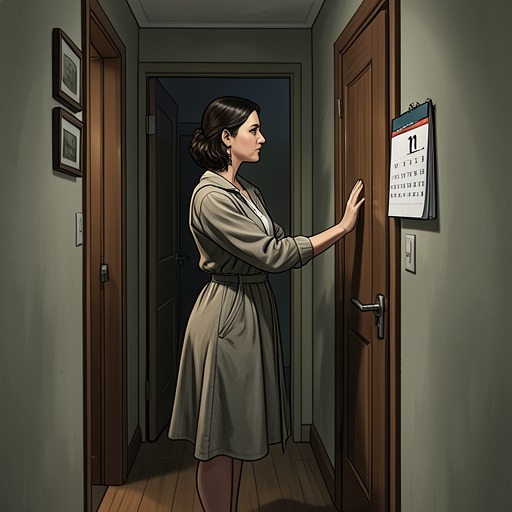
Anna-Lena and Roger
Anxious PeopleAnna-Lena and Roger’s marriage is presented as a partnership in which irritation and care have become difficult to separate. Recently retired and still adjusting to days without a clear reason to hurry, they bicker over household details and apartment viewings, yet remain finely attuned to each other’s needs. Their bond shows itself less through declarations than through shared projects, familiar routines, and small acts of consideration that persist beneath the quarrels.
Identity and Shared Habits
Retired for a few years, Anna-Lena and Roger have not yet grown used to retirement. They are often anxious about something without having anywhere they actually need to be. Their temperaments differ: Anna-Lena is described as a woman of strong feelings, Roger as a man of strong opinions. Together they have cultivated a brisk, judgmental commentary on domestic life. They write highly detailed one-star reviews of household goods, theater performances, tape dispensers, and small glass ornaments; sometimes they have not even tried the product before deciding what they think of it. In their view, the need to investigate something fully would leave too little time to have an opinion.
That shared habit becomes a comic portrait of how they occupy their time and space. At an apartment viewing, Anna-Lena criticizes the green curtains and speculates aloud about the people who might have chosen them. Roger, meanwhile, kicks at a baseboard and declares it loose; the narration leaves open the possibility that his repeated kicking has made it so. Their separate observations rarely coincide, but they unfold side by side, each absorbed in a familiar way of assessing the world.
Arguments and Projects
Their exchanges can sound like constant disagreement, though the boundary between arguing and not caring has become hard to locate. At the viewing, Anna-Lena complains that the apartment needs serious renovation. Roger tells her to keep emphasizing that point to the other visitors, since it might discourage them from making an offer. She initially takes this as good for everyone. He explains that it is good for them because they can do the work, whereas the other prospective buyers appear to know nothing about renovation. The disagreement is also a strategy they share: Roger wants the apartment, and Anna-Lena is meant to help make it less attractive to competing buyers.
Roger’s phrase “For God’s sake, darling” punctuates their exchanges, but it does not simply signal exasperation. He uses it while telling Anna-Lena how to describe the renovation, and the familiar address sits inside their working arrangement as a couple. Their repeated friction has its own shorthand, built over years of knowing how the other will respond.
A shared project also has a more intimate purpose. Anna-Lena says Roger likes them to have something in common to work on because he fears that otherwise they will run out of things to talk about. She believes he worries she is not interesting enough to spend all day with unless they have a project. Her account is framed as her understanding of his concern, not as an objective verdict on her worth. It nevertheless shows how the practical business of choosing and improving a home can become a structure for remaining together through retirement.
Affection in Routine
Anna-Lena thinks of their marriage as having come to resemble that of sharks, and the resemblance brings her quiet sorrow. The image suggests a relationship kept moving by habit and activity, even when the motion itself has become troubling to her. Yet their routines also offer evidence that motion is not the whole story. Anna-Lena knows the IKEA catalog well enough to recite it, and she and Roger have visited every IKEA store in the country. The stores are familiar territory where she feels his love in small, legible gestures.
On a recent visit, Roger suggested that they each have a piece of cake at the cafeteria because he understood that the day mattered to Anna-Lena. Its importance to her was enough to make it important to him. The gesture is modest, but it answers the fear that shared life has narrowed into nothing but criticism and logistics. Their long familiarity allows affection to pass without an announcement: knowing what matters to the other becomes a way of saying it matters to oneself as well.
Grief and Mutual Care
Roger’s reaction to the apartment’s child’s room reveals a more painful limit to their everyday joking. He objects to the room being labeled for a child, insisting that it could simply be an ordinary bedroom. He also dislikes viewings attended by expectant couples because he believes they tend to bid too much. Anna-Lena recognizes that children’s rooms are difficult for him and distracts him in IKEA by asking questions as they pass through the children’s section. The narration describes his response as grief, without explaining its cause. Anna-Lena’s questions are therefore more than conversation: they are a familiar means of redirecting his attention when a subject hurts.
Their care runs in both directions. Anna-Lena’s account of his need for projects carries its own worry about what their days together might become, while her recollection of the cafeteria cake presents his attention as a reassurance. Neither detail erases the other. Their relationship holds apprehension and tenderness at once, with ordinary plans and familiar shops serving as settings where they manage feelings that are not easily spoken about directly.
Narrative Significance
The couple’s relationship makes domestic comedy a way of registering attachment rather than evidence that affection is absent. At the viewing, they complain about curtains, baseboards, and other buyers, and Roger recruits Anna-Lena into a plan to discourage competition; beneath the maneuver, they are imagining a home they can renovate together. At IKEA, the same shared domestic world becomes a storehouse of intimate knowledge and small accommodations. Their disagreements remain real, but so does the practiced attention that lets them anticipate each other’s sensitivities.
The contrast between their apparent bickering and their quiet accommodations defines the partnership. Anna-Lena’s shark image voices her sadness about a marriage that seems unable to stop moving, while Roger’s cake, their shared project, and her efforts to steer him away from painful reminders show the care still carried by that movement. Their life together is neither presented as effortless harmony nor reduced to irritation: its emotional substance lies in the work of continuing to notice one another.