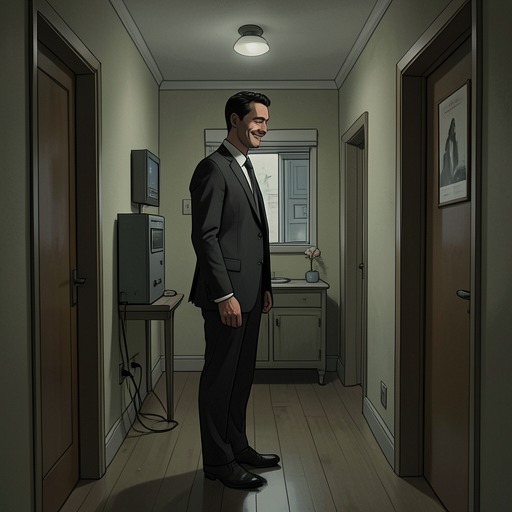
Anna-Lena hires Lennart to sabotage apartment viewings
Anxious PeopleAnna-Lena hires Lennart to sabotage apartment viewings, turning Roger’s competitive pursuit of property into the reason for a secret campaign of disruption. The arrangement helps explain how the couple acquired apartments below market value, but its revelation also exposes a deeper conflict: Anna-Lena has come to want a home rather than another victory in the housing market, and fears that her deception will damage the partnership she meant to help.
The Arrangement and Its Rationale
Anna-Lena eventually admits that she and Lennart first made contact online, though she cannot explain the beginning of their arrangement as a deliberate plan. She presents it as something that was not supposed to happen and then did. Lennart, in turn, identifies himself not as someone offering the kind of professional service Roger initially suspects, but as a paid disruptor of property viewings. His business card names No Boundaries Lennart Ltd., lending an official label to a business built around making prospective buyers want to leave.
The work had several forms. Lennart could pose as an alcoholic neighbor, or rent the apartment above a viewing and play an erotic film loudly enough to disturb the event. His most expensive service involved arriving early, concealing himself in the apartment, and appearing in an absurd rabbit costume when potential buyers entered. The point was not to alter the property itself: it was to make the viewing memorable for the wrong reasons, so that buyers would be reluctant to live there. Lennart describes these methods as a range of packages, while Anna-Lena’s confession makes clear that she had commissioned him to interfere more than once.
How the Disruptions Worked
The tactic had already produced a striking result. Anna-Lena recalls a viewing in a recently renovated turn-of-the-century building where a drunken-neighbor performance involved throwing spaghetti Bolognese at prospective buyers. Roger remembers the episode, but understands it as one of his own successful negotiations: he and Anna-Lena bought the apartment for 325,000 below its market value. The incident therefore carries two histories at once. For Roger, it confirms his skill at bargaining; for Anna-Lena, it is evidence of the concealed intervention that helped make the bargain possible.
The rabbit-costume performance reveals the same method in a more openly theatrical form. Lennart explains that the scene is designed to lodge in viewers’ memories, making the apartment difficult to imagine as a home. His deliberately elaborate explanation contrasts with the practical goal of the service: to make competing viewers withdraw, leaving Roger better placed to secure a property. The comedy of the disguise does not erase the deception. It makes the machinery behind the couple’s apparent success visible, including the fact that Roger’s celebrated tactics were not the whole story.
Disclosure and Its Consequences
When Roger realizes Lennart has been helping Anna-Lena, he asks about his negotiations and tactics. Anna-Lena cannot meet his gaze. She explains that she acted because Roger became distressed when he lost a bid and she wanted him to feel like a winner. That stated reason is sincere but incomplete: she is worried that revealing the full extent of the betrayal will be too much for him. Roger’s broken question about how many times makes the repeated nature of the arrangement impossible to treat as a single lapse.
Anna-Lena later describes how she had initially told herself the intervention would happen only once, and how the lie became easier to repeat. She acknowledges that she claimed to be doing it for Roger while also acting for herself. This admission complicates the motive she had offered at the viewing: concern for her partner was part of the explanation, but it did not encompass her own investment in the scheme or the changing meaning of their pursuit of property.
A Home Rather Than Another Win
Her account places the sabotage within a longer dissatisfaction with the couple’s way of living. Anna-Lena has spent years decorating apartments to make them feel like places where someone might want to stay, yet she wishes she could be that person herself. She and Roger, she says, have been passing through rather than properly living anywhere. Her desired change is not simply to win a different bid; she wants to settle somewhere and to stop organizing life around competition for apartments.
That longing does not cancel the harm of going behind Roger’s back. Anna-Lena says she should not have done it, while also recognizing the pressure that made the deception seem useful: Roger’s distress at losing, her wish to reassure him, and her own desire for a home. The episode consequently turns a comic scheme for clearing viewings into a conflict about trust and what housing means to the couple. The apartments have been treated both as prizes to acquire and as homes to inhabit; Anna-Lena’s confession reveals that those aims have ceased to feel equivalent.